
Amanojaku: Amanojaku is a demon-like creature from Japanese folklore known for its contrarian and mischievous nature.
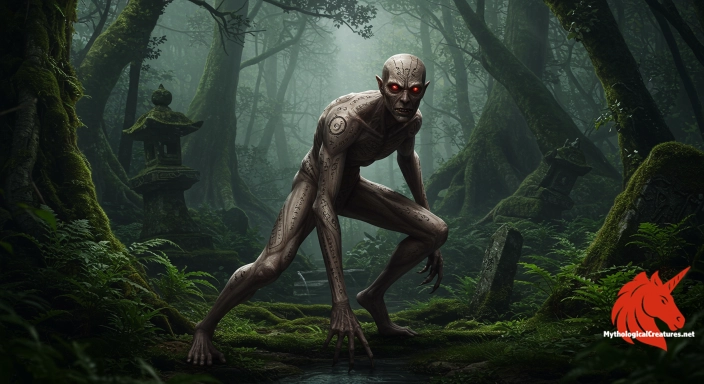
Amanojaku
Amanojaku - Embodies the darker aspects of human nature by provoking actions contrary to social norms, serving as a cautionary figure in myth.
the legend in five swipes.
the legend in five swipes.
The First Records of the Amanojaku
The Amanojaku is a uniquely enigmatic spirit deeply embedded within the tapestry of Japanese folklore, its very name meaning 'heavenly evil spirit.' Its existence traces back to a blend of ancient Shinto animism and Buddhist influence, emerging in early oral narratives and classical texts that reveal a deep-seated duality between divine order and chaotic impulse. This demon is renowned for provoking the darker aspects of human nature, serving as a mirror to our innermost vices and rebellions. Over the centuries, tales of the Amanojaku have been used to symbolise that latent impulse within us to subvert conventional ethics and authority. The spirit’s role as an instigator of mischief and moral questioning has allowed it to occupy a paradoxical position of both fear and respect. Early records and continuing oral traditions depict it as unpredictable, embodying the eternal struggle between social order and internal chaos. Its enduring myth serves as a cautionary emblem, urging communities to acknowledge and wrestle with inner contradictions. As a result, the Amanojaku continues to fascinate storytellers and audiences alike, its presence a constant reminder of the blurred lines between good and evil. This layered legacy reinforces the creature’s status as a vital, if unsettling, component of Japan’s cultural heritage.
Amanojaku: From Oral Tale to Written Record
Ancient manuscripts and long-forgotten folktales offer a rich tapestry of narratives that shape the legend of the Amanojaku. Early texts from eras such as the Edo period mention this demon in allegorical stories that explored the complexities of human frailty and moral transgression. Oral traditions, passed down through generations, have painted it variably as both a spiteful tempter and a reflective critic of societal norms. Some regional accounts cast the spirit in the role of a subversive guide, whose interventions are meant to stir hidden impulses in the human soul. In certain Buddhist and Shinto narratives, the creature’s very existence appears to underscore the eternal conflict between order and the seduction of chaos. Folkloric versions often vary from one locale to another, with storytellers adapting its characteristics and deeds to resonate with local concerns. These shifting portrayals have contributed to numerous variants of the myth, each highlighting different facets of human nature and cosmic balance. The multiplicity of sources reflects how the Amanojaku has been used as a versatile symbol across Japan’s literary and oral traditions. Ultimately, these diverse accounts ensure that the spirit’s legacy remains dynamic and ever-evolving in the collective cultural imagination.
How did the old accounts describe the Amanojaku?
The Amanojaku is typically depicted as a small, enigmatic demon with a strikingly peculiar appearance that blends humanity with the bestial. Its face is often rendered with grotesque elegance, featuring sharply defined features and a twisted expression that hints at concealed mischief. Traditional images frequently adorn it with a pair of curling horns that lend it an unmistakably diabolical silhouette. A pair of piercing eyes, sometimes rendered with an eerie luminosity, are said to reveal both malice and an unsettling charm. Its skin is commonly portrayed in shades ranging from a deep, almost blood-like red to an ashen grey, symbolising its connection to dark forces. Clad in garments that appear ancient and tattered, the Amanojaku’s attire further accentuates a sense of timeless decay and rebellious spirit. Artists have not shied away from incorporating subtle animalistic traits, such as pointed ears or claw-like fingers, which intensify its uncanny visage. Variations in its depiction, including differences in size and detail, speak more to the allegorical power of the myth than to any fixed anatomical reality. Across centuries, its physical portrayal has continually adapted to mirror the internal fears and cultural aesthetics of each generation.
Which regions tell stories of the Amanojaku?
Regional interpretations of the Amanojaku reveal a fascinating mosaic of local cultural influences and mythic adaptations. In mountainous areas of central Japan, the demon is sometimes seen as a guardian of nature’s wild, untamed forces, albeit one that harbours a latent menace. Coastal regions have re-imagined it with maritime nuances, where it appears as a cunning trickster challenging both the natural world and human endeavours. Local festivities and seasonal rituals have, at times, incorporated the spirit into their lore, underscoring its role as a disruptive yet integral cultural symbol. In some rural narratives, slight modifications in its appearance—such as variations in horn shape and skin texture—reflect specific regional iconographies and aesthetic preferences. Urban reinterpretations, meanwhile, project modern anxieties onto the ancient figure, presenting it as a metaphor for the unpredictable disruptions in contemporary society. These diverse local adaptations demonstrate how folklore is pliable, absorbing and reflecting the experiences of distinct communities. Whether seen as an ominous omen or a perversely charming rebel, the Amanojaku’s image is continually reshaped to align with region-specific values and traditions. Such regional dynamism enriches its overall mythos, ensuring that its core essence remains both timeless and locally resonant.
Amanojaku: Parallels in Other Cultures
When compared to trickster figures across the world, the Amanojaku stands out for its multifaceted blend of malevolence and self-reflective provocation. Like the imps of European lore or the restless spirits found in various indigenous traditions, it serves as a catalyst for challenging societal order and moral complacency. Its penchant for inciting inner turmoil mirrors that of the Norse god Loki, who similarly uses mischief to disrupt the natural and social order. The demon’s capacity to evoke both fear and introspection resonates with the roles of antiheroes in global mythologies, where chaos is interwoven with a critical commentary on human nature. In many cultures, such trickster figures have been used to symbolise the continuous battle between structure and entropy, a theme that is strikingly evident in the stories of the Amanojaku. The presence of such a character underscores a universal understanding that every society must reckon with its own contradictions and hidden impulses. Cross-cultural comparisons reveal that these mythic figures often carry dual functions: they entertain while also imparting cautionary lessons about overreaching pride and moral laxity. Both subtle and overt, these parallels allow for a rich dialogue between disparate cultural narratives on the nature of sin and redemption. Thus, the Amanojaku occupies a distinctive niche that both honours and transcends the archetypal trickster, linking Japanese folklore with a broader, global mythic tradition.
What does the Amanojaku mean to people today?
The evolution of the Amanojaku from a feared folklore demon to a fixture in modern popular culture is a testament to its enduring appeal and symbolic power. Initially recorded as a dire cautionary figure in ancient epics and oral traditions, its character was steeped in warnings about defiance and uncontrolled inner chaos. Over time, as Japan’s cultural landscape shifted, the creature was reimagined by artists and writers, adopting nuances that resonate with contemporary themes of rebellion and subversion. Historical depictions in woodblock prints and classical literature have given way to innovative representations in manga, anime, and digital media. In these modern contexts, the Amanojaku is often portrayed as an antihero—a complex figure that encapsulates the unpredictable nature of modern society. Contemporary reinterpretations have embraced its ambiguity, using it to explore themes of social dissent, internal conflict, and the ongoing struggle between order and anarchy. The creature’s adaptable image reflects a broader trend of re-evaluating traditional myths in light of current societal challenges. As a result, the Amanojaku’s legacy continues to grow, evolving with each new generation while retaining its core essence as a symbol of subversion and introspection. In this way, the myth endures, bridging the gap between age-old superstitions and today’s cultural expressions.
Interesting Fact
Amanojaku’s reputation as a contrarian spirit challenges normal behaviour, making it a unique embodiment of chaos and mischief in Japanese folklore.
Mythological Treasures
Japanese Yōkai: A field guide to the spirits and demons of Japanese folklore
Fifteen spirits, with the signs to watch for and what the old tales say to do if you meet one.
Greek Myths: A field guide to the monsters of ancient Greece
Every monster here earned its place in legend, and each gets a full page of artwork and the story behind it.
Norse Sagas: A field guide to the beasts of the Viking world
Drawn from the saga accounts themselves, with the powers, weaknesses and doom of each being set out.
the legend in five swipes.
Sponsor this space
Tasteful, fixed-fee placements for myth projects
No bidding wars or flashing banners. We offer simple placements for a small set of creators and brands aligned with our readers.
Request further detailsQuick Creature Info
Features:
Our Mythic Legendary Rating:

Also Sometimes Known As:
Habitat:
Supernatural Powers:
Physical Attributes:
Abilities:
Behavior:
Lore:
References
Discover Another Mythical Legend You May Not Have Heard Of?
Uncover the mysteries of ancient folklore and expand your knowledge of legendary beings from cultures around the world.
Dare to Meet the Hesperides....

The Mythological Creatures Book Series
Yōkai, Greek, Norse, Egyptian & Chinese. Five illustrated field guides to the creatures the old stories either warned or told you about.
Curated by the Mythological Creatures Team
Series editor: Mythological Creatures Directory
Primary desk: Asian & Pacific Myth Cycles Desk
(rev. November 2025)