
Amay Yay Yin: Amay Yay Yin, also known as Yayin Kadaw and Anauk Medaw, is a revered Burmese nat and goddess associated with water.
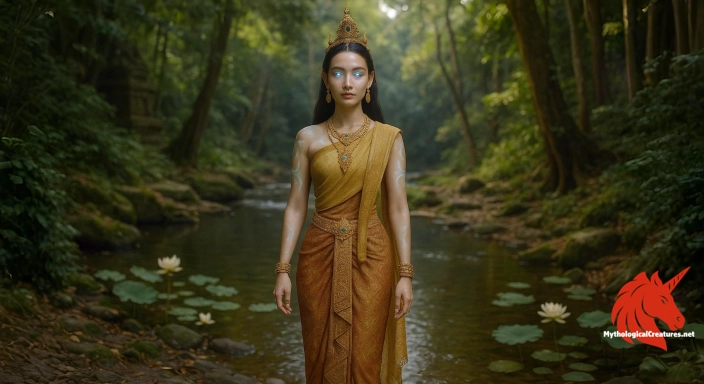
Amay Yay Yin
Amay Yay Yin - Her unique ascension to goddesshood without a violent death sets her apart in Burmese spirituality, underscoring her role as a nurturing and protective deity.
Origins & First Encounters
Amay Yay Yin emerges as one of the most revered figures in Burmese spiritual tradition, embodying both the gentle power of water and maternal benevolence. Her name, which translates to 'mother of the stream or soft water underground', reflects a deep connection with nature and its nurturing elements. She holds a unique place among the Burmese nats as one of the five mother nats, also known as 'Anauk Medaw' or the royal mother of the west. Unlike many of her nat counterparts, who are born out of violent demises, Amay Yay Yin ascended to divinity without the trauma of death. Her origins, shrouded in mystique, highlight a transition from mortal to divine that is both graceful and awe-inspiring. Throughout various narratives, she is depicted as a symbol of life’s continuous flow and the sustaining power of water. Her influence permeates cultural rituals and traditional ceremonies, underscoring her role as a guardian and nurturer. Over time, Amay Yay Yin has become an emblem of peace, naturally bridging the mortal world with the divine forces of nature. Her legacy resonates with devotees who see in her the enduring spirit of both water and motherhood. The enduring reverence for her speaks of a deep cultural interplay between myth and the everyday cycles of life.
Source Texts & Tale Variants
Ancient chronicles and local oral narratives provide a rich tapestry of accounts concerning Amay Yay Yin, with each source contributing layers to her divine persona. Manuscripts preserved in old temple archives sometimes portray her gentle emergence from the natural world of streams and underground waters. Various nat shrines and traditional rituals highlight her central role in seasonal celebrations, capturing the fluidity of her myth. In some versions, her ascent to goddesshood is depicted as a blessed evolution rather than a consequence of misfortune. Folk performances and ceremonial dances often re-enact her story, illustrating the seamless blend of art and divinity in Burmese culture. Local priests and traditional healers have passed down tales of her benevolence and protective presence over generations. The multiplicity of her narrative is evident in both written sources and the vibrant oral history circulating within rural communities. Storytellers provide alternative accounts that sometimes intertwine her essence with the life cycle of water and agrarian prosperity. Despite slight variations across regions, these diverse sources all contribute to a cohesive image of a nurturing goddess. As a result, the cumulative traditions surrounding her serve not only as historical records, but as living expressions of cultural identity.
Form & Powers
Amay Yay Yin is usually depicted as a figure of serene beauty and dignified elegance, her features exuding both grace and an inherent mysticism. Artistic portrayals often show her draped in flowing garments that mimic the gentle current of a stream, reinforcing her connection with water. Intricate jewellery and an ornate headdress commonly adorn her image, symbolising her regal status among the nats. Her eyes, soft and contemplative, reflect the quiet wisdom of timeless waters, inviting the viewer to a sense of calm and introspection. Many representations accentuate delicate, curvilinear lines that evoke the natural movement and spontaneity of water cascading over smooth stones. Subtle motifs, such as aquatic flora and delicate ripples, further embellish her attire and surroundings, blending nature with divine elegance. Her overall composition in traditional art balances both human warmth and an ethereal quality, suggesting a harmonious merger of the earthly and the spiritual. In some depictions, a luminous glow envelops her figure, reminiscent of moonlight on a tranquil pond. Variations in her portrayal across different artworks hint at a dynamic iconography that adapts to evolving cultural aesthetics. Ultimately, her physical representation has been carefully curated to project an image of nurturing protection and elemental beauty.
Regional Faces
Regional interpretations of Amay Yay Yin reveal an intricate array of adaptations that reflect the diversity of Burmese and broader Southeast Asian cultural landscapes. In central Myanmar, she is predominantly revered as a mother figure whose divine attributes are closely tied to the natural cycles of water and agriculture. In some local communities, elements of her myth have merged with indigenous water deity traditions, leading to a hybrid iconography that varies from one locale to another. Neighbouring regions often embrace her story by intertwining local folklore with her established attributes, thereby creating a multifaceted divine persona. The symbolism of flowing water, central to her identity, resonates particularly in agrarian societies that depend on seasonal monsoons and river systems for survival. Artistic depictions in different provinces sometimes feature variations in her attire and symbolic accessories, reflecting regional artistic traditions and local cultural influences. Festivals dedicated to water and fertility often incorporate her image, demonstrating her adaptability to varied ceremonial contexts. Furthermore, certain communities have developed unique rituals that honour her protective qualities, blending traditional beliefs with localized natural phenomena. This regional diversity not only enriches her myth, but also underscores the universal appeal of water as a symbol of life. Through these nuanced variations, Amay Yay Yin continues to embody the dynamic and ever-evolving spirit of her cultural heritage.
Cultural Parallels
Amay Yay Yin’s role as a nurturing water goddess finds interesting parallels in many mythological traditions around the world, highlighting the universal symbolism of water as a life giver. In Greek mythology, for example, the naiads preside over natural springs and streams, much like Amay Yay Yin governs the soft, underground waters. Her gentle yet commanding presence can be compared to other deities such as the Japanese Suijin, whose association with water brings forth themes of protection and renewal. Much like the Egyptian goddess Isis, who was revered as a maternal protector and a symbol of natural cultivation, Amay Yay Yin embodies virtues that transcend geographical boundaries. Both figures exemplify the power of water to sustain and nurture, while also serving as a bridge between the human and the divine. These cultural parallels emphasise how different societies harness similar imagery and metaphors to describe feminine divinity. Comparative analysis shows that regardless of regional differences, water deities often carry messages of fertility, healing, and the enduring flow of life. In many respects, the myth of Amay Yay Yin reinforces a common narrative found across diverse cultures, where nature itself is revered as a source of both creative power and solace. Her narrative thus resonates within a broader framework of global mythology, underlining the shared human fascination with the elemental forces of nature. These cross-cultural comparisons invite a richer understanding of how similar divine archetypes are celebrated throughout history.
Legacy & Modern Evolution
The evolution of Amay Yay Yin’s portrayal over time reveals a fascinating dialogue between tradition and modern reinterpretation. Early renditions emphasised her divine connection to the natural world, portraying her as a serene water goddess of immense nurturing power. As Burmese culture evolved, so too did the artistic and literary depictions of her character, blending time-honoured symbolism with contemporary sensibilities. In recent decades, her image has been revitalised in modern art and digital media, where traditional motifs are reimagined in innovative ways. Contemporary festivals and cultural exhibitions frequently invoke her spirit as a symbol of environmental stewardship and the importance of preserving natural resources. Her enduring relevance is reflected in a growing trend among younger generations to explore and reinterpret ancient mythologies, finding inspiration in her graceful resilience. This modern legacy not only honours her historical roots but also projects her enduring influence into the future. Urban artists and cultural practitioners continue to celebrate her with public installations and creative performances that marry folklore with modern iconography. In reimagining her myth for today’s audience, these new interpretations serve as a bridge between the ancient and the modern. Through this evolving narrative, Amay Yay Yin remains a vibrant symbol of both cultural heritage and the imperishable power of nature.
Interesting Fact
Unlike most nats, who become spirits through violent deaths, Amay Yay Yin's seamless transformation into a goddess is a remarkable deviation that underscores her unique place in Burmese spiritual lore.
Sponsor this space
Tasteful, fixed-fee placements for myth projects
No bidding wars or flashing banners. We offer simple placements for a small set of creators and brands aligned with our readers.
Request further detailsQuick Creature Info
Origin:
Associations:
Our Mythic Legendary Rating:

Also Sometimes Known As:
Habitat:
Supernatural Powers:
Physical Attributes:
Abilities:
Behavior:
Lore:
Related Creatures, Tales or Lore
- SShin Myat Thwe
- TThuyathadi
- MMin Mahagiri
References
Discover Another Mythical Legend You May Not Have Heard Of?
Uncover the mysteries of ancient folklore and expand your knowledge of legendary beings from cultures around the world.
Dare to Meet the Tlalocayotl....

Curated by the Mythological Creatures Team
Series editor: Mythological Creatures Directory
Primary desk: Asian & Pacific Myth Cycles Desk
(rev. November 2025)