
Anggitay: The Anggitay is a mythological being from Philippine folklore with the upper body of a female human and the lower body of a horse.
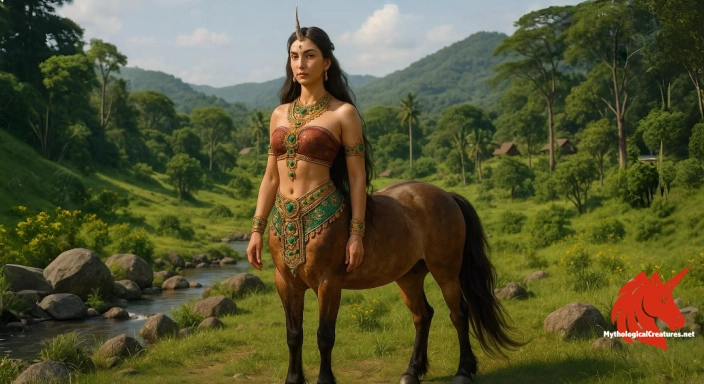
Anggitay
Anggitay - Represents the female centaur archetype in Philippine mythology and serves as the counterpart to Tikbalang, blending human and equine traits with a distinctive unicorn-like horn.
the legend in five swipes.
the legend in five swipes.
Who first told stories about the Anggitay?
The Anggitay is a captivating figure from Philippine lore, celebrated for her unique blend of feminine grace and equine strength. Born from ancient oral traditions, she symbolises a harmonious fusion between the human and natural worlds. Emerging from indigenous mythologies, her story has been shaped over time by regional narratives that highlight both her beauty and mystery. Her legend first surfaced in local communities, particularly in areas such as Santo Tomas, Batangas, where the environment itself seems to echo her mythic presence. The tales that recount her origins are rich in cultural symbolism, reflecting the values and artistic expressions of early Filipino society. Over the centuries, her image has evolved while retaining core attributes that celebrate femininity and empowerment through nature. The duality in her form—embodying both the delicate human upper body and the powerful horse’s lower form—continues to enchant both scholars and enthusiasts of mythology. Throughout her enduring presence in folklore, the Anggitay remains a symbol of both beauty and the untamed essence of the natural world. Her narrative invites modern interpretations of ancient mythical ideals and continues to inspire a broad spectrum of cultural expressions. The myth of the Anggitay is as multifaceted as the islands she calls home, merging humanity with nature in an everlasting dance of myth and reality.
Where can you read about the Anggitay?
The principal insights into the Anggitay are derived from a rich tapestry of oral traditions and local folk narratives. While formal ancient texts are scarce, the knowledge of her existence has been preserved through generations in communities across the Philippines. Colonial-era documents and Spanish accounts provide intermittent, though intriguing, glimpses into her lore, emphasising the transformative power of local myth. Artisans, dancers, and storytellers have all played a role in keeping her legend vibrant across centuries. Variations in her tale appear in regional ballads, ritual performances, and traditional artworks, enriching the collective retelling of her story. In some accounts, her affinity for precious gemstones is highlighted, symbolising both material allure and mystical wisdom. Over time, different storytellers have imbued her narrative with subtle nuances, reflecting local values and the shifting cultural landscape. This multifaceted transmission of her legend underlines a living tradition where each retelling contributes new layers to her mythic persona. The multiplicity of sources ensures that the Anggitay remains an intriguing and dynamic character in the continuum of Philippine mythology. Even in modern times, reinterpretations of her tale continue to emerge, blending ancient aesthetics with contemporary creative expressions.
Anggitay: Powers, Strengths and Vulnerabilities
The Anggitay is distinguished by a striking physical form that melds the elegance of a human woman with the robust anatomy of a noble horse. Her upper body is typically depicted as graceful and delicate, with features that convey both allure and a quiet strength reminiscent of classical beauty. From the waist down, her form seamlessly transforms into that of a well-built steed, complete with muscular legs, a sleek coat, and an air of untamed vitality. A singular, spiralling horn often graces her forehead, adding an element of mystique reminiscent of the unicorn’s magic. This horn, subtle yet commanding, differentiates her from other hybrid creatures and marks her as a being of supernatural origin. Artists and storytellers have frequently adorned her with intricate details, from the flowing locks of her hair to the delicate patterns on her equine hide. Her eyes, deep and reflective, are as if portals to the ancient tales she represents, and her overall silhouette exudes both power and femininity. The juxtaposition of soft, human features with the dynamic lines of a horse’s form creates an image that is both enchanting and formidable. Detailed depictions often include hints of lavish adornments such as jewellery that highlights her mythical attraction to precious gemstones. Such comprehensive portrayals serve to enhance her legendary status within the rich framework of Philippine folklore.
Where was the Anggitay best known?
Across the Philippine archipelago, the portrayal of the Anggitay varies remarkably, reflecting the diversity of local cultural influences. In Santo Tomas, Batangas, her legend is intricately woven into the fabric of community identity, where natural surroundings amplify her mythical attributes. Regional storytellers infuse her character with qualities that resonate with local traditions, sometimes depicting her with a more pronounced equine build or additional supernatural embellishments. Certain areas enhance her narrative by stressing her connection to the land, while other regions portray her as a guardian of hidden treasures and sacred sites. Variations in her depiction—ranging from the presence of elaborate headgear to differing interpretations of her singular horn—illustrate the dynamic and evolving nature of folk storytelling. Local art and performances, whether in the form of traditional dance or mural paintings, capture these differences, making her a perennial muse across generations. The shifts in her portrayal also mirror the blending of indigenous animistic beliefs with later influences brought about by colonial encounters. Despite these regional adaptations, a core image of the Anggitay, characterised by her hybrid form and ethereal beauty, remains consistent throughout the archipelago. Each community’s version of her legend not only enriches her narrative but also highlights the multifaceted nature of Philippine mythology. This regional diversity underscores how a singular mythic figure can encapsulate distinct local identities and cultural values.
Anggitay: Counterparts Around the World
The essence of the Anggitay resonates well beyond her immediate cultural sphere, drawing intriguing comparisons with hybrid creatures in other mythologies. Echoing the Greek centaurides, she embodies a rare fusion of human intellect and animalistic vigour that defies ordinary boundaries. Much like her Greco-Roman counterparts, the Anggitay navigates the liminal space between civilisation and the wild, heralding universal themes of transformation and duality. Her depiction with a solitary horn also invites parallels with unicorn legends, further establishing her as a creature of both beauty and mystical power. Across diverse mythic narratives, she is seen as a counterbalance to male-dominated equine figures, offering a feminine perspective within a predominantly patriarchal framework. Comparative analysis often highlights how different cultures utilise such hybrid forms to symbolise freedom, mystery, and the transition between worlds. Furthermore, her story shares similarities with local entities like the Tikbalang, yet she distinguishes herself through an emphasis on ethereal allure and benevolent strength. This cross-cultural dialogue not only enriches her character but also situates her within a broader global mythology. By drawing comparisons with other legendary beings, the Anggitay emphasises themes of hybridity and metamorphosis that are central to mythological thought worldwide. In this way, her narrative opens up conversations about the universality of certain mythic motifs and the shared human fascination with the unknown.
How is the Anggitay remembered today?
The evolution of the Anggitay’s image reflects a fascinating journey through time, mirroring shifts in societal values and artistic expression. In earlier centuries, her portrayal was deeply rooted in pastoral traditions and the mysticism of indigenous belief systems. Over time, elements of her character were adapted and refined, partly under the influence of colonial encounters that introduced new symbolic layers. In the modern era, the Anggitay has transcended traditional folklore to become a celebrated figure in popular culture, frequently appearing in art, literature, and digital media. Contemporary reinterpretations often emphasise her as an icon of feminine strength and a symbol of ethereal beauty, resonating with audiences far beyond her original cultural context. Creative communities, ranging from local illustrators to global fantasy creators, have reimagined her persona, blending ancient mysticism with modern narrative techniques. Her enduring allure is evident not only in academic circles and folk festivals but also in merchandise, comic books, and online platforms dedicated to myth and legend. The metamorphosis of her imagery over the centuries underlines her ability to adapt to the changing cultural landscapes while maintaining her core mystique. Her story continues to inspire debates, artistic endeavours, and scholarly studies, securing her place as a timeless emblem of the enchanting interplay between humanity and nature. In every modern reinterpretation, the Anggitay not only honours her mythic origins but also reinvents them, ensuring that her legacy remains as dynamic and multifaceted as the culture that birthed her.
Interesting Fact
Anggitay is one of the few Philippine mythological beings that uniquely melds centaur and unicorn characteristics, making it a standout figure in local folklore.
Mythological Treasures
Japanese Yokai: A field guide to the spirits and demons of Japanese folklore
Fifteen spirits, with the signs to watch for and what the old tales say to do if you meet one.
Greek Myths: A field guide to the monsters of ancient Greece
Every monster here earned its place in legend, and each gets a full page of artwork and the story behind it.
Norse Sagas: A field guide to the beasts of the Viking world
Drawn from the saga accounts themselves, with the powers, weaknesses and doom of each being set out.
the legend in five swipes.
Partner with us
Sponsor this space
Reach thousands of mythology enthusiasts with a curated placement on our creature pages.
Learn about sponsorshipQuick Creature Info
Origin:
Features:
Our Mythic Legendary Rating:

Also Sometimes Known As:
Habitat:
Physical Attributes:
Lore:
Related Creatures, Tales or Lore
References
Discover Another Mythical Legend You May Not Have Heard Of?
Uncover the mysteries of ancient folklore and expand your knowledge of legendary beings from cultures around the world.
Dare to Meet the Gwragedd Annwn....

The Mythological Creatures Book Series
Yokai, Greek, Norse, Egyptian & Chinese. Five illustrated field guides to the creatures the old stories either warned or told you about.

Curated by the Mythological Creatures Team
Series editor: Mythological Creatures Directory
Primary desk: Asian & Pacific Myth Cycles Desk
(rev. November 2025)