
Aoandon: Aoandon is a ghostly spirit from Japanese folklore, depicted as a blue-complexioned woman with twin horns and sharp teeth.
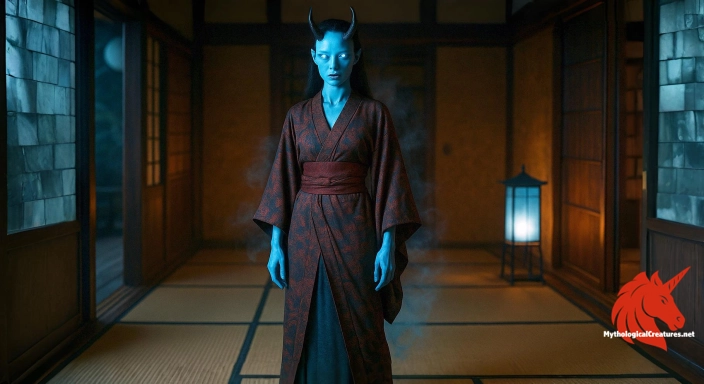
Aoandon
Aoandon - Aoandon represents the fusion of light and darkness in Japanese folklore, symbolising the transient nature of ghostly apparitions and the power of collective imagination.
Origins & First Encounters
Aoandon emerges from the rich tapestry of Japanese folklore as a spectral figure whose origins are entwined with the eerie ambiance of ghost-telling sessions. Its first attestation lies in the celebrated illustrations of Toriyama Sekien in the Konjaku Hyakki Shūi, a work that encapsulated a host of supernatural beings from the Edo period. The creature’s name, derived from the blue andon lamps used to illuminate the darkened rooms during Hyakumonogatari Kaidankai games, encapsulates its intrinsic connection with the mysterious realm of the night. It has been painted as a spirit that appears at the culmination of ghost story gatherings, often evoking both dread and fascination among its audience. Aoandon’s depiction as a woman with a striking blue complexion and twin horns has established her as a symbolic bridge between beauty and terror. Her story reflects the cultural penchant for conjuring supernatural imagery to both entertain and caution. The tradition behind this apparition continues to resonate as an artefact of folkloric expression, blending artistry with supernatural lore. The enduring presence of Aoandon affirms the deep-seated human fascination with the unknown and redoubts the power of myth in shaping cultural memory. Its historical roots are a testimony to the creative interpretations of fear and light during Japan’s transformative periods. This enigmatic being remains a compelling figure, embodying both the allure and the peril of the metaphysical world.
Source Texts & Tale Variants
The primary record of Aoandon is rooted in the illustrious Konjaku Hyakki Shūi by Toriyama Sekien, an essential compendium of yōkai that has shaped the way these beings are perceived. Within this ancient text, Aoandon is elegantly depicted, anchoring her role as a spirit that haunts the final moments of ghost story sessions during Hyakumonogatari Kaidankai. The original illustration has spurred a diverse range of narrative variants in the ensuing centuries, each adding unique dimensions to her character. Oral traditions and subsequent folklore compilations have embraced these visual cues and enriched them with additional layers of myth. At various junctures, storytellers and chroniclers have expanded upon her brief description, interweaving her existence with other local legends and supernatural occurrences. Certain literary sources have even postulated a more complex backstory, suggesting that Aoandon might represent the collective memory of haunted gatherings. The shifting interpretations found across texts and recitations highlight a dynamic interplay between literary tradition and oral narration. These varied accounts underscore how the essence of Aoandon has been reshaped through generations, each retelling adding nuances to her mythos. The synthesis of visual art and narrative tradition has crafted a legacy that remains both fragile and potent across time and region. In every recounting, her spectral presence is celebrated as an archetype of mystery and the uncanny.
Form & Powers
Artistic depictions of Aoandon reveal a woman of ethereal beauty marked by an arresting blue complexion that seems to glow like the flicker of a candle in the dark. Her skin, rendered in a luminous blue tone, evokes the chiaroscuro created by traditional blue-paper andon lamps, enhancing her otherworldly allure. Twin horns emerge from her brow in a graceful yet formidable arc, setting her apart from ordinary human forms and underscoring her supernatural origins. Her eyes often shimmer with an intense, penetrating gaze that hints at enigmatic wisdom as well as latent menace. The creature’s facial features are sharply defined, the starkness of her teeth lending an almost predatory air to her seductive presence. Flowing hair, sometimes depicted as merging with the surrounding darkness, contributes to the illusion of a form that is simultaneously corporeal and spectral. Certain renditions introduce subtle embellishments such as delicate markings or ethereal patterns that further accentuate her mystical nature. Her figure is both imposing and graceful, a visual paradox that captures the dual themes of beauty and horror. The intricate balance of delicate human traits and grotesque supernatural elements makes her an enduring subject of artistic fascination. Variations in her depiction, whether in tone or detail, continue to inspire artists who wish to explore the interplay between light, shadow, and the supernatural.
Regional Faces
Across different regions of Japan, the narrative of Aoandon has been adapted to reflect local aesthetics and cultural nuances. In some areas, the spirit is closely associated with seasonal festivities where the eerie interplay of light and shadow is a cherished element of communal gatherings. Localised stories sometimes portray her in a slightly altered form, emphasising her role not just as a fearsome apparition but also as an omen or even a guardian of certain sacred sites. Variations in her iconography include differences in the prominence of her horns, the intensity of her blue hue, or even additional symbolic adornments that echo regional symbolism. In rural folklore, Aoandon’s appearance is occasionally interwoven with natural phenomena, being likened to the mysterious blue glow that sometimes graces fog-bound landscapes. These adaptations demonstrate a fluidity in her representation, which shifts to mirror the concerns and imaginations of distinct communities. In some locales, her tale is imbued with elements of melancholic tragedy, hinting at a fate intertwined with the cycles of nature and destiny. Such regional retellings ensure that her myth remains vibrant, evolving in concert with local customs and storytelling traditions. The diverse portrayals speak to a broader cultural impulse to see beyond literal depictions and embrace the spirit’s metaphorical resonance. In essence, regional variations have enriched the legacy of Aoandon, underscoring the adaptability of supernatural lore in the face of changing societal landscapes.
Cultural Parallels
The spectral characteristics of Aoandon invite comparisons with several similar entities across diverse mythological traditions. Within Japanese folklore, she is often paralleled with figures such as Yuki-Onna, each embodying a blend of seductive beauty and latent danger. Both spirits are intricately tied to natural elements—in Aoandon’s case, the evocative blue light of andon lamps, and in Yuki-Onna’s, the icy breath of winter. Beyond Japan, parallels can be drawn with the figures of the banshee in Celtic mythology, whose mournful wails also signal impending doom. This cross-cultural reflection reveals a universal motif: the convergence of alluring beauty and inherent peril as a means of expressing collective anxieties about the unknown. Aoandon’s visual and narrative elements have thus become a focal point for comparative studies in supernatural folklore. The interplay of light and shadow in her portrayal resonates with broader themes found in countless legends, from the spectral apparitions of European ghost stories to the transformative entities in Eastern mystical traditions. The analytical juxtaposition of these mythic figures often highlights a shared human endeavour to personify the mysteries lurking at the fringes of everyday life. Such comparative examinations enrich the understanding of how different cultures grapple with the metaphysical and the eerie. In many ways, Aoandon serves as a bridge linking distinct narrative traditions through a common language of fear, beauty, and the transcendent unknown.
Legacy & Modern Evolution
Throughout the centuries, the image of Aoandon has evolved from a serendipitous illustration in an Edo period compendium into a multifaceted icon within modern popular culture. Contemporary reinterpretations in manga, anime, and video games have allowed her to traverse the boundaries of time, blending ancient aesthetics with modern sensibilities. These fresh depictions maintain the core allure of her blue, otherworldly visage while often updating her story to reflect current cultural preoccupations. The spirit’s transition from an emblem of ghost story gatherings to a character celebrated in various creative media highlights the adaptive nature of folklore. Modern artists and writers portray her as both a cautionary figure and a symbol of the enduring enigma that haunts the human imagination. Public exhibitions and cultural festivals dedicated to yōkai frequently feature Aoandon, cementing her role as a vital part of Japan’s mythological heritage. Her presence in digital media has further propagated her image on an international scale, inviting reinterpretation by new generations. The historical evolution of Aoandon’s character mirrors broader shifts in societal attitudes towards the mystical and the unexplained. In contemporary narratives, she is often explored as a complex figure who embodies the oscillation between beauty and terror. This transformation not only reaffirms her original symbolism but also ensures that she remains a dynamic, resonant emblem of the ethereal in the modern world.
Interesting Fact
Aoandon's iconic depiction by Sekien has cemented her status as a cultural emblem of Japan's ghost story tradition, influencing modern portrayals of yōkai in various media.
For publishers and studios
Your next readers are already here
Many of our visitors are looking for books, campaigns, and resources that deepen their journey into myth. Position your title or setting here.
Discuss a placementQuick Creature Info
Our Mythic Legendary Rating:

Also Sometimes Known As:
Habitat:
Supernatural Powers:
Physical Attributes:
Abilities:
Behavior:
Lore:
Related Creatures, Tales or Lore
References
Discover Another Mythical Legend You May Not Have Heard Of?
Uncover the mysteries of ancient folklore and expand your knowledge of legendary beings from cultures around the world.
Dare to Meet the Camarina....
-a86f0e84-3d2b-47b6-a5f8-4ecaa0970b66_small.webp "Depiction of Camarina")
Curated by the Mythological Creatures Team
Series editor: Mythological Creatures Directory
Primary desk: Asian & Pacific Myth Cycles Desk
(rev. November 2025)