
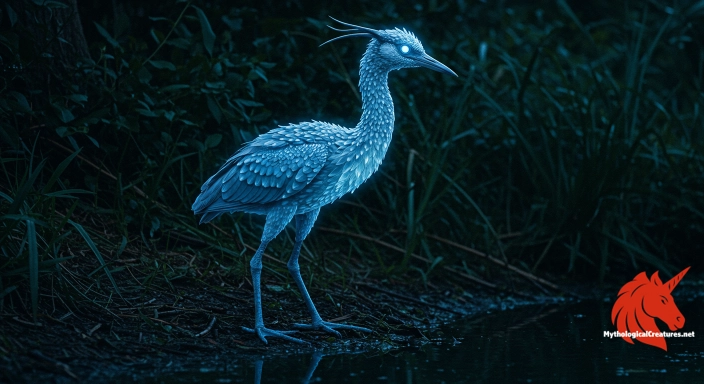
Aosaginohi: Aosaginohi, also known as Aosagibi, is a mystical phenomenon in Japanese folklore depicting a luminous, transformed black-crowned night heron.
Aosaginohi
Aosaginohi - Embodies the fusion of natural beauty and supernatural transformation, highlighting the mysterious allure of yōkai in Japanese culture.
the legend in five swipes.
the legend in five swipes.
Aosaginohi: First Encounters and Early Records
Aosaginohi, also known as Aosagibi or the "blue heron fire," captivates with its blend of natural elegance and supernatural mystery. It originates from the imaginative realms of Japanese folklore, crystallised in the Edo period through the art of Toriyama Sekien. The phenomenon is steeped in cultural symbolism, merging the ordinary essence of a night heron with an otherworldly luminescence that has fascinated generations. Its narrative recounts the subtle transformation of an ageing black-crowned night heron into a graceful yōkai, demonstrating the fluid boundaries between animal nature and mystic energy. The creature’s story first appears in classical illustrated texts, marking a striking moment when traditional folklore embraced fantastical elements. Traditional storytellers have since expanded on this account, emphasising the heron’s intrinsic shyness even in its supernatural form. This merging of the natural and the ethereal reflects the Japanese aesthetic of finding beauty in ephemeral, often transient, moments of wonder. The allure of Aosaginohi lies in the delicate interplay between natural behaviour and the incandescent magic of the night.
What sources tell us about Aosaginohi?
The earliest documentation of Aosaginohi is found in the classical compilations of yōkai art, most notably in Toriyama Sekien’s Konjaku Gazu Zoku Hyakki. The depiction in these works has provided a visual foundation that has influenced subsequent folklore and literary renditions. Although written sources remain sparse beyond the Edo period, oral traditions have richly expanded its narrative through generations. Variants of the story are told in local folktales, where the luminous heron undergoes a subtle metamorphosis into a gentle spirit. In some retellings, the transformation emphasises the creature’s ethereal glow, while others focus on the miraculous conversion of feathers to shimmering scales. Additional references sometimes link Aosaginohi with cautionary tales that warn against confusing its benign flame with malevolent onibi. Folkloric accounts occasionally differentiate the creature’s nocturnal appearances during particular seasons or weather patterns, thereby enriching its mythological context. The accumulation of visual, textual, and oral sources has cemented its role as an enigmatic figure within the broader tapestry of Japanese supernatural lore.
What could Aosaginohi do?
The physical form of Aosaginohi is a striking adaptation of the common night heron, now transfigured into a mystical spectacle. Its dark plumage gives way to an iridescent coating that resembles luminous blue scales, offering an otherworldly sheen under the cover of night. The transformation is marked by the fusion of traditional feathers into a textured surface that seems almost crystalline. Close observation reveals that its beak and talons gleam subtly, accented by hints of golden brilliance that mirror the creature’s ethereal exhalations. The heron’s eyes carry a contemplative glint, contributing to a sense of depth and ancient wisdom. As it glides through the darkness, a gentle aura of cool blue light envelops its body, lending the impression of a living, breathing constellation. The edges of its expansive wings are sometimes depicted with delicate, flickering patterns that evoke a dance of shadows and light. Small, yet imposing in its ambience, the creature maintains the natural proportions of its biological counterpart while exuding an aura of supernatural majesty. Ultimately, its physicality blurs the line between the corporeal and the ephemeral, making it as enigmatic as it is enchanting.
How does Aosaginohi differ by region?
The lore of Aosaginohi exhibits subtle regional variations that reflect the diverse cultural landscapes of Japan. In some areas, especially in parts of the Kanto region, local traditions emphasise the creature’s role as a harbinger of seasonal change, associating its luminous presence with the onset of cooler nights. Rural communities have sometimes portrayed it as a benevolent omen that graces their waterways, its light offering guidance to those navigating the darkness. In contrast, folk narratives from the Kansai region place greater emphasis on its mystic transformation, weaving legends where the luminous heron is seen as a transient messenger from the world beyond. Certain local variants even suggest that the creature’s golden exhalation possesses subtle healing or protective attributes. Artistic depictions in regional festivals may highlight differences in the intensity of its blue radiance or even adjust the scale of its form to better align with local aesthetic sensibilities. These variations, though modest, underscore how environmental factors and regional storytelling traditions shape the myth. Despite these local adaptations, the core motif of an intangible, glowing heron persists, unifying the legend across Japan.
Is Aosaginohi unique, or found elsewhere?
The tale of Aosaginohi resonates with a number of global mythological phenomena that symbolise the interplay between nature and supernatural illumination. Its gentle transformation shares similarities with the lore surrounding other spectral lights, such as the will-o’-the-wisp found in European folklore, though its benign character sets it apart. Like the enigmatic firebirds of Slavic myths, Aosaginohi embodies the concept of a natural creature elevated into an otherworldly realm through mysterious energies. Its striking blue radiance finds echoes in other traditions where the colour blue is symbolic of ethereal guidance and celestial protection. Comparisons can also be drawn with other Japanese yōkai, where benign spirits often mask a deeper connection to natural forces and moral lessons. In the broader context of East Asian mythology, creatures with luminous attributes are sometimes seen as auspicious messengers that bridge the gap between the physical world and the spiritual. The gentle, fire-like glow of Aosaginohi also stands in contrast to more malevolent onibi, inviting a comparative analysis that explores the duality of light as both a guide and a potential warning. These cross-cultural parallels underscore a common human fascination with light phenomena in the dark and the metaphysical possibilities they evoke.
Aosaginohi: How the Legend Lives On
Over the centuries, the depiction of Aosaginohi has undergone a subtle yet enduring evolution, adapting to changing artistic and cultural landscapes. Its early portrayals in classical art have left an indelible mark on Japanese visual culture, inspiring later generations of artists and storytellers. The inherent mystery of a heron transformed by radiant, blue fire has lent itself well to modern reinterpretations in manga, anime, and contemporary art installations. Modern depictions often emphasise its luminous quality, sometimes melding digital art techniques with traditional symbolism to create striking visual narratives. The creature’s legacy also lives on in local festivals and cultural events, where its image is invoked as a symbol of transformation and the ephemeral beauty of the night. In academic and popular discourse alike, Aosaginohi serves as a reminder of Japan’s rich tradition of blending the natural world with supernatural wonder. Its evolution reflects broader trends in myth-making, where ancient motifs are continuously reimagined to speak to new audiences. Ultimately, the continued fascination with this yōkai symbolises an ever-present human desire to understand and celebrate the transformative potential of the natural world.
Interesting Fact
An interesting aspect of Aosaginohi is that its fiery glow produces no heat, challenging common assumptions about fire and adding to its enigmatic charm.
Mythological Treasures
Japanese Yokai: A field guide to the spirits and demons of Japanese folklore
Fifteen spirits, with the signs to watch for and what the old tales say to do if you meet one.
Norse Sagas: A field guide to the beasts of the Viking world
Drawn from the saga accounts themselves, with the powers, weaknesses and doom of each being set out.
Egyptian Legends: A field guide to the gods and monsters of ancient Egypt
Guardians of the living and devourers of the dead, with the role each played in judgement.
the legend in five swipes.
Partner with us
Sponsor this space
Reach thousands of mythology enthusiasts with a curated placement on our creature pages.
Learn about sponsorshipQuick Creature Info
Features:
Associations:
Our Mythic Legendary Rating:

Also Sometimes Known As:
Habitat:
Supernatural Powers:
Physical Attributes:
Abilities:
Behavior:
Lore:
Related Creatures, Tales or Lore
- OOnibi
- KKitsunebi
- HHitodama
References
Discover Another Mythical Legend You May Not Have Heard Of?
Uncover the mysteries of ancient folklore and expand your knowledge of legendary beings from cultures around the world.
Dare to Meet the Orcus....
The Mythological Creatures Book Series
Yokai, Greek, Norse, Egyptian & Chinese. Five illustrated field guides to the creatures the old stories either warned or told you about.

Curated by the Mythological Creatures Team
Series editor: Mythological Creatures Directory
Primary desk: Asian & Pacific Myth Cycles Desk
(rev. November 2025)