
Ashinagatenaga: Ashinagatenaga, also known as Ashinaga-tenaga, is a paired yokai from Japanese folklore noted for their abnormal physical proportions.
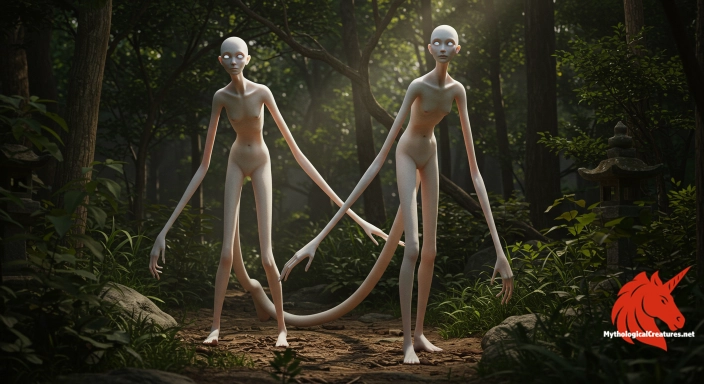
Ashinagatenaga
Ashinagatenaga - They represent the unusual and challenge conventional human form, symbolising the mysterious qualities of yokai in Japanese culture.
Origins & First Encounters
The tale of Ashinagatenaga emerges from a deep well of Japanese folklore, embodying a striking blend of surreal physical exaggeration and mysterious supernatural allure. These yōkai, comprising a pair where one boasts uncommonly long legs and the other remarkably elongated arms, have intrigued audiences for centuries. The earliest attestation of these figures appears in the revered encyclopedia Wakan Sansai Zue, underscoring an early scholarly engagement with the realm of myth. Their roots are interlaced with the rich cultural heritage of Kyushu, a region celebrated for its enigmatic traditions and storied mysticism. Each being is distinct not only through their extraordinary form but also through the nuanced layers of legend that have grown around them over time. Their very names evoke images of fantastical proportions, weaving together both whimsy and an underlying sense of the uncanny. Over the years, their presence has permeated literature, art, and oral traditions, reflecting broad themes that oscillate between the grotesque and the marvelously bizarre. The enduring allure of Ashinagatenaga lies in their ability to symbolise the boundaries of human form and the transformative power of myth. In essence, they continue to captivate the imagination as icons of anomaly and the playful subversion of normalcy.
Source Texts & Tale Variants
The primary literary reference to these peculiar beings originates from the Japanese encyclopedia Wakan Sansai Zue, a distinguished source from a bygone era. This seminal work provided one of the first systematic accounts of their existence, setting a foundation upon which later narratives would build. Additional mentions of Ashinagatenaga are scattered throughout various regional compendia and folklore anthologies, where their vivid physical traits are given detailed attention. Over time, oral traditions across Kyushu enriched their lore, blending the rigour of scholarly documentation with the spontaneity of local myth-making. Diverse narratives illustrate them as either isolated wanderers in mysterious landscapes or enigmatic figures imbued with both charm and disquiet. In select accounts, their roles oscillate between benevolence and misfortune, lending a layered ambiguity to their character. Each retelling contributes distinct elements, from their uncanny physical abilities to symbolic nuances in their behaviour. Modern compilations have since assimilated Ashinagatenaga into broader collections of yōkai, thereby cementing their place in the tapestry of Japanese mythology. This convergence of historical text and vibrant oral tradition highlights the dynamic evolution of their narrative through the centuries.
Form & Powers
Physically, Ashinagatenaga is divided into two distinct yet complementary entities defined by dramatic elongation of their limbs. The being known as Ashinaga-jin is celebrated for his impossibly long legs, often depicted as stretching to monumental proportions that defy the norms of human anatomy. In contrast, Tenaga-jin is characterised by arms that extend far beyond ordinary reach, crafting a silhouette that is both surreal and unsettling. These exaggerated features lend them an otherworldly grace, while simultaneously evoking a sense of disquiet among those who encounter their image. Detailed artistic renderings capture every nuance, from the lithe, extended contours to the subtle hints of movement that suggest an ethereal agility. Some illustrations portray Ashinaga-jin with limbs that seem to flow like liquid, whereas Tenaga-jin’s arms are imbued with a dexterity that borders on the supernatural. The play of light and shadow in traditional depictions accentuates the eerie contrast between human familiarity and fantastical distortion. Such elaboration in their anatomy serves as both a visual spectacle and a metaphor for the transcendence of physical limitations. In this way, every brushstroke of their depiction contributes to a portrait of wonder intertwined with the uncanny.
Regional Faces
Regional interpretations of Ashinagatenaga display a vibrant tapestry of local colour and symbolic diversity that varies across Japan. While their traditional lore firmly ties them to the mysterious landscapes of Kyushu, other regions, such as Kansai, have interwoven their own distinctive nuances into the narrative. Local storytellers often adapt the peculiarities of these beings to reflect prevailing cultural attitudes and societal concerns, thus breathing unique life into the myth. In some rural villages, Ashinagatenaga serve as harbingers of both mirth and misfortune, their exaggerated limbs acting as metaphors for the extremes of human experience. There are versions where the duo is imbued with a tragic element, portrayed as cursed remnants of lost identities or fractured familial bonds. Urban interpretations sometimes temper their eerie qualities with a dash of playful mischief, rendering them endearingly odd rather than overtly monstrous. Festival depictions and artistic portrayals in various regions further reveal how these creatures can symbolise both caution and celebration. Such regional adaptations underscore how local history and values actively shape the way myth is transmitted and transformed. Ultimately, this diversity in portrayal mirrors the broader cultural tendency to reimagine legend in ways that resonate with local experiences and contemporary themes.
Cultural Parallels
Viewed through a cross-cultural lens, Ashinagatenaga resonate with a host of mythic beings known for their exaggerated forms and supernatural qualities. Their pronounced physical distortions evoke comparisons with European legends of giants and elongated humanoids, where disproportionality is a key narrative device. The motif of stretching or distorting the human form appears in various traditions, symbolising both the potential for transcendence and the disruption of natural order. Eastern mythologies, particularly within China, also embrace figures with extended features, often interpreting them as embodiments of mystic power or longevity. This comparative perspective reveals that the duality inherent in Ashinagatenaga is not unique; many cultures employ physical exaggeration to articulate themes of otherness and transcendence. Their dual structure—with one figure distinguished by elongated legs and the other by extended arms—mirrors a balance seen in other mythological pairs across the globe. Such symbolic dichotomies are often used to represent internal conflicts or broader philosophical ideas about human nature. The interplay between humour and unease in their portrayal is a theme that recurs in modern adaptations of myth worldwide. In essence, the saga of Ashinagatenaga contributes to a global dialogue on the significance of physical form and its role in expressing the mysteries of existence.
Legacy & Modern Evolution
Over the centuries, the depiction of Ashinagatenaga has evolved in response to shifting cultural sensibilities and artistic explorations. Early portrayals were steeped in an atmosphere of eerie foreboding, reflecting societal anxieties about the unknown and the unconventional. With the passage of time, however, their narrative softened, embracing a more playful and multifaceted characterisation. Contemporary Japanese media, including anime, manga, and video games, have reimagined these yōkai, imbuing them with rich backstories and a touch of self-aware humour. This modern reinterpretation blends traditional myth with innovative design elements, ensuring that elements of the ancient legend resonate with today's audiences. Artists now utilise their exaggerated features to symbolise themes of resilience, transcendence, and the celebration of the unconventional. The metamorphosis of their image mirrors broader trends in the reinterpretation of folklore, where the once ominous gradually acquires a more ambiguous, sometimes even endearing, presence. In modern society, Ashinagatenaga stand as a bridge between Japan’s storied mythological past and the dynamic, ever-evolving landscape of contemporary pop culture. Their continued re-emergence in diverse creative forms affirms both the timeless quality of myth and its ability to adapt to changing cultural narratives. Ultimately, the legacy of Ashinagatenaga sustains a dialogue between ancient fears and modern aspirations, inviting each generation to rediscover the magic of the unusual.
Interesting Fact
They are one of the few yokai documented as a complementary pair, with each member embodying an extreme of human physical form.
For authors, artists, and makers
Created something from the realm of myth?
If your book, deck, game, or artwork draws from legendary creatures and lore, you can showcase it here in a tasteful, year-round placement.
Share your projectQuick Creature Info
Features:
Our Mythic Legendary Rating:

Also Sometimes Known As:
Habitat:
Supernatural Powers:
Physical Attributes:
Abilities:
Behavior:
Lore:
Related Creatures, Tales or Lore
References
Discover Another Mythical Legend You May Not Have Heard Of?
Uncover the mysteries of ancient folklore and expand your knowledge of legendary beings from cultures around the world.
Dare to Meet the Aosaginohi....
Curated by the Mythological Creatures Team
Series editor: Mythological Creatures Directory
Primary desk: Asian & Pacific Myth Cycles Desk
(rev. November 2025)