
Astraea: Astraea is the virgin Greek goddess of justice, innocence, purity, and precision, celebrated for her role during the Golden Age.
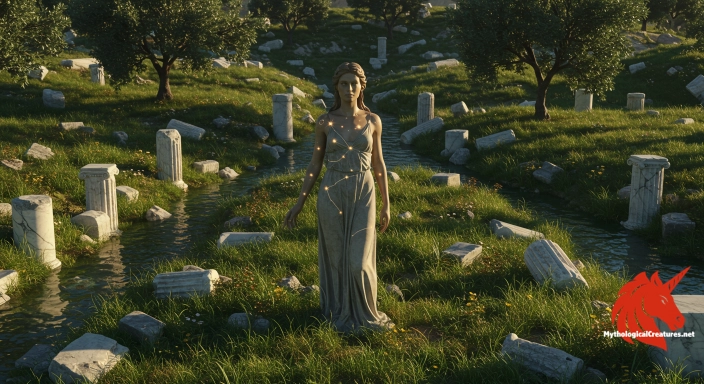
Astraea
Astraea - Represents the ideal of a just and virtuous society during the Golden Age and the eventual loss of innocence among humanity.
Origins & First Encounters
Astraea emerges in ancient myth as a luminous embodiment of justice, innocence, purity, and precision, her celestial presence echoing the harmonious ideals of a bygone era. Her origins trace back to a divine lineage as the daughter of Astraeus and Eos, intimately connecting her with the cosmic cycles of night and dawn. Rooted in a mythic Golden Age, she symbolised a period when humankind flourished in virtue and ethical clarity. As antiquity celebrated her for her unwavering commitment to fairness, Astraea became an emblem of the moral integrity that once defined society. The gradual decay of human goodness led her to forsake the earthly realm, marking a poignant end to an age of untainted simplicity. Her ascension to the heavens, where she shimmers as the constellation Virgo, serves as a timeless reminder of divine justice. This goddess’s story is interwoven with the cultural narrative of an ideal world, inspiring countless retellings throughout history. Her legacy endures as a beacon for those who yearn for a restoration of purity and fairness in human affairs.
Source Texts & Tale Variants
Ancient literary traditions and mythological texts are the primary reservoirs of Astraea’s enduring tale. Her narrative is interlaced with the accounts of the Golden Age, where ideals of justice and innocence found a divine personification. Texts from various periods, ranging from early Greek poetry to later Hellenistic writings, provide different facets of her myth. In some stories, her identity aligns closely with the themes of law and order that underscored the ancient world. The variations in her story, including her relationship with deities like Dike, reflect the dynamic evolution of myth over time. Some ancient accounts present her as both a compassionate protector of virtue and a symbol of the inevitable decline of mortal ethics. As her myth was transmitted through diverse oral and written traditions, each version added layers to her character and significance. The multiplicity of these sources assures that Astraea’s myth has been richly reinterpreted across generations, inviting continuous scholarly and creative engagement.
Form & Powers
Astraea is traditionally portrayed as a radiant and ethereal figure whose appearance seems to mirror the glimmer of the starlit heavens. Classical imagery often presents her with refined, graceful features that capture both her celestial lineage and her commitment to impartial justice. Her flowing robes, seemingly woven from strands of light, evoke the delicate interplay between the cosmic realm and mortal existence. Artists have frequently endowed her with a gentle, yet penetrating gaze that reflects a deep-seated wisdom and the clarity of her divine purpose. Subtle details in her depiction, such as the inclusion of scales or a sword, symbolise her unwavering dedication to fairness and balance. While she is rendered in youthful splendour, there is an unmistakable timeless quality in her visage—a hint of the eternal passing of ages. Her form, often surrounded by a soft, otherworldly glow, underscores the ethereal nature of her being. Over time, the visual portrayal of Astraea has evolved to combine classical traditions with imaginative brilliance, making her an emblem of both celestial beauty and moral rectitude.
Regional Faces
Across various regions of the ancient Greek world, Astraea’s myth was adapted to reflect local cultural sensibilities and religious practices. In some city-states, her character was closely interlaced with that of Dike, reinforcing the ideals of civic justice and the rule of law. Local iconography sometimes emphasised her association with the rejuvenating powers of the dawn, linking her to the cycles of renewal inherent in the natural world. Other regions accentuated her celestial aspects, portraying her as an eternal presence out of reach of mortal impurities. As the myth travelled through Mediterranean traditions during the Hellenistic and Roman periods, local interpretations further diversified her image. These adaptations allowed communities to adopt Astraea as a symbol that resonated with their unique philosophical and moral inquiries. The variations in her portrayal reveal both the universality of her divine mission and the particularities of regional belief systems. Ultimately, her adaptable myth demonstrates how a universal ideal can be embraced in distinct cultural forms, bridging disparate traditions through the common language of justice.
Cultural Parallels
Astraea’s role as a divine arbiter of justice invites striking comparisons with other mythological figures revered for their commitment to fairness and moral order. Her legacy resonates with that of Dike and Themis, both of whom similarly represent the balance and precision necessary for social harmony in classical thought. In wider antiquity, figures such as the Roman Justitia and the modern allegorical image of Lady Justice echo Astraea’s serene and precise embodiment of fairness. These cultural parallels highlight a shared human aspiration to encapsulate an ideal of orderliness and ethical clarity through divine personification. Across cultures, her ascent from the mortal realm to a celestial domain epitomises a metaphor for the transcendence of ethical virtues over temporal corruption. This interconnection with other deities and allegorical figures underscores the shared thematic concerns of justice and balance that traverse cultural and temporal boundaries. Her myth serves as a bridge between the literal and metaphorical realms of justice, symbolically connecting ancient traditions with contemporary ideologies. In this way, Astraea’s narrative enriches the global tapestry of myth, linking diverse perspectives on the eternal quest for fairness and integrity.
Legacy & Modern Evolution
The enduring myth of Astraea reflects a dynamic evolution from the classical narratives of an idyllic Golden Age to modern representations of justice and moral purity. In ancient times, her story encapsulated the hope for a society governed by ethical perfection, a vision that continued to inspire creative expression and philosophical debate. Over the centuries, her transformation from a resident of the earthly domain to a constellatory symbol has underscored the enduring allure of transcendent justice. During the Renaissance, renewed interest in classical mythology saw Astraea reimagined in art and literature as a symbol of lost innocence and the pristine ideals of an idealised past. Contemporary interpretations have further expanded her legacy, blending astronomical homage—such as the naming of a major asteroid—with allegorical depictions in modern sculpture and literature. Her myth now functions as a powerful emblem in discussions on law, order, and the ethical responsibilities innate to civil society. The evolution of her imagery and narrative illustrates how mythic figures can be reworked to address the moral complexities of successive eras. Through these modern lenses, Astraea continues to inspire a profound reflection on justice, serving as a timeless guidepost in the continuous journey toward societal equilibrium.
Interesting Fact
The asteroid 5 Astraea, named in her honor, highlights the enduring influence of her myth, linking ancient Greek mythology with modern astronomical discovery.
Reach myth fans
Connect your myth-driven brand with this audience
Our readers are writers, educators, gamers, and collectors who care about mythology. Enquire about a limited sponsor placement on creature pages.
Enquire about sponsorshipQuick Creature Info
Origin:
Associations:
Our Mythic Legendary Rating:

Also Sometimes Known As:
Habitat:
Supernatural Powers:
Physical Attributes:
Abilities:
Behavior:
Lore:
Related Creatures, Tales or Lore
- DDike
- TThemis
- JJustitia
References
Discover Another Mythical Legend You May Not Have Heard Of?
Uncover the mysteries of ancient folklore and expand your knowledge of legendary beings from cultures around the world.
Dare to Meet the Areia....
-fe72acdc-936c-46ef-938f-1e5e9e790747_small.webp "Depiction of Areia")
Curated by the Mythological Creatures Team
Series editor: Mythological Creatures Directory
Primary desk: Hellenic & Ancient Mediterranean Desk
(rev. November 2025)