
Augenbrand: Augenbrand is a spectral black dog with burning fire eyes, originating from the legends of the Canton of Jura in Switzerland.
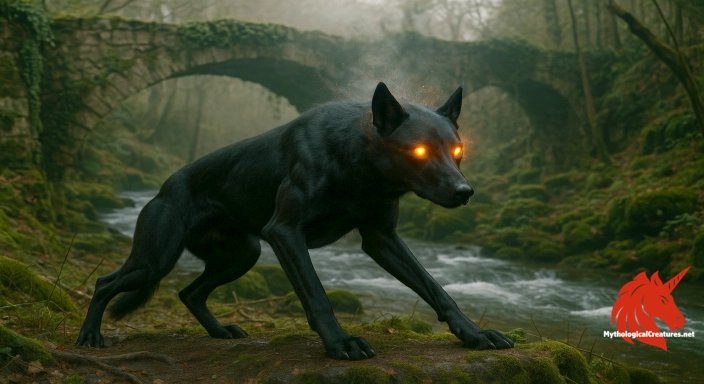
Augenbrand
Augenbrand - Represents the tragic, cursed search for a lost master and serves as a forewarning to wayward travelers.
Origins & First Encounters
Augenbrand emerges from the shadowy traditions of the Canton of Jura as a spectral canine whose eerie presence has captivated local imaginations for centuries. It is said that this ghostly dog, with its unearthly fire-lit eyes, haunts the vicinity of the ancient Soyhières bridge over the Birs. The creature is entwined with the tragic fate of Count Rodolphe de Sogren, murdered in 1233, for whom the hound forever searches as if compelled by an undying loyalty. Its origins appear rooted in a melding of medieval superstition and the natural human fascination with the unexplained. Local lore transforms the beast into a symbol of both retribution and mourning, a living embodiment of a historical curse. The legend hints at a time when supernatural explanations were offered for sudden disappearances and ill fate. In these tales, Augenbrand is portrayed as both guardian and harbinger, straddling the worlds of the living and the departed. The narrative surrounding this creature has evolved over time, reflecting the changing attitudes towards mystery and fate in the region. Its legacy continues to evoke a complex blend of dread, wonder, and respect among those who encounter its story.
Source Texts & Tale Variants
Early accounts of Augenbrand are sparse and largely transmitted through oral traditions, with the earliest mention dating back to local chronicles in the medieval period. Ancient folktales passed down through generations speak of the spectral hound appearing on fog-laden nights near the remnants of Soyhières bridge. Manuscripts and local records, though few and fragmentary, recount episodes of travellers being pursued by a black dog whose eyes burned like coals. These narratives were later compiled into collections of regional legend, often intertwined with the mysterious death of Count Rodolphe de Sogren. Variants of the story present differing details about the circumstances of the count’s murder, yet the image of the burning-eyed guardian remains constant. Some lesser-known texts suggest that the creature’s appearance served as an omen, foretelling additional tragedies in the area. Over time, ballads and local poems embellished the account, thereby diversifying the portrayal of Augenbrand. The surviving sources, though limited in written detail, have provided a rich tapestry of myth that fuels further speculation about his true nature. Each retelling has contributed to a composite view of the creature, cementing its place in the local mythos.
Form & Powers
The physical representation of Augenbrand is both striking and shrouded in supernatural mystery. Described as a black dog of considerable size, its coat is said to be as dark and impenetrable as the night sky, absorbing light rather than reflecting it. The most distinguishing trait is its pair of burning eyes, which flicker with a ghostly fire that seems almost otherworldly in their intensity. These eyes give the creature an aura of both menace and tragic longing, as if they hold untold memories of past suffering. Observers claim that the dog’s form is simultaneously solid and ephemeral, appearing to waver at the edges like a mirage. Some accounts detail a lean, muscular build complemented by elongated limbs that enhance its spectral grace. The creature is often depicted with an almost unnerving silence in its step, emphasising a preternatural stillness and purpose. Variations in the descriptions sometimes note subtle hints of a tattered, ancient aura, as if remnants of a lost noble lineage cling to its form. Every element of its physical description reinforces its role as a portent of mystery and a symbol of unfulfilled destiny.
Regional Faces
While Augenbrand is primarily associated with the Canton of Jura, regional interpretations have imbued it with distinct local flavours in different parts of Europe. In some neighbouring communities, the spectral hound is viewed not only as a remnant of a tragic historical event but also as a protector of sacred locales. Alternative accounts from adjacent regions portray the creature with slightly altered physical traits, such as a more pronounced spectral glow or a leaner, more agile frame. In parts of Switzerland and nearby French-speaking territories, the hound is sometimes seen as a symbolic link between the human and supernatural realms. Rural inhabitants have adapted the story, integrating it with local customs and seasonal festivals, which celebrate the mystery of the unexplained. These adaptations often emphasise the dog's role as a guide or a warning to travellers venturing into treacherous paths. Some interpretations even suggest that the creature’s appearance fluctuates with the phases of the moon, adding an astronomical dimension to its legend. Thus, regional narratives have not only preserved the core legend of Augenbrand but have also evolved it to reflect local values and environmental elements. The diversity found in these regional adaptations underscores the dynamic nature of myth and its ability to absorb cultural nuances over time.
Cultural Parallels
Eyes ablaze in the darkness, Augenbrand finds echoes in numerous spectral hound legends across European folklore. Much like the Black Shuck of East Anglia and the Barghest of Northern England, this ghostly dog embodies both a warning of impending doom and the sorrow of a restless spirit. In a broader mythological context, these similar apparitions serve to remind communities of the blurred boundary between the physical and metaphysical realms. The spectral canine motif appears in many cultures, where it is frequently used to symbolise fate, retribution, or the haunting persistence of past sins. Unlike some of its counterparts, which often serve as malevolent omens, Augenbrand’s perpetual quest for his lost master lends a tragic, almost honourable dimension to his character. Comparative myths also show that while some of these hounds are associated with the afterlife’s punitive aspects, others act as guides helping lost souls find their way. Such cross-cultural parallels suggest a shared human fascination with the ephemeral and the inexplicable. The similarities between these legends underscore an enduring narrative archetype: the search for resolution beyond mortal life. In this confluence of myth and memory, Augenbrand occupies a unique niche that resonates with universal themes of loss, loyalty, and the inexorable pull of destiny.
Legacy & Modern Evolution
The myth of Augenbrand has undergone significant transformation since it was first whispered in medieval corridors and rural settlements. Over the centuries, the narrative has shifted from a mere ghost story to a complex symbol of historical grief and metaphysical mystery. In earlier accounts, the creature was perceived as both an omen and a guardian, a spirit tethered to the violent fate of a long-deceased noble. As modernity encroached on traditional folklore, Augenbrand gradually evolved into an icon of local heritage, with his fiery eyes and restless search inspiring a range of artistic expressions. Contemporary literature and media have reimagined him as either a tragic spectre bound by duty or a vengeful spirit warning of untold perils. Modern interpretations often highlight the hound as a metaphor for unavenged wrongs and the enduring influence of history upon the present. Festivals and local gatherings in the Canton of Jura sometimes pay homage to the creature with performances and exhibitions that blend history with the supernatural. Today, the legend continues to spark the imagination, bridging the gap between ancient myth and modern storytelling, while reminding us of the timeless allure of the unexplained.
Interesting Fact
Unique among spectral creatures, Augenbrand's burning eyes not only illuminate the darkness but also symbolise the eternal torment of a master lost to violence, making him a compelling blend of tragedy and terror in Swiss folklore.
For serious myth projects
Feature your work alongside the legends
From academic works to story-rich games, we highlight projects that respect world mythologies. Talk to us about a measured, long-term placement.
Start a conversationQuick Creature Info
Features:
Associations:
Our Mythic Legendary Rating:

Habitat:
Supernatural Powers:
Physical Attributes:
Abilities:
Behavior:
Lore:
Related Creatures, Tales or Lore
- BBlack Shuck
- BBarghest
- CCu Sith
References
Discover Another Mythical Legend You May Not Have Heard Of?
Uncover the mysteries of ancient folklore and expand your knowledge of legendary beings from cultures around the world.
Dare to Meet the Leprechaun....

Curated by the Mythological Creatures Team
Series editor: Mythological Creatures Directory
Primary desk: Northern & European Folklore Desk
(rev. November 2025)