
Bake-kujira: The Bake-kujira is a ghostly yōkai manifesting as a skeletal whale from western Japan.
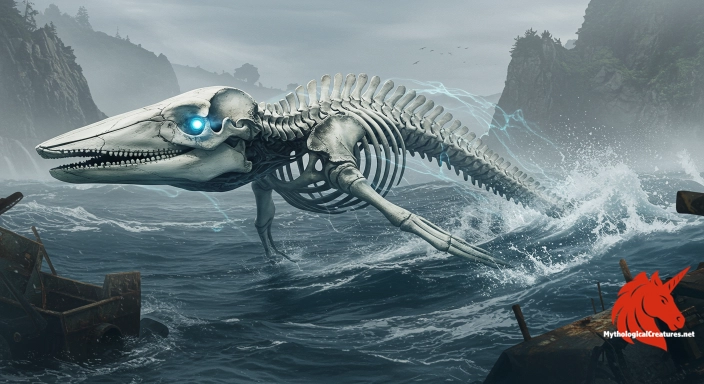
Bake-kujira
Bake-kujira - Acts as a supernatural force that punishes whale hunters and consumers by cursing them with plagues and fire, symbolising nature's retribution.
Origins & First Encounters
The Bake-kujira is an enigmatic yōkai whose spectral presence has captivated coastal communities in western Japan for centuries. Emerging from the rich tapestry of maritime folklore, this ghostly whale is depicted as a bleached skeletal remnant of what was once a living leviathan. Its origins seem intertwined with the collective anxieties of a society deeply connected to the sea and its bounties. The figure is a potent reminder that nature demands respect, serving as a warning against the over-exploitation of marine resources. In its earliest attestations, the Bake-kujira appears as both a mesmerizing and foreboding force, embodying the consequences of human interference in natural order. Local voices in fishing villages would recount encounters with this eerie apparition, weaving its tale into everyday life. The creature’s retributive nature, cursing those who hunt whales or consume their flesh, reflects the intricate relationship between cultural taboos and environmental preservation. Over time, its legend has been enriched by various artistic and literary renditions, ensuring that its haunting image endures. This spirit of the deep remains a symbol of nature’s unyielding ability to reclaim its dignity.
Source Texts & Tale Variants
The earliest narratives concerning the Bake-kujira are preserved in traditional scrolls and oral histories, passed down by generations of seafarers. Detailed illustrations and written accounts from the Edo period hint at an evolving myth that straddles the line between reality and supernatural retribution. Local coastal chronicles and anecdotal records provide numerous versions of the tale, each underscoring the creature’s role as a divine avenger. These primary sources reveal that encounters with the ghost whale were frequently linked to moments of environmental imbalance and human folly. Over the centuries, stories have been shared in hushed tones during long nights by the sea, each retelling adding layers of moral and spiritual significance. Some accounts specifically mention the Bake-kujira’s eerie company of strange fish and peculiar birds, which intensify the overall spectral impression. The narrative’s persistence in regional folklore is a testament to its deep cultural resonance and the communities’ desire to explain the inexplicable. As folklore collectors and chroniclers later documented these diverse stories, a rich mosaic of variants emerged, each coloured by local traditions and cultural nuances. The multifaceted sources together illustrate a complex relationship between humanity and the natural world, rendered mysterious through myth.
Form & Powers
The physical manifestation of the Bake-kujira is as striking as it is surreal, presenting itself as a colossal whale reduced to a ghostly skeleton. Its bones, seemingly bleached by time and the relentless power of the sea, exude an almost otherworldly luminescence in low light. The skeletal structure is meticulously portrayed, with finely detailed elements that evoke both the majesty and the morbidity of a once-living entity. The creature's eye sockets and fractured jaw contribute to an expression that is hauntingly void, as though it sees far beyond the mortal realm. Accompanying its skeletal form are swarms of unidentifiable fish and bizarre birds, adding to the unsettling tableau. These subordinate beings enhance its ominous presence and underline the idea that the ghost whale is not merely a relic of the past, but a vessel of otherworldly energies. Observers have often described a surreal glow that seems to emanate from within the bones themselves, hinting at a residual spirit or accumulated curse. The detailed physical description, with its stark contrasts of decay and spectral light, creates a vivid impression that lingers long after the encounter. Every anatomical nuance of the Bake-kujira is a deliberate echo of nature’s dual power—its beauty and its ability to instill a sense of dread.
Regional Faces
Regional renditions of the Bake-kujira vary widely, reflecting the diverse cultural landscapes of Japan’s coastal areas. In western Japan, where the legend is most firmly rooted, the ghost whale is traditionally seen as a curse against those who harm the marine ecosystem. Local adaptations tend to emphasise its role as both a protector of the ocean’s sanctity and a harbinger of misfortune. In some villages, the apparition is described with additional mystical features, such as a haunting glow or the sudden appearance of dense, eerie fog. Contrasting interpretations from neighbouring regions augment its myth with different supernatural accessories, embellishing its skeletal form with symbols of ancestral wrath and natural justice. Coastal communities might also integrate regional superstitions, associating the spectral whale with unusual climatic disturbances or maritime disasters. Over time, as communities adapted the tale to suit local moral and ecological concerns, variations in narrative details emerged. Each cultural adaptation reinforces a shared sentiment—a reminder that the balance of nature should not be taken for granted. The regional nuances of the Bake-kujira not only deepen its mythic presence but also highlight the dynamic interplay between environment and folklore.
Cultural Parallels
The spectral nature of the Bake-kujira finds interesting parallels with other mythological creatures, both within Japan and beyond. Much like the enigmatic Umibōzu, another sea-related yōkai, it personifies the dangers lurking within the deep and the mysteries hidden beneath the waves. Its skeletal appearance has drawn comparisons to Western legends such as the Flying Dutchman, where maritime misfortunes are heralded by ghostly apparitions. Unlike typical sea monsters that may rely on monstrous physicality alone, the Bake-kujira combines the stark reality of a whale’s remains with an ethereal aura that transcends the ordinary. This juxtaposition of tangible decay and supernatural presence is a hallmark shared with numerous ghostly figures in global folklore. Comparative mythology often reveals how disparate cultures utilise spectral imagery to warn against the exploitation of natural resources. In both Eastern and Western traditions, these otherworldly beings serve not only as omens of impending disaster but also as moral arbiters of human conduct. The shared motifs of retribution and natural justice underline a cross-cultural narrative where nature’s fury is personified in ghostly guise. Such comparisons illuminate the universal human drive to understand and mythologise the unknown forces of the natural world.
Legacy & Modern Evolution
The transformation in the depiction of the Bake-kujira over the centuries mirrors a broader change in societal attitudes towards nature and retribution. Historically, its myth was a somber reminder embedded in the everyday lives of fishing communities and coastal inhabitants. With the advent of modern environmental challenges, the ghost whale has evolved from a folklore cautionary tale into a symbol of ecological accountability. Contemporary portrayals often cast its eerie figure against the backdrop of environmental degradation, serving as a powerful allegory for the consequences of human exploitation of natural resources. Modern artists, filmmakers, and writers have embraced the Bake-kujira’s haunting imagery, adapting its narrative to explore themes of environmental justice and sustainable living. In these re-imaginings, the creature is not merely a figure of terror but also an embodiment of nature’s resilience and the urgent need to reassess our relationship with the planet. This continual evolution has allowed the Bake-kujira to remain both a source of cultural intrigue and a catalyst for environmental discourse. Its enduring appeal lies in the ability to bridge ancient superstition with modern ecological concerns, making it a poignant symbol for contemporary audiences. The legacy of the ghost whale thus persists as a timeless reminder of the power of myth to mirror and influence societal values.
Interesting Fact
A striking aspect of the Bake-kujira is that its appearance not only signals impending disaster but also embodies the deep spiritual connection between humans and the natural world in traditional Japanese belief systems.
Curated sponsor space
One subtle banner. Thousands of myth lovers.
We offer a small number of curated sponsor spots for relevant books, courses, games, and art. No clutter, just well-matched partners.
Partner with usQuick Creature Info
Features:
Associations:
Our Mythic Legendary Rating:

Also Sometimes Known As:
Habitat:
Supernatural Powers:
Physical Attributes:
Abilities:
Behavior:
Lore:
Related Creatures, Tales or Lore
- GGashadokuro
- UUmibozu
- EEnenra
References
Discover Another Mythical Legend You May Not Have Heard Of?
Uncover the mysteries of ancient folklore and expand your knowledge of legendary beings from cultures around the world.
Dare to Meet the Sin....
-1922aea2-f020-43b6-9001-5028fda6a267_small.webp "Depiction of Sin")
Curated by the Mythological Creatures Team
Series editor: Mythological Creatures Directory
Primary desk: Asian & Pacific Myth Cycles Desk
(rev. November 2025)