
Barachiel: Barachiel is the Archangel of Blessings, revered in Jewish and Christian traditions for his role in bestowing divine grace.
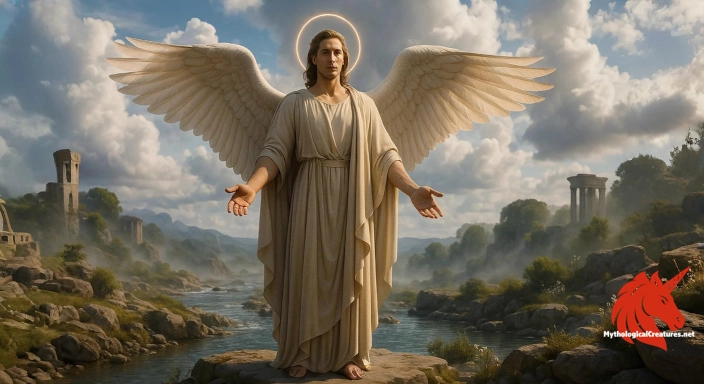
Barachiel
Barachiel - Symbolises divine blessings and mercy, representing God's benevolence in the heavenly hierarchy.
Origins & First Encounters
Barachiel emerges as a majestic archangel whose very name, meaning 'God has blessed', encapsulates the divine purpose of his existence. He is revered as the Archangel of Blessings within Jewish, Byzantine Catholic, and Eastern Orthodox traditions. His origins trace back to ancient mystical texts where he is portrayed not only as a figure of benevolence but also as one who bridges mortal hopes with celestial favour. Early attestations in texts such as the Third Book of Enoch place him amongst the angelic princes, surrounded by a vast host of ministering angels. The cultural context of his story is richly imbued with themes of mercy, love, and divine providence. He is particularly associated with the Sephirah of Chesed, symbolising kindness and benevolence in Kabbalistic traditions. His role as a conduit of blessings has earned him a lasting place in religious art and liturgy, influencing both ceremonial practices and personal devotion. Throughout the centuries, Barachiel has continued to inspire awe and reverence as embodiments of hope and divine generosity.
Source Texts & Tale Variants
Textual sources and oral traditions have played a significant role in shaping the narrative surrounding Barachiel. His mention in the Third Book of Enoch provides a foundational image of an archangel presiding over a host of 496,000 ministering angels. The Almadel of Solomon further enriches his portrayal by listing him among the chief angels associated with specific celestial realms. These ancient texts are complemented by a variety of mystic and apocryphal writings that expand his mythological dimensions. Different manuscript traditions and liturgical texts provide nuanced variations, reflecting the evolving spiritual and cultural contexts. Some early Byzantine sources use elaborate descriptions and symbolic language that align him with heavenly phenomena such as the planet Jupiter. Jewish mystical literature, including aspects of Kabbalistic thought, ties him to the divine attribute of Chesed, further deepening his iconography. Local folk tales and medieval devotional writings have at times reinterpreted his role, blending scriptural accounts with popular piety. The diversity of these sources highlights the rich, multifaceted legacy that Barachiel has acquired over time.
Form & Powers
Barachiel is commonly depicted with expansive, luminous wings that seem to radiate celestial light and ethereal grace. His visage is rendered with a serene, compassionate expression, conveying both wisdom and gentle authority. In many artistic traditions, he is shown wearing flowing robes that shimmer with subtle hues of gold and deep blue, symbolising his connection to the heavens. The intricate detailing in his garments often includes motifs that evoke cosmic patterns and ancient symbolism. His eyes, frequently depicted as deep and insightful, are said to reflect the mysteries of the divine order and the benevolence of the cosmos. Some depictions include a radiant halo or nimbus, adding to the impression of otherworldliness and sanctity. Modern iconography sometimes introduces objects such as a sceptre or chalice, symbols associated with the conferral of blessings. Artists have portrayed him in both robust, imposing forms and delicate, ethereal outlines, reflecting the dual aspects of divine power and mercy. Each representation seeks to capture the interplay between the mortal and the celestial, ensuring that his physical form remains a powerful emblem of divine enchantment. The variations in his depiction across media underscore not only regional artistic tendencies but also the evolving understanding of his spiritual significance.
Regional Faces
Cultural interpretations of Barachiel vary considerably across different regions, each adding distinct nuances to his character. In Jewish mystical traditions, he is closely linked with the Sephirah of Chesed, embodying a force of unconditional love and abundant kindness. Byzantine representations often integrate classical ecclesiastical art styles which highlight his elevated position within the angelic hierarchy. In Eastern Orthodox communities, his image is sometimes interwoven with local iconographic traditions that stress both his protective and beneficent aspects. Mediterranean regions, with their rich tapestry of religious art, frequently depict him in a style that blends celestial symbolism with earthy humanism. In areas influenced by Kabbalistic thought, his association with divine blessings is accentuated through intricate numerological and symbolic detail. Eastern European renditions often fuse local folk customs with canonical imagery, resulting in portrayals that are both vibrant and warmly accessible. Despite these regional variations, the essential message of Barachiel as a giver of divine blessings remains a constant thread that unites communities across different cultural landscapes.
Cultural Parallels
A comparative look at Barachiel reveals interesting parallels with similar celestial benefactors across diverse mythological and religious traditions. While he is distinct in his role as the Archangel of Blessings, his characteristics share common ground with other archangels such as Raphael, who also embodies healing and nurturing qualities. In broader religious contexts, figures like Uriel represent wisdom and illumination, overlapping with Barachiel’s theme of bestowing divine favour upon humanity. Outside the Abrahamic tradition, deities like the ancient Roman god Jupiter, who was associated with power and providence, echo elements of Barachiel’s symbolism. In many iconographic traditions, the embodiment of grace and blessing is a recurring motif, whether in the form of benevolent spirits or guiding deities. This convergence reflects a universal cultural need to conceptualise a divine intermediary between the celestial and the earthly. Artistic and literary traditions frequently draw on these common themes to create images that resonate with audiences across different periods and cultures. Even as the details of their portrayals may differ, the central idea of a protective, blessing-bestowing figure remains prominent in both Eastern and Western traditions. Barachiel thus stands alongside other mythological figures as a timeless symbol of hope, healing, and the sustaining power of divine love.
Legacy & Modern Evolution
The depiction of Barachiel has evolved significantly from the early mystical manuscripts to modern artistic interpretations. Initially, his image was deeply intertwined with allegory and mysticism, serving primarily as a symbol of divine benevolence in ancient texts. Over the centuries, his role expanded and adapted to the changing theological and artistic landscapes of Byzantine and Eastern Christian contexts. Medieval manuscripts and iconographies began to infuse his figure with more elaborate regalia, reflecting both a deep reverence for tradition and an emerging aesthetic of celestial grandeur. As cultural exchanges increased, regional adaptations added layers of local colour and interpretation, ensuring that his image was both universally recognisable and locally resonant. In recent decades, contemporary artists and theologians have reimagined Barachiel as a beacon of hope and renewal, a symbol particularly relevant in times of personal and social uncertainty. His enduring association with themes of blessing and compassion continues to influence modern liturgical practices, literature, and visual media. The evolution of his depiction mirrors broader shifts in how spiritual beings are understood, combining elements of ancient mysticism with modern sensibilities. Today, Barachiel remains a potent emblem of divine generosity, inspiring those who seek a connection to the transcendent and the compassionate. His legacy, built on centuries of reinterpretation and faith, continues to illuminate the path towards spiritual enrichment and communal hope.
Interesting Fact
A striking aspect of Barachiel’s myth is the account of his 496,000 ministering angels, which symbolically represents the limitless scope of divine blessings he bestows.
Mythology commerce, done carefully
Align your store with our global myth audience
If you sell myth-inspired jewellery, prints, decks, or collectibles, we can feature your brand without overwhelming the reading experience.
Partner with usQuick Creature Info
Associations:
Our Mythic Legendary Rating:

Also Sometimes Known As:
Habitat:
Supernatural Powers:
Physical Attributes:
Abilities:
Behavior:
Lore:
Related Creatures, Tales or Lore
- MMichael
- GGabriel
- RRaphael
References
Discover Another Mythical Legend You May Not Have Heard Of?
Uncover the mysteries of ancient folklore and expand your knowledge of legendary beings from cultures around the world.
Dare to Meet the Anigrides....

Curated by the Mythological Creatures Team
Series editor: Mythological Creatures Directory
Primary desk: Hellenic & Ancient Mediterranean Desk
(rev. November 2025)