
Bean-nighe: Bean-nighe is a spectral washerwoman from Scottish folklore who foretells death by washing the clothes of those destined to die.
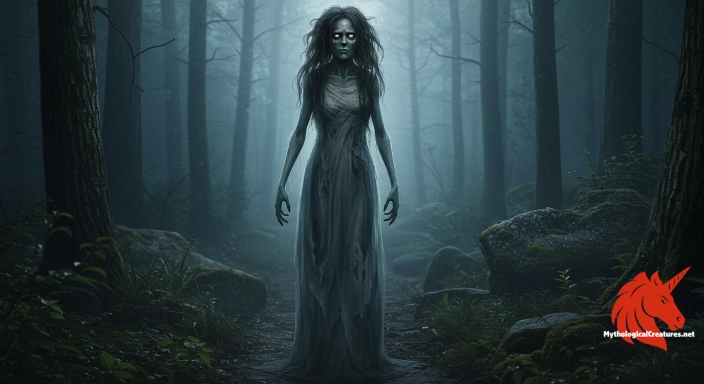
Bean-nighe
Bean-nighe - Symbolises the inevitability of death and the connection between the mortal realm and the Otherworld.
Origins & First Encounters
The Bean-nighe is a haunting presence deeply woven into Scottish folklore, emerging as a spectral washerwoman at the edge of lonely streams. Her origins are lost in the mists of ancient Gaelic tradition, where the belief in an Otherworld was interlaced with daily life and destiny. She embodies the archetype of a messenger from the realm of the dead, her spectral chores signalling the inevitable approach of mortality. Often, locals recount eerie sightings of her near water, where she appears to cleanse the garments of those doomed to die. Oral traditions dating back centuries speak of her as both an omen and a poignant reminder of life’s fragile nature. Over time, her image has evolved, reflecting both fear and a strange sort of reverence, where the mundane act of washing is transmuted into an otherworldly ritual. This blend of everyday life with the supernatural has captivated the cultural imagination of the Highlands and beyond. Her narrative teaches that the boundary between the living and the dead is as fluid as the waters she inhabits. In every whispered tale, the Bean-nighe continues to invoke both awe and a deep, unshakeable melancholy.
Source Texts & Tale Variants
Ancient folktales, ballads, and oral legends form the backbone of the Bean-nighe’s storied past, preserving her enigmatic role across generations. Her tale runs parallel to that of the Irish banshee, with early Gaelic narratives painting her as a spectral harbinger of fate. Episodes recounted in these traditions often detail encounters along desolate streams, where her presence presages untimely ends. Variations in her story emerge from different storytellers, with some narratives emphasising a deep sorrow and others hinting at a ferocious warning. In some accounts, she is known by diminutive titles such as Nigheag and Nigheag na h-ath, each variant adding layers to her mysterious character. Written records, though sparse, interweave with rich oral traditions that underscore her dual nature as both guide and omen. Medieval texts and later collections of Celtic lore contribute to a mosaic of interpretations that enrich her myth. This diversity in storytelling reflects the adaptability of oral culture in transmitting warnings of mortality. Ultimately, the multiple versions of her legend celebrate the intricate dance between life and death in the folklore of the region.
Form & Powers
The Bean-nighe is frequently depicted as a spectral figure draped in the tattered garb of a long-forgotten washerwoman. Her skin appears pale and almost translucent in the faint glow of moonlight, lending her an ethereal quality. Often, she is imagined with long, unkempt hair cascading around her shoulders like streams of mist, enhancing her connection to water and sorrow. The garments she wears—the remnants of a once mundane existence—are depicted as threadbare and drenched, symbolically linking her to the act of washing. Her eyes, when seen, are filled with a haunting luminescence that speaks of an eternal sorrow. Descriptions of her physical form blend human frailty with ghostly impermanence, making her seem both real and unreal. Some portrayals describe her as gaunt and aged, while others hint at a more youthful yet tragic visage. The interplay between her corporeal presence and spectral aura blurs the line between life and death. Every detail, from her worn attire to the melancholic expression etched on her face, reinforces the inevitability of fate and the ephemeral nature of existence.
Regional Faces
Although the Bean-nighe’s roots lie in Scottish tradition, her portrayal shifts subtly across different regions and local cultures. In the rugged Scottish Highlands, she is consistently seen as a solitary figure standing by bleak, flowing waters—a reminder of impending doom. Coastal communities sometimes imbue her with a protective quality, interpreting her presence as a guide to souls transitioning from life to the hereafter. Variations in her depiction can be observed in neighbouring Gaelic regions where her role may shift from that of a fearsome harbinger to a more benign spirit. In Ireland, for instance, the closely related banshee shares many characteristics with the Bean-nighe, though local details lend a distinct domestic texture to each tale. Some local traditions refer to her with affectionate diminutives such as Nigheag bheag a bhroin, softening her otherwise ominous image. French folklore’s Les Lavandières add another layer of complexity, mingling the motif of the night washerwoman with unique cultural nuances. Such regional adaptations illustrate how communities have tailored the myth to reflect their own relationships with death and the supernatural. Each cultural variation, while respecting the core myth, offers a fresh perspective on an ancient and persistent legend.
Cultural Parallels
The Bean-nighe occupies a unique niche among spectral figures, standing shoulder-to-shoulder with the famed Irish banshee in the pantheon of death omens. Her role as a silent announcer of life's end is echoed in European legends, notably through the French Lavandières who similarly labour by night to cleanse the vestiges of mortal existence. The recurring motif of a female figure engaged in a domestic chore that mirrors the natural cycle of life underscores a common mythological parallel that spans cultures. Various traditions portray such washerwomen as both harbingers and guides, blurring the line between a benign domestic spirit and a forewarning spectre. Her seemingly mundane duties, set against the dark tapestry of death, evoke comparisons with other cultural figures who connect everyday life with the realm of the dead. The gentle melancholy that pervades her myth contrasts with more overtly violent depictions of death in other traditions. This nuanced role invites analysis, as scholars observe the symbolic resonance of communal rituals interwoven with the inevitable end of life. As a comparative figure, the Bean-nighe exemplifies how diverse cultures use similar imagery to negotiate themes of mortality and transition. By juxtaposing domesticity with the supernatural, she continues to fascinate and inspire cross-cultural dialogue.
Legacy & Modern Evolution
Over the centuries, the portrayal of the Bean-nighe has undergone a fascinating transformation, evolving from an austere omen of death to a symbol rich with layered meaning. Early portrayals, shared in hushed tones among rural communities, focused primarily on her role as an unmistakable herald of mortality. With the passage of time, literary and artistic reinterpretations have introduced complexities that render her both tragic and enigmatic. Romantic and Gothic sensibilities of later eras have enriched her image with themes of sorrow, loss, and the inexorable passage of time. Contemporary retellings in horror fiction and film often blend traditional elements with modern narratives, presenting her as a multifaceted character embodying both terror and deep, poignant humanity. Digital media, video games, and modern literature have all contributed to revitalising her legend, ensuring that her spectral presence endures in popular culture. This modern legacy invites audiences to reconsider historical superstitions through a lens of empathy and artistic expression. Even as her traditional role as a messenger of death remains intact, new interpretations often highlight her inner turmoil and the emotional weight of her eternal duty. Thus, the Bean-nighe has transformed into an enduring icon, symbolising the timeless interplay between life, death, and the mysteries that lie between.
Interesting Fact
An intriguing aspect of Bean-nighe is that, despite her ominous role as a death omen, she is not considered evil but rather a necessary herald of fate in Scottish Gaelic mythology.
For indie creators
Give your myth project a permanent home
Indie authors, artists, small studios, and makers can secure an annual, non-intrusive sponsor slot that meets readers where they explore.
Obtain more informationQuick Creature Info
Features:
Associations:
Our Mythic Legendary Rating:

Also Sometimes Known As:
Habitat:
Supernatural Powers:
Physical Attributes:
Abilities:
Behavior:
Lore:
Related Creatures, Tales or Lore
- BBanshee
- LLes Lavandières
- LLa Llorona
References
Discover Another Mythical Legend You May Not Have Heard Of?
Uncover the mysteries of ancient folklore and expand your knowledge of legendary beings from cultures around the world.
Dare to Meet the Ionides....
Curated by the Mythological Creatures Team
Series editor: Mythological Creatures Directory
Primary desk: Northern & European Folklore Desk
(rev. November 2025)