
Brahma: Brahma is the Hindu god of creation and a key figure in the Trimurti.
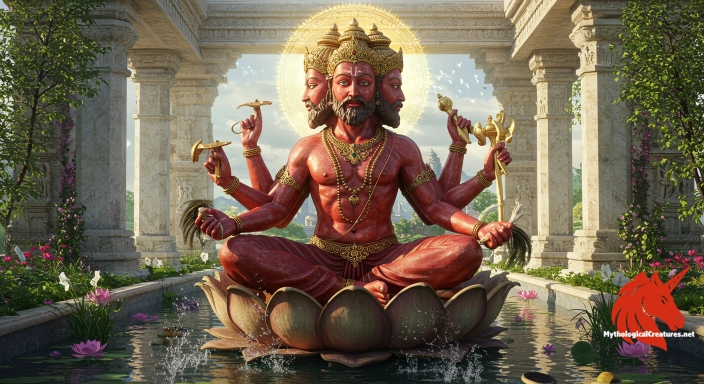
Brahma
Brahma - Brahma is revered as the creator of the universe and a foundational figure in Hindu mythology, symbolising cosmic creation and knowledge.
Origins & First Encounters
Brahma stands as one of the most significant figures in Hindu thought, celebrated as the ultimate source of creation and the wellspring of cosmic wisdom. He emerged from the ancient tapestry of Vedic cosmology and is intrinsically linked with the origins of the universe, symbolising the divine spark that brings forth all of existence. His early manifestation in texts such as the Vedas and later in various Puranas highlights a deity born from the golden cosmic embryo known as Hiranyagarbha. Over time, his identity became intertwined with that of Prajapati, reinforcing his role as the progenitor of both the physical world and spiritual knowledge. His portrayal within the revered Trimurti alongside Vishnu and Shiva cemented his position as a key architect of the cosmos. Each element of his myth underscores a profound connection between creative energy and the diligence that sustains existence. Brahma’s narrative reflects a rich historical evolution, bridging ancient metaphysical ideas with enduring philosophical insights. His legacy represents not just the act of creation, but also the enduring pursuit of knowledge and order in an ever-changing universe. The mystical dimensions of Brahma continue to inspire reverence and intellectual exploration, uniting spiritual traditions with the quest for understanding the origins of life. His story remains a compelling reminder of the delicate interplay between creation and dissolution that defines the cosmic cycle.
Source Texts & Tale Variants
The legend of Brahma flows through a wide spectrum of ancient texts, from the hymns of the Vedas to the intricate narratives of the Puranas. Diverse scriptures paint his origin with varying shades, ranging from self-manifestation in a cosmic egg to a more symbolic emergence as a progenitor of life. Multiple story variants offer unique insights, some accentuating his role as a primordial creator while others focus on his function as an architect of religious wisdom. His presence in the Brahma Sutras, alongside references in epic literature, has provided fertile ground for centuries of devotional interpretation and scholarly debate. Regional folklore enriches his myth, often blending abstract cosmic principles with local cultural practices. Some traditional accounts imbue his character with multifaceted layers that reflect the changing tide of spiritual thought across eras. The continuity found in these texts illustrates a fluid narrative, one that adapts seamlessly to various religious and philosophical outlooks. Overall, these sources offer not just a record of myth but also a dynamic dialogue about the origins of existence and the eternal power of creation.
Form & Powers
The visual depiction of Brahma is a masterful blend of symbolism and artistry, designed to reflect his role as the creator of all things. He is most famously illustrated with four distinct heads, each orchestrating the recitation of a sacred Veda and looking toward a different cardinal direction. His skin is often rendered in rich hues of red or a resplendent golden tone, evoking the radiance of cosmic energy. In his four graceful hands, Brahma is shown holding symbolic objects that may include the scriptures, a lotus flower, a prayer bead, and a water pot, all of which underscore various facets of life and order. The serene yet commanding expression on his face communicates boundless wisdom and an unwavering focus on the cosmic order. His seated posture on a lotus further signifies purity and the process of spiritual unfolding, reinforcing his connection to divine beauty. Accompanying him is the gentle hamsa, his vahana, whose quiet elegance not only complements his dignified appearance but also serves as a metaphor for the soul's journey. Every aspect of his form is meticulously crafted to embody the infinite complexity and creativity inherent in the universe.
Regional Faces
Across the rich landscape of the Indian subcontinent, Brahma’s iconography and worship exhibit distinctive regional flavours that celebrate local artistic traditions and devotional sensibilities. In some northern regions, his depictions are stark and austere, emphasising his role as an unembellished master of creation and order. Contrastingly, in parts of southern India, Brahma appears in more ornate forms, interwoven with vibrant local motifs that highlight the festive and celebratory aspects of creation. The ancient temple at Pushkar in Rajasthan stands as a singular monument to his legacy, where intricate carvings and rituals reinforce his traditional persona. Beyond the boundaries of India, layered adaptations of his myth appear, notably in Thailand where elements of Brahma have merged into local religious practices, as seen in revered sites like the Erawan Shrine. These regional interpretations reveal how local beliefs and artistic expression can reshape a cosmic figure while preserving the core ideals of creation and knowledge. Even where his popularity has waned, community traditions continue to invoke his image during specific cultural festivals and ceremonial occasions. Ultimately, the regional variations in Brahma’s portrayal underscore the dynamic nature of myth-making and the universal quest to understand the divine.
Cultural Parallels
Brahma’s role as the primordial creator invites comparisons with similar figures across a range of global mythologies. In many ancient traditions, creators are depicted as beings whose cosmic actions set the stage for life, much like the Egyptian deity Atum who brings order from chaos. In Greek lore, figures associated with the birth of the cosmos, such as the primordial gods of creation, share thematic resonances with Brahma’s role. Comparatively, the intellectual aspects of Brahma find echoes in other cultures, where divine wisdom is embodied by multi-faceted deities who integrate both creative might and profound insight. Across diverse traditions, creators are often depicted with multiple features symbolising their comprehensive oversight of the universe, a trait that Brahma shares through his four heads each representing a sacred body of knowledge. His narrative also aligns with the universal metaphor of the divine craftsman, a role seen in indigenous mythologies where the act of creation is celebrated in rituals that underscore the unity of life. The cross-cultural exploration reveals not only the shared human fascination with origins but also how symbolic imagery adapts to express similar truths in differing aesthetic and theological languages. In this way, Brahma serves as a bridge between diverse mythic traditions, highlighting the common quest to comprehend the mysterious emergence of the cosmos.
Legacy & Modern Evolution
The evolution of Brahma’s divine role reflects a dynamic journey through the annals of religious thought and cultural history. Once revered as a primary deity in early Vedic and Puranic traditions, his prominence gradually gave way to the more widely embraced figures of Vishnu and Shiva as religious practices evolved. Despite this shift, the ancient imagery and philosophical ideas connected to Brahma have endured through art, literature, and enduring temple traditions. His legacy is preserved in unique sites like the Brahma Temple at Pushkar, which continues to attract devotees seeking a connection with the creative force of the universe. In modern interpretations, his myth has transcended ritual worship to become a symbol of the eternal cycle of birth and renewal, inspiring intellectual debates and reinterpretations in contemporary cultural discourse. Artistic renditions in modern media and scholarly reflections serve to revive his complex identity, blending age-old traditions with fresh perspectives. Outside traditional worship, Brahma’s iconography is often evaluated for its metaphorical resonance with creativity, order, and the omnipresent mystery of existence. His historical evolution, from a central cosmic creator to a more symbolic figure in modern spirituality, highlights the mutable nature of myth and the ongoing journey to understand the forces that shape our world.
Interesting Fact
Brahma is one of the few major deities in Hinduism with very few temples dedicated to him, highlighting a unique shift in devotional focus within the religion over time.
For serious myth projects
Feature your work alongside the legends
From academic works to story-rich games, we highlight projects that respect world mythologies. Talk to us about a measured, long-term placement.
Start a conversationQuick Creature Info
Features:
Associations:
Our Mythic Legendary Rating:

Also Sometimes Known As:
Habitat:
Supernatural Powers:
Physical Attributes:
Abilities:
Behavior:
Lore:
References
Discover Another Mythical Legend You May Not Have Heard Of?
Uncover the mysteries of ancient folklore and expand your knowledge of legendary beings from cultures around the world.
Dare to Meet the Bestla....
Curated by the Mythological Creatures Team
Series editor: Mythological Creatures Directory
Primary desk: Asian & Pacific Myth Cycles Desk
(rev. November 2025)