
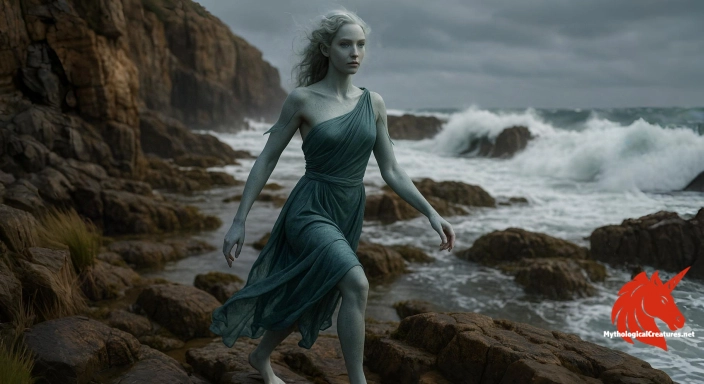
Capheira: Capheira is an Oceanid from Greek mythology, the daughter of Oceanus and possibly Tethys, known for her stormy essence.
Capheira
Capheira - Symbolises the untamed, stormy aspects of the sea and the interconnectedness of nature in Greek mythology.
the legend in five swipes.
the legend in five swipes.
Capheira: Origins and First Sightings
Capheira emerges from the rich tapestry of Greek mythology as one of the Oceanids, a distinct group of nymphs born of primordial forces. Her lineage is both illustrious and elemental, being traditionally cited as a daughter of Oceanus, the great Titan of the Sea, and, in some accounts, Tethys, his consort. The etymology of her name, translating to 'stormy-breath', hints at the turbulent and tempestuous characteristics that the ancients may have attributed to her essence. She is often seen as a personification of the raw, dynamic power of the ocean and the storms that it sometimes unleashes. Capheira’s brief but evocative mention in classical texts encapsulates the mystique that surrounds many minor deities of the natural world. Her presence, though not elaborated upon in epic narratives, symbolises the unpredictable moods of the sea and the atmospheric disturbances beyond mortal control. Mythmakers may have employed her figure to explain natural phenomena, embodying both the beauty and ferocity of the maritime realm. The duality of her nature—gentle in appearance yet powerful in spirit—mirrors the ancient Greeks’ respect and caution towards nature. In the broader cultural context, she stands as a reminder of the many forces that govern the natural world, often remaining an enigmatic figure amid the pantheon of deities.
Capheira: Manuscripts, Texts and Variants
The literary record of Capheira is notably sparse, with her name appearing mainly in genealogical lists that trace the origins of various divine entities. Among the earliest sources, Hesiod’s works provide a backdrop along which figures like her are mentioned in connection with the infinite progeny of Oceanus and Tethys. Although she does not feature in elaborate myths, ancient scholia and later mythographers have preserved fragments of her identity and reputation. References to Capheira can be found woven into broader discussions of the natural world and the divine forces underlying the cosmos. Some fragments of later Hellenistic interpretations hint at variations in her character, suggesting a link between her and the capricious forces of the storm. In these texts, her character is occasionally intermingled with allegories of nature’s unpredictable temperament. The lack of a detailed myth narrative means that Capheira’s story is often overshadowed by those of her more prominent siblings. Nonetheless, the few sources that mention her highlight a subtle complexity in the way the ancients conceptualised the interplay between calm and chaos in the sea. Though her appearances are fleeting, the preservation of her name in ancient registers affirms her place in the mythological tradition. Her sparse literary footprint invites modern scholars to reconstruct her mythos from the interstices of related mythological accounts.
How would you recognise Capheira?
In artistic and poetic depictions, Capheira is envisioned as an ethereal embodiment of both beauty and the wild force of nature. Often, she is imagined with a graceful form that reflects the fluid, ever-changing surface of the sea. Descriptions, although limited, evoke an image of luminous skin reminiscent of moonlight on gentle waves and eyes that mirror the tempestuous sky. Her flowing hair, suggested to be the colour of salt-sprayed foam, is sometimes depicted as intertwining with the currents of the ocean. The aesthetic drawn by ancient visionaries blends softness with the inherent drama of a brewing storm. Variations in her portrayal might include subtle hints of both femininity and elemental power, with garments seemingly woven from the mists and vapours of the sea. While no definitive canonical image survives, later artistic traditions occasionally attribute her with features that suggest both fragility and strength. The merging of human and natural elements in her depiction serves to symbolise the deep connection between mankind and the watery realm. Overall, her visual representation is less about precise anatomy and more about capturing an atmospheric essence that conveys the spirit of a storm.
What regional forms of Capheira exist?
The myth of Capheira, while rooted in classical Greek tradition, found subtle echoes in various regional adaptations across the Mediterranean. In certain locales, she was interwoven with local folklore as a personification of seasonal storms and tempestuous weather conditions. Some coastal communities, for instance, incorporated her legend into rituals aimed at appeasing the unpredictable nature of the sea. The local variations often emphasised her association with maritime weather phenomena, reflecting the environmental concerns of seafaring people. In regions where the worship of water deities was predominant, Capheira’s attributes were sometimes merged with local nymphs to form composite spirits of the sea. Her character is seen to morph through time as the narrative of ocean deities was adapted to suit local cultural needs and the natural landscape. While the core idea of a storm-associated spirit remained, the nuances of her myth could change from one community to another. These regional adaptations have added layers of interpretative potential to her character and allowed her myth to persist even where the original classical texts have faded. The local embellishments often highlight an enduring human attempt to connect natural phenomena with divine archetypes, ensuring that Capheira’s legacy resonates beyond the confines of the ancient world.
What figures resemble Capheira?
Comparatively, Capheira stands alongside other water-associated deities and nymphs within both Greek mythology and the mythologies of neighbouring cultures. Her role as an Oceanid places her in a broad family of divine entities whose identities are intimately linked with water and its capricious nature. Similar figures can be observed in the myths of other Mediterranean cultures, where local water spirits and storm gods echo her attributes. In the Celtic tradition, for example, certain water fairies and deities are imbued with qualities that conjure both the seductive allure and unpredictability of the natural world. The parallel between Capheira and figures such as the Naiads, who also symbolise the fluidity and mystery of water, highlights shared themes across cultural boundaries. These comparative myths illustrate how different societies have sought to personify natural forces in ways that express both cultural identity and environmental reverence. Her distinctive epithet, 'stormy-breath', invites comparisons with tempest deities found in other ancient traditions, suggesting a universal recognition of the dramatic power of nature. Despite the regional specificities, the underlying metaphor of a potent, life-infusing yet dangerous natural force remains constant. Through this cross-cultural lens, Capheira not only enriches our understanding of Greek myth but also provides a bridge to the broader mythological landscape of water deities.
Why does Capheira still matter?
Over the centuries, Capheira’s subtle mythic presence has evolved from a peripheral figure in ancient texts into a symbol of nature’s dual character in modern interpretations. The concept of a deity encapsulating both beauty and the fury of the storm has resonated with artists and poets during the Renaissance and into contemporary creative endeavours. In modern reinterpretations, she is often portrayed as a muse of the sea, inviting reflections on humanity’s intricate relationship with the natural environment. Her name, which implies a breath imbued with the storm’s intensity, has inspired literary works and visual arts that explore themes of transformation and nature’s caprice. Contemporary works sometimes reimagine her myth in the context of environmental awareness, highlighting the ongoing struggle between human progress and the power of natural forces. As myths are retold and reinterpreted for new audiences, Capheira’s enduring image attests to the universal appeal of deities who embody elemental forces. The evolution of her portrayal over time reflects broader changes in the cultural understanding of nature and the divine. While she remains a relatively obscure figure, her representation in modern literature and art underscores a timeless fascination with the interplay of calm and chaos. Today, Capheira symbolises not only ancient myth but also our modern quest to reconcile with the unpredictable, often stormy, mood of the natural world.
Interesting Fact
Despite her relatively obscure mention in myth, Capheira’s evocative name and divine ancestry highlight the ancient Greeks' nuanced belief in nature's power, making her an enduring symbol of the wild, stormy aspects of the sea.
Mythological Treasures
Greek Myths: A field guide to the monsters of ancient Greece
Every monster here earned its place in legend, and each gets a full page of artwork and the story behind it.
Egyptian Legends: A field guide to the gods and monsters of ancient Egypt
Guardians of the living and devourers of the dead, with the role each played in judgement.
Chinese Beasts: A field guide to the dragons and demon kings of Chinese myth
From river dragons to demon kings, with the legends that shaped five thousand years of storytelling.
the legend in five swipes.
Sponsor this space
Tasteful, fixed-fee placements for myth projects
No bidding wars or flashing banners. We offer simple placements for a small set of creators and brands aligned with our readers.
Request further detailsQuick Creature Info
Origin:
Associations:
Our Mythic Legendary Rating:

Also Sometimes Known As:
Habitat:
Supernatural Powers:
Physical Attributes:
Abilities:
Behavior:
Lore:
References
Discover Another Mythical Legend You May Not Have Heard Of?
Uncover the mysteries of ancient folklore and expand your knowledge of legendary beings from cultures around the world.
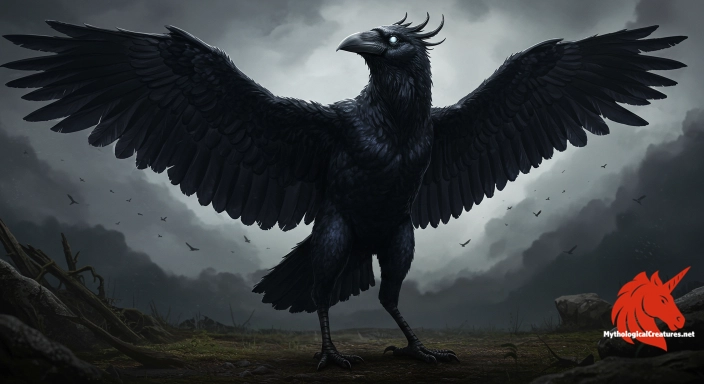
Dare to Meet the Badb....
The Mythological Creatures Book Series
Yokai, Greek, Norse, Egyptian & Chinese. Five illustrated field guides to the creatures the old stories either warned or told you about.



Curated by the Mythological Creatures Team
Series editor: Mythological Creatures Directory
Primary desk: Hellenic & Ancient Mediterranean Desk
(rev. November 2025)