
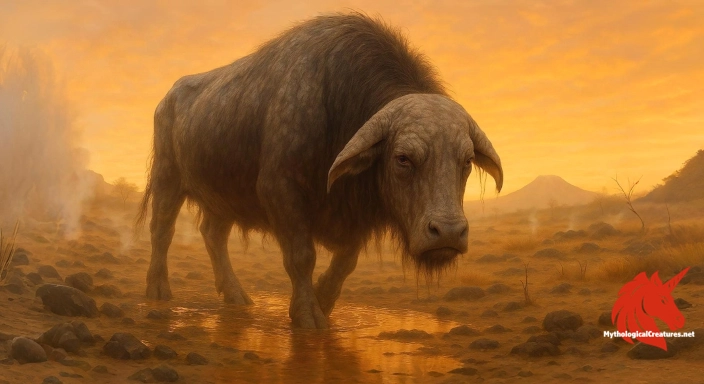
Catoblepas: The Catoblepas is a legendary creature from Aethiopia resembling a cape buffalo with a hog-like head.
Catoblepas
Catoblepas - Represents the ancient human attempt to explain and mythologise dangerous natural phenomena.
the legend in five swipes.
the legend in five swipes.
Who first told stories about the Catoblepas?
The catoblepas is a creature imbued with mystery and steeped in ancient lore, captivating the imagination of those who seek the wonders of myth. Believed to have originated in the remote regions of Aethiopia, its first attestation can be traced back to classical accounts that blend observation with imaginative embellishment. Early records identify the beast through its odd and disconcerting trait—a head that is habitually bent downward because of its daunting weight. Classical authors, including Pliny the Elder and Claudius Aelianus, provided the foundational descriptions that have continued to influence its portrayals. Over the years, the creature has become emblematic of the delicate interplay between natural curiosity and the supernatural unknown. Its narrative occupies a unique space where the boundaries of fact and fantasy blur. The cultural context of its inception reflects an era that sought to understand unfamiliar and exotic elements in the natural world. Through centuries of reinterpretation, the catoblepas has evolved into a symbol of enigmatic power and timeless fascination.
Where can you read about the Catoblepas?
Ancient literature forms the cornerstone of our understanding of the catoblepas, with early texts laying down a legacy that still echoes today. The earliest recorded mentions appear in the works of Pliny the Elder, whose keen observations intermingled the real with the mythical. Later narrative additions by Claudius Aelianus contributed further layers to the story, enriching the creature’s mystique. Despite the brevity of these classical accounts, they have spawned a variety of subsequent legends and interpretations. Over time, the original descriptions have been diversified by medieval manuscripts and folklore, each variant adding subtle modifications to its defining traits. The lethal gaze and potentially fatal presence have inspired storytellers to weave cautionary tales and allegorical myths. Oral traditions have also played a significant role, ensuring that the creature’s dangerous allure is passed from one generation to another. Modern interpretations continue to draw on these ancient texts, reimagining the catoblepas for contemporary audiences while preserving its storied past.
How powerful did people believe the Catoblepas to be?
Artistic renditions and literary descriptions of the catoblepas are marked by a fusion of naturalistic detail with fantastical embellishment. It is often depicted as possessing the robust, formidable body of a cape buffalo, unmistakably hinting at raw strength and a daunting presence. One of its most striking physical characteristics is a head burdened with extraordinary weight, forcing it to hang in a perpetual downward incline. In several accounts, the creature is shown bearing the head of a hog, which adds an unsettling nuance to its overall appearance. These depictions are underscored by a sense of disproportion, where robust physical form meets an almost comic, yet dangerous, imbalance. Variations in its portrayal—regarding size, skin texture, and colouration—further underscore the myth’s adaptability to different cultural standards of the grotesque. Many visual interpretations also emphasize its lethal potential, hinting subtly at its deadly gaze and toxic breath. In every retelling, the physical form of the catoblepas remains a blend of the familiar and the fantastic, embodying the mystery that has made it a perennial figure in myth.
Which communities kept the Catoblepas tradition alive?
Interpretations of the catoblepas vary markedly across different regions, reflecting both local wildlife and cultural predilections. Within its purported homeland of Aethiopia, the beast is often seen as an emblem of the wild and the untamed, its exotic nature drawing on the landscape’s inherent majesty and peril. In neighbouring cultures, the creature’s attributes have merged with local fauna, occasionally resulting in comparisons to animals such as the buffalo and the wildebeest. Some regions place greater emphasis on its perilous gaze while others highlight the metaphor of its heavy, bowed head as a symbol of inevitable doom. Such regionally tailored descriptions have allowed the myth to flourish in diverse storytelling traditions. Local adaptations have enriched the creature’s narrative, incorporating unique symbolic meanings that resonate with indigenous environmental and social narratives. This adaptability across regions demonstrates the enduring power of myth to absorb and reflect local identities. Ultimately, the catoblepas serves as a testament to the creative interplay between ancient descriptions and regional reinterpretations, illustrating how legends evolve with cultural exchange.
Catoblepas: Counterparts Around the World
The catoblepas occupies an intriguing position when compared with other legendary creatures across the mythological spectrum. Its lethal attributes, particularly the capacity to inflict petrification, invite comparisons with myths surrounding the basilisk and other creatures whose mere presence spells danger. Parallels can also be drawn with figures like the Gorgon, where a gaze capable of turning onlookers to stone becomes a central, fear-inducing theme. Such similarities highlight a recurring motif in mythologies that intertwine the boundaries between life and death. Moreover, its hybrid appearance—a mix of both familiar and uncanny animal characteristics—is a hallmark it shares with numerous legendary chimera-like beings. This cross-cultural tapestry of ideas underscores how different societies have utilised fantastical animals as metaphors for broader existential anxieties. By bridging the gap between the natural world and myth, the catoblepas reinforces universal themes of transformation and mortality. Its mythological kinship with other fearsome entities further accentuates its role as a cultural symbol of nature’s enigmatic power.
Catoblepas: Modern Retellings and Reinventions
The catoblepas has journeyed far from its early classical mentions to become an enduring icon in modern myth and popular culture. Over centuries, its narrative has morphed from a roughly sketched beast in ancient texts to a richly detailed symbol explored in medieval bestiaries and contemporary fantasy media. The evolution of its depiction—from cautionary emblem to a character reimagined in literature and visual art—demonstrates the fluid nature of myth-making. Modern adaptations often highlight its dangerous allure, repurposing its legendary qualities to suit new creative and symbolic contexts. In today's media, the creature appears in novels, games, and artwork, where its ominous presence continues to evoke both fear and wonder. Its persistent allure lies in the balance between the realistic and the fantastical, making it an ideal subject for narratives that explore the unknown. The reimagined catoblepas serves as a reminder that ancient myths are not static relics but living stories that evolve with time. Thus, its legacy endures as a bridge between our past imaginings and future creative explorations.
Interesting Fact
Some scholars believe that the myth of the Catoblepas may have originated from exaggerated accounts of wildebeest or other large African animals.
Mythological Treasures
Greek Myths: A field guide to the monsters of ancient Greece
Every monster here earned its place in legend, and each gets a full page of artwork and the story behind it.
Chinese Beasts: A field guide to the dragons and demon kings of Chinese myth
From river dragons to demon kings, with the legends that shaped five thousand years of storytelling.
Japanese Yokai: A field guide to the spirits and demons of Japanese folklore
Fifteen spirits, with the signs to watch for and what the old tales say to do if you meet one.
the legend in five swipes.
Partner with us
Sponsor this space
Reach thousands of mythology enthusiasts with a curated placement on our creature pages.
Learn about sponsorshipQuick Creature Info
Origin:
Features:
Associations:
Our Mythic Legendary Rating:

Also Sometimes Known As:
Habitat:
Supernatural Powers:
Physical Attributes:
Abilities:
Behavior:
Weaknesses:
Lore:
Related Creatures, Tales or Lore
- BBasilisk
- CCockatrice
- GGorgon
References
Discover Another Mythical Legend You May Not Have Heard Of?
Uncover the mysteries of ancient folklore and expand your knowledge of legendary beings from cultures around the world.
Dare to Meet the Bolina....

The Mythological Creatures Book Series
Yokai, Greek, Norse, Egyptian & Chinese. Five illustrated field guides to the creatures the old stories either warned or told you about.
Curated by the Mythological Creatures Team
Series editor: Mythological Creatures Directory
Primary desk: Hellenic & Ancient Mediterranean Desk
(rev. November 2025)