
Cù-sìth: The cù-sèch is a mythical hound from Irish and Scottish folklore.
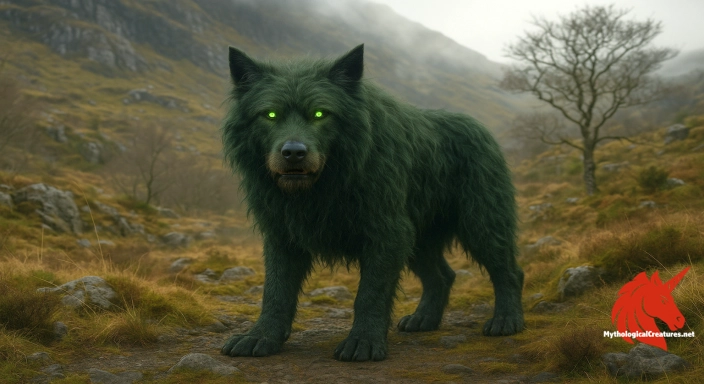
Cù-sìth
Cù-sìth - The cù-sèch serves as a portent warning, its three terrifying barks signalling imminent mortal danger.
Origins & First Encounters
The cù-sêche is a mysterious spectral hound that has captured the imagination of Gaelic-speaking cultures for centuries.
Its origins lie deep within the mists of early Celtic folklore, where oral traditions wove tales of otherworldly creatures prowling the wild landscapes of Ireland and Scotland.
Historical references to the creature are scarce, with its first attested mentions emerging from fragmented medieval narratives and local bardic recitations.
The creature appears to have been conceived as a symbol of the liminal spaces between the known and the supernatural, integrating natural elements with the mysticism of the Otherworld.
Its presence is intimately linked with the rugged moorlands and craggy highland clefts, environments that themselves exude a sense of ancient mystery.
Over time, the cù-sêche has evolved from a purely ominous harbinger into a multifaceted emblem of both dread and the untamed spirit of nature.
Cultural memory in Gaelic regions has preserved the legend through generations, often embedding the creature within local rites and superstitions.
Its narrative resonates with themes of impending fate and serves as a stark reminder of the delicate balance between civilisation and the wild.
Source Texts & Tale Variants
Ancient manuscripts and the oral traditions of Gaelic peoples provide the primary sources for the legend of the cù-sêche.
Though rarely detailed in extensive texts, the hound makes intermittent appearances in traditional ballads, folktales, and local lore recorded by early ethnographers.
Early scribes often mentioned the creature in passing alongside other mythic beings, suggesting that its notorious reputation was long established.
Local storytellers recounted variant narratives that sometimes portrayed the hound as a spectral guardian of the wild, while in other accounts it appeared as an omen of death.
A notable variant is found in the parallel tradition of the Welsh Cŵn Annwn, which hints at a broader Celtic motif surrounding supernatural hounds.
In some regions, the hound’s lethal three barks have been incorporated into modern retellings, reinforcing its status as an imminent warning of misfortune.
Collectively, these sources illustrate a tradition of storytelling that prized brevity and ritualised symbolism over extensive narrative detail.
The sparse textual evidence is complemented by richly embroidered oral accounts that continue to evolve with each retelling.
Form & Powers
The physical depiction of the cù-sêche is both striking and unusual, characterised primarily by its shaggy, dark green coat that evokes the deep hues of ancient woodland and rugged highland terrain.
It is described as being unusually large, roughly the size of a small cow, which lends it an imposing stature among other mythical beasts.
Observers of the creature have recounted an almost spectral luminescence in its eyes that hints at an otherworldly vitality.
The creature’s body, robust yet agile, suggests a design adapted to rapid movement across uneven moorlands and rocky crevices.
Its fur, tangled and unkempt, contributes to an overall visage that is both formidable and eerie.
Interestingly, the creature is reputed to move with a silence that belies its size, making its sudden, threefold bark all the more startling.
There is a near-tactile quality to the detailed descriptions in local lore, with some accounts noting that the hound’s form seems to merge harmoniously with the natural landscape.
Variations in size and appearance are noted across different traditions, with subtle distinctions reflecting local environmental and cultural influences.
Regional Faces
Across the Gaelic-speaking regions, the depiction of the cù-sêche exhibits notable variations that reflect the diverse cultural landscapes of Ireland and Scotland.
In Scottish lore, the hound is often regarded as a solitary sentinel of the remote highland moors, with its home in the rugged clefts of ancient rock formations.
Conversely, Irish accounts sometimes imbue the creature with a dual nature, intermingling its roles as both a harbinger of peril and an enigmatic guardian of sacred groves.
Local adaptations of the myth can be seen in the differing colourations of its coat and subtle variations in its size, with some communities describing it as even more formidable than its Scottish counterpart.
The auditory phenomenon of its three distinctive barks is a recurring motif, though regional narratives adjust the distance over which its call may be heard.
Every locale adapts the creature to its own environmental context, with the dark moors of the Highlands providing a stark backdrop to the hound’s legend.
The creature’s habitat is often portrayed as a liminal space, reflecting regional beliefs in the thin boundary between the world of the living and the supernatural.
This regional diversity enriches the myth, ensuring that the cù-sêche remains a versatile symbol within various cultural and geographical settings.
Cultural Parallels
The cù-sêche stands shoulder to shoulder with other spectral hounds found in Celtic and broader European folklore, most notably with the Welsh Cŵn Annwn.
This striking similarity underscores shared mythological themes of death and the supernatural that pervade Celtic tradition.
Other legendary dogs, such as the English Black Shuck, mirror the cù-sêche in their role as ominous sentinels of an impending fate.
These creatures are typically portrayed as liminal figures, whose otherworldly presence signals transitions between life and death.
A comparative study reveals that many of these spectral hounds share a common motif: the ability to move silently and, when vocalised, to deliver a final, fatal warning.
The number three, as encapsulated in the hound’s trio of barks, recurs in multiple mythic contexts, symbolising both perfection and the inevitability of destiny.
Additionally, the spectral hound archetype is prevalent in various Indo-European traditions, hinting at a possible ancient origin for these mythic narratives.
This cross-cultural examination highlights a universal human fascination with the boundary between the mortal realm and the supernatural.
Legacy & Modern Evolution
Over the centuries, the portrayal of the cù-sêche has undergone notable evolution, reflecting shifting cultural attitudes towards myth and the supernatural.
The creature’s classical depiction as a fearsome omen has been reinterpreted in contemporary literature and visual arts, where it often symbolises nature’s untamable and mysterious spirit.
Modern interpretations have infused the hound with new layers of meaning, transforming it into a complex metaphor for the interface between life and death.
Recent retellings in popular media and fantasy genres frequently balance its role as an omen of doom with an appreciation of its intrinsic, wild beauty.
In academic and cultural circles, the cù-sêche has become a subject of renewed interest, prompting discussions on the enduring nature of folklore and its adaptability to modern contexts.
The creature has found a niche in the imaginative realms of gothic fiction and art, often portrayed as both a warning and a guardian of wild, untamed lands.
Contemporary Gaelic revival movements have also embraced the legend, reimagining the creature as a symbol of cultural heritage and resilience.
Its transformation from a fearsome supernatural entity to an icon of moorland mystique underscores the dynamic interplay between tradition and modernity.
Interesting Fact
An intriguing aspect of the cù-sèch is its fixed pattern of three barks, a feature that uniquely distinguishes it from other spectral hounds in folklore.
For serious myth projects
Feature your work alongside the legends
From academic works to story-rich games, we highlight projects that respect world mythologies. Talk to us about a measured, long-term placement.
Start a conversationQuick Creature Info
Features:
Associations:
Our Mythic Legendary Rating:

Also Sometimes Known As:
Habitat:
Supernatural Powers:
Physical Attributes:
Abilities:
Behavior:
Lore:
Related Creatures, Tales or Lore
- CCŵn Annwn
- BBlack Shuck
- BBarghest
References
Discover Another Mythical Legend You May Not Have Heard Of?
Uncover the mysteries of ancient folklore and expand your knowledge of legendary beings from cultures around the world.
Dare to Meet the Dungavenhooter....
Curated by the Mythological Creatures Team
Series editor: Mythological Creatures Directory
Primary desk: Northern & European Folklore Desk
(rev. November 2025)