
Despoina: Despoina is a mysterious Greek goddess revered in the Eleusinian Mysteries.
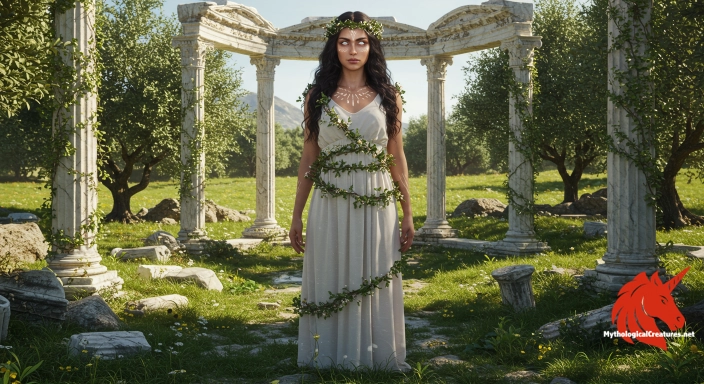
Despoina
Despoina - Despoina embodied the hidden, ineffable aspects of the divine and was integral to the secret rites honoring Demeter in Eleusis.
Origins & First Encounters
Despoina emerges from the fabric of ancient Greek mystery as a goddess whose identity remains cloaked in secrecy and reverence. Born of Demeter and Poseidon, she is celebrated under the title ‘the Mistress’, a designation that hints at both authority and the untold secrets of her true nature. Her cult was at the heart of the Eleusinian Mysteries, where initiates were granted glimpses into sacred truths while the goddess’s genuine name was kept hidden. The intriguing duality of her origin – intertwined with both the nurturing aspects of the earth and the tempestuous forces of the sea – positions her as a symbol of balance between creation and mystery. A subtle interplay exists between her persona and that of her better-known sibling, Persephone, highlighting themes of concealment and revelation. Ancient worshippers regarded her not only as a daughter of the great earth goddess but also as a divine intermediary in the cycle of life and death. This enigma, preserved through secret rituals, invited deep reflection on the transient nature of worldly knowledge versus divine mystery. Over generations, the aura of Despoina has intrigued historians and devotees alike, making her both a cultural emblem and a subject of perpetual scholarly inquiry. Her legacy, woven into the rituals of ancient mystery cults, continues to evoke the timeless interplay between the known and the hidden realms.
Source Texts & Tale Variants
Early accounts of Despoina are preserved in the vivid descriptions of ancient travellers, with Pausanias offering insights into the complex tapestry of her myth. Written during the second century A.D., his narratives provide one of the few windows into the secretive rites of the Eleusinian cult, where her true name was reserved solely for the initiated. Various fragments from ancient texts and inscriptions further contribute to the composite picture of her character, weaving together poetic allusions and ritualistic details. Diverse story variants illustrate her remarkable birth, which involved the transformation of Demeter and the intervention of Poseidon in a dramatic interplay between human and divine forms. Other narrative strands, emerging from oral traditions and local lore, embellish her persona with regional attributes that underscore her elusive nature. The multiplicity of sources, though fragmentary, underscores the deliberate mystery surrounding her identity and functions. Over time, these narratives have converged to form a mythic archetype that remains as enigmatic as the goddess herself. Some accounts hint at symbolic representations in secret ceremonies, while others emphasise the transformative power of her concealed essence. Thus, the surviving literary and archaeological fragments collectively attest to a goddess whose mystery was integral to her cult and enduring influence.
Form & Powers
The physical depictions of Despoina are as elusive as her hidden name, often confined to subtle and symbolic renditions rather than explicit portrayals. In the scarce visual artefacts, she is alluded to through graceful lines and veiled features that suggest a calm yet commanding presence. Her imagery is seldom detailed, as the mystery surrounding her identity necessitated a visual language rich in metaphor and symbolism. Some ancient representations incorporate elements of fertility such as abundant flora or grain, hinting at her connection to Demeter and the bounties of the earth. The limited iconography available points to a visage that balances softness with an inscrutable solemnity, reflective of her dual origin. In certain depictions, the goddess appears in close association with figures of maternal authority, yet always marked by an inherent otherness that sets her apart. There is evidence that artisans employed shadow and light to evoke the dichotomy between revelation and concealment in her form. The variations that do exist in regional art suggest a flexible interpretation of her attributes, which changed subtly over time. Ultimately, the art dedicated to Despoina is not a literal image but a symbolic portrayal that captures the essence of a divine enigma.
Regional Faces
While the heart of Despoina’s worship lay in Eleusis, her presence radiated into various corners of the ancient Greek world with intriguing regional nuances. In some communities, her secretive identity was blended with local agricultural rites, thereby emphasising her role as a guardian of fertility and seasonal renewal. Other regions adapted her myth to incorporate elements of the underworld, enhancing her mystique through associations with cycles of rebirth and transformation. In these locales, the goddess was sometimes depicted as a bridge between earthly abundance and the hidden realms beneath. Local artistic traditions further modified her iconography by incorporating regional symbols, ranging from earthen motifs to subtle hints of marine influence. The consistent element across these adaptations was the deliberate concealment of her true name, which maintained a sacred aura regardless of local variation. Despite the diverse interpretations, the underlying theme of duality—linking visible fertility with hidden spiritual power—remained constant. The regional variants not only highlight the flexibility of her myth but also illustrate how local communities could infuse a common deity with unique cultural life. This diversity of representation testifies to the dynamic interplay between pan-Hellenic religious practice and localized ritual innovation.
Cultural Parallels
Despoina’s secretive character finds parallels in a number of other goddesses whose identities are veiled by mystery and ritual. Her deliberate obscurity recalls figures like Isis, whose hidden truths also beckon the initiated in complex ceremonial traditions. In many ways, her myth harmonises with the dualistic portrayals of fertility and darkness found in other ancient mythologies, suggesting a universal motif in the portrayal of female divinity. The concealed nature of her identity resonates with broader themes where knowledge is both a blessing and a burden, similar to the enigmatic figures in the Orphic and mystery traditions. There are echoes of her narrative in Eastern goddesses, whose ambiguous and multifaceted roles blur the boundaries between nurturer and formidable force. Even within the Greek pantheon, her contrast with the more publicly recognised Persephone underscores a tension between the obvious and the occult. By comparing her with deities revered in secret rites across diverse cultures, one notices a recurring emphasis on hidden wisdom and transformative power. Such cross-cultural connections highlight that the mystique of a veiled identity served to elevate a deity’s authority and allure. Ultimately, Despoina stands as a compelling example of how secretive divine figures continue to capture the imagination across time and tradition.
Legacy & Modern Evolution
Over the centuries, the cult of Despoina has faded from public worship, yet her enigmatic legacy endures through the study of ancient mysteries and reinterpretations in modern art. The decline of the Eleusinian Mysteries meant that much of the secret knowledge surrounding her was lost, yet scholars and enthusiasts continue to probe the depths of her myth. Modern interpretations often cast her as a symbol of hidden power and the eternal interplay between visible reality and concealed truths. Artists and writers have found in her a muse for exploring themes of inner mystery, transformation, and the duality of human nature. Contemporary depictions sometimes reframe her narrative to align with modern sensibilities, connecting ancient rites to current explorations of spirituality and the feminine divine. Discussions in philosophical and mythological circles frequently invoke her archetype as a reminder of the limits of human understanding. Her story, though shrouded by the mists of antiquity, inspires a critical re-examination of the relationship between ritual secrecy and the construction of identity. The symbol of a goddess whose true name was forever hidden continues to fascinate and provoke debate. In this way, Despoina serves as a bridge between the ancient world and modern interpretations of divine mystery and power. Her enduring legacy invites us to consider how hidden aspects of history and spirituality can remain powerfully relevant.
Interesting Fact
It is particularly intriguing that, unlike many deities, Despoina’s true name was never disclosed, preserving an eternal enigma that continues to captivate scholars and mystics alike.
For myth educators and toolmakers
Built a resource for mythology learners?
If you offer courses, teaching tools, or research platforms focused on myth and folklore, consider a discrete placement on our reference pages.
Introduce your resourceQuick Creature Info
Origin:
Our Mythic Legendary Rating:

Also Sometimes Known As:
Habitat:
Supernatural Powers:
Lore:
Related Creatures, Tales or Lore
- PPersephone
- HHecate
- CCybele
References
Discover Another Mythical Legend You May Not Have Heard Of?
Uncover the mysteries of ancient folklore and expand your knowledge of legendary beings from cultures around the world.
Dare to Meet the Býleistr....

Curated by the Mythological Creatures Team
Series editor: Mythological Creatures Directory
Primary desk: Hellenic & Ancient Mediterranean Desk
(rev. November 2025)