
Fachan: Fachan is a grotesque monster from Scottish folklore, notable for its singular anatomical traits such as one eye, one hand, and one leg.

Fachan
Fachan - Represents the fusion of giant and dwarf traditions in Gaelic mythology, highlighting monstrous deformity and supernatural curse abilities.
the legend in five swipes.
the legend in five swipes.
Where in the world does the Fachan come from?
The fachan stands as an extraordinary figure in the rugged tapestry of Scottish folklore, distinguished by its singular anatomical features and mythic charm. Originating from the Gaelic traditions of the West Highlands, this peculiar being was first brought to attention through detailed oral accounts that were later committed to writing by early folklorists. Its early attestations appear in the works of chroniclers like John Francis Campbell, whose vivid descriptions have ensured the creature’s enduring presence in myth. Believed to be linked to ancient tales of giants and other monstrous figures, the fachan embodies the mysterious interplay between human imagination and the natural world. Local storytellers recounted its exploits amid the shadowy glens and wild moorlands, weaving a narrative that was both cautionary and infused with wonder. The creature’s odd and fragmented form prompted listeners to see in it a symbol of nature’s capricious creativity as well as a manifestation of supernatural forces. Its legend illustrates how myth can capture aspects of human imperfection and cosmic uncertainty, imbuing the creature with an ambiguous moral and symbolic presence. The fachan has long served as a bridge between what is known and the ineffable, its tale resonating with an audience that spans generations. Ultimately, this being exemplifies the way folklore transforms ordinary narrative elements into extraordinary and enduring myth.
Which books and scrolls describe the Fachan?
The primary narratives surrounding the fachan are preserved in a select number of influential folk collections that capture its myriad features with striking detail. John Francis Campbell’s Popular Tales of the West Highlands provides one of the earliest systematic characterisations, presenting the creature as a singular entity with a one-eyed gaze and a fragmented body. Douglas Hyde’s Beside the Fire extends this picture by citing an Irish manuscript that enriches the account with added elements such as enchanted weaponry and mystical ornaments. Several variations of its story have been transmitted through oral tradition, each emphasising different aspects of its disjointed anatomy and ominous presence. In some accounts, the fachan wields a thick iron flail-club, with chains and a sequence of enchanted apples that only enhance its menacing allure. These diverse descriptions indicate that the creature emerged from a common Gaelic tradition, molded over time by regional storytellers. The interplay between the oral sources and their later literary renditions has produced a multifaceted image of the fachan, rich in symbolic complexity. Each recorded version contributes to a layered understanding of the creature, balancing physical oddities with elements of supernatural dread. This tapestry of sources illustrates how the narrative of the fachan evolved in tandem with the culture that nurtured its legend.
Did the Fachan have any weaknesses?
The physical form of the fachan defies conventional anatomy, marked foremost by a single, central eye that radiates an almost eerie intensity. Its head is crowned by a lone tuft of hair, so infamously stubborn that tradition suggests bending it would be an impossible feat. Intriguingly, the creature possesses no ordinary pair of arms; instead, a solitary, hairy hand protrudes from its chest, emphasising its otherworldly condition. A single leg, emerging from the centre of its torso, supports this asymmetrical figure in a manner that defies both biology and balance. The countenance of the fachan is often described in sombre tones, its single eye and blackened facial features contributing to a visage more demonic than human. In detailed accounts, the creature is also portrayed as wearing a close-fitting, dark blue mantle made of twisted, hard feathers that serve as an eerie protective shroud. Every aspect of its anatomy, from the iron-like weaponry it sometimes wields to the simplicity of its bodily structure, reinforces the sense of abnormality and mystery. The composite image of the fachan—a creature both physically malformed and imbued with inexplicable power—continues to captivate those who study its lore. This singular configuration of features invites speculation about the symbolic meaning behind its disjointed design, echoing themes of incompleteness and supernatural intervention.
Where is the legend of the Fachan strongest?
The fachan’s myth is rooted deeply in the Scottish Highlands, yet its narrative finds echoes in Irish folklore, where variations on its form and function add rich layers to its legend. In Scotland, the creature is alternatively termed Direach Ghlinn Eitidh or Dithreach, names which invoke the specific locality of Glen Etive and embed the creature within its rugged terrain. Irish folk narratives, while retaining the essential characteristics of the fachan, often embellish its features with additional mystical attributes that align with local supernatural traditions. These regional adaptations highlight subtle shifts in emphasis, where aspects such as enchanted weaponry or elaborate feathered mantles might be accentuated to suit local tastes. In some areas, the fachan is portrayed as a hulking giant, reinforcing a connection to broader Gaelic tales of formidable beings. Other accounts present the creature as a spectral anomaly, reflecting the enduring power of folklore to morph and adapt to its environmental context. Local retellings often mix elements of fear with a wry sense of humour, underscoring the multifaceted nature of its legend. The adaptations found in different regions illustrate how the core myth of the fachan was interwoven with the distinctive cultural and natural landscapes of the British Isles. Through these regional variations, the creature remains a dynamic symbol that is at once uniquely local and resonant with shared mythic themes.
Which other cultures tell a story like that of the Fachan?
The unusual characteristics of the fachan find intriguing parallels with mythological figures from cultures across the world, each echoing themes of asymmetry and partial existence. The single eye of the fachan, for instance, brings to mind the cyclopes of Greek mythology, whose one-eyed presence symbolised both raw power and alternative perception. Similarly, descriptions of creatures such as the Arabic nesnas and shikk—beings noted for their incomplete, half-formed structure—highlight cross-cultural fascinations with the fractured and the uncanny. Across different traditions, such beings are often imbued with a duality that allows them to be seen as both cautionary figures and as embodiments of otherworldly power. The fachan, with its combination of unique physical attributes and symbolic armour, mirrors these themes, suggesting that the partial or the fragmented carries its own kind of completeness. Examining these parallels illuminates how diverse cultures have sought to explain the inexplicable through the creation of creatures that break from the norm. The recurring motif of a being positioned on the margins of wholeness reflects a shared human preoccupation with the nature of existence and the mysteries that lie beyond conventional form. This cross-cultural dialogue enhances our appreciation of the fachan, situating it within a broader tapestry of myth that celebrates both the beauty and the strangeness of the monstrous.
What does the Fachan mean to people today?
Over time, the fachan has transitioned from a fearsome spectre of ancient oral tradition into a captivating icon within modern myth and fantasy literature. Early chroniclers depicted the creature as a stark embodiment of nature’s unpredictable power, a warning and a marvel rolled into one terrifying figure. With the evolution of storytelling, the fachan’s image has shifted, transforming into a symbol that bridges the gap between archaic superstition and contemporary creativity. Modern reinterpretations often blend its classical features with innovative narrative twists, rendering it as both an object of dread and a source of fascination for enthusiasts of the supernatural. This transformation is evident in various media, where the fachan’s bizarre single eye, hand, and leg have inspired artists and writers to explore themes of imperfection and fragmented identity. The creature’s distinctive form has also prompted a re-evaluation of ancient myth, prompting discussions about the relationship between folklore, culture, and modern fantasy. In the modern era, the fachan frequently appears as a character in graphic novels, fantasy films, and role-playing games, each representation paying homage to its storied past while reimagining its legacy for new audiences. This enduring legacy reflects a wider cultural shift that embraces the mix of fear and wonder inherent in ancient myths, allowing them to be reinterpreted in diverse and imaginative ways. Today, the fachan stands not only as a relic of historical superstition but also as a dynamic symbol whose myth continues to evolve and inspire across generations.
Interesting Fact
Interestingly, the name 'fachan' may be a diminutive of 'fathach' (giant), and its alternative name 'Dithreach' (dwarf of Glen Etive) illustrates the fluid and contradictory ways Gaelic folklore classifies monstrous beings.
Mythological Treasures
Norse Sagas: A field guide to the beasts of the Viking world
Drawn from the saga accounts themselves, with the powers, weaknesses and doom of each being set out.
Egyptian Legends: A field guide to the gods and monsters of ancient Egypt
Guardians of the living and devourers of the dead, with the role each played in judgement.
Chinese Beasts: A field guide to the dragons and demon kings of Chinese myth
From river dragons to demon kings, with the legends that shaped five thousand years of storytelling.
the legend in five swipes.
Reach myth fans
Connect your myth-driven brand with this audience
Our readers are writers, educators, gamers, and collectors who care about mythology. Enquire about a limited sponsor placement on creature pages.
Enquire about sponsorshipQuick Creature Info
Features:
Our Mythic Legendary Rating:

Also Sometimes Known As:
Habitat:
Supernatural Powers:
Physical Attributes:
Abilities:
Behavior:
Lore:
Related Creatures, Tales or Lore
- NNesnas
- SShikk
- CCyclops
References
Discover Another Mythical Legend You May Not Have Heard Of?
Uncover the mysteries of ancient folklore and expand your knowledge of legendary beings from cultures around the world.
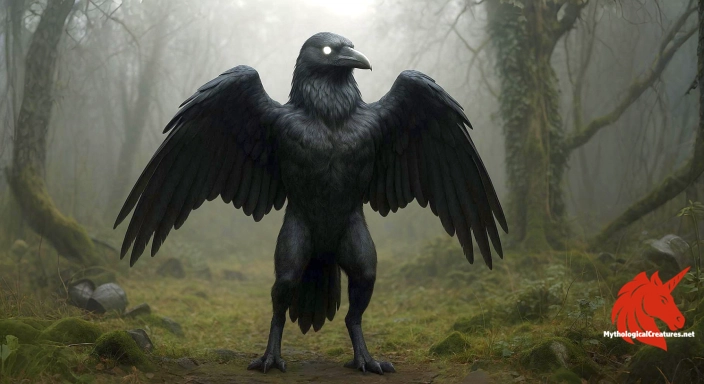
Dare to Meet the Valravn....
The Mythological Creatures Book Series
Yokai, Greek, Norse, Egyptian & Chinese. Five illustrated field guides to the creatures the old stories either warned or told you about.
Curated by the Mythological Creatures Team
Series editor: Mythological Creatures Directory
Primary desk: Northern & European Folklore Desk
(rev. November 2025)