
Fames: Fames is the Roman personification of hunger and a malevolent force.
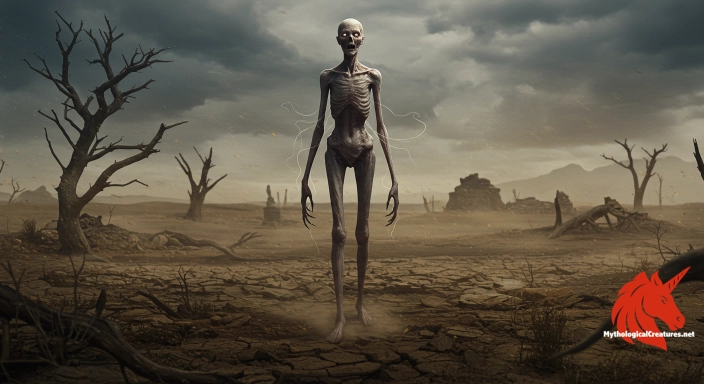
Fames
Fames - Represents the destructive power of hunger and acts as a divine warning against neglecting the balance of sustenance.
the legend in five swipes.
the legend in five swipes.
The Earliest Known Accounts of Fames
Fames emerges from the Roman mythological landscape as a striking embodiment of hunger, a force that transcends mere appetite to become a tangible, punitive presence. Born from ancient beliefs that revered and feared the caprices of survival, she first appears in literary texts where the precarious balance of life and nourishment is a common theme. Her very existence symbolises the fear of insatiable need, a dark mirror reflecting the consequences of excess and neglect alike. Myth and legend intertwine in her narrative, associating her with the shadowy fringes of the Underworld where mortal destinies are sealed. She is often portrayed as an inevitable harbinger of doom, destined to afflict those who stray too far from moderation. The classical depictions portray her as both a tormentor and an unintentional teacher, warning mortals of the destructive power of unbridled desire. The enduring cultural context of Fames illuminates her as a personification of nature’s harsh retribution, resonating with societies that have long battled the spectre of famine. In art and literature, her image has evolved from that of a simple deity to a complex allegory for existential and societal deprivation. Her myth challenges us to consider the dual-edged nature of hunger, both as a physical need and as a moral failing. Ultimately, Fames occupies a unique place in Roman mythology, synthesising elements of punishment, natural law, and the inexorable march of fate.
Fames in the Historical Record
Ancient literary sources provide the backbone of Fames’ myth, with Ovid’s Metamorphoses offering one of the earliest and most vivid portrayals of her relentless character. In this and other texts, her activity in the barren regions of Scythia illustrates a landscape defined by perpetual deprivation. Servius, in his commentaries, elevates her status by referring to her as the greatest of the Furies, further cementing her role as an agent of divine retribution. Various versions of her story reveal a creature who is both feared and invoked during times of duress, highlighting the ancient understanding of hunger as a supernatural affliction. Other fragmented traditions from Rome suggest that Fames not only personified hunger but also served as an omen of impending societal collapse. Some less widely known variants recast her influence in the context of agricultural rites, where appeasing her might avert the scourge of famine. The interplay between literary texts and localized oral traditions has enriched her character, allowing multiple narratives to flourish across different regions. Additionally, the similarity of her role to that of the Greek Limos underscores a cultural dialogue between Rome and Greece on the nature of deprivation. Each retelling serves to deepen the layers of interpretation surrounding her, offering varied perspectives on the intrinsic fear of starvation. Through these sources, Fames continues to be a subject of both awe and caution across the ages.
The Described Form of Fames
Artistic interpretations of Fames often render her as a spectral figure whose appearance is as haunting as the hunger she embodies. Her form is typically described with gaunt, sallow features that evoke the stark imagery of starvation and despair. In many portrayals, she is draped in tattered robes, the fabric of which seems to flutter with the breath of lost vitality. Emaciated limbs, protruding cheekbones, and hollow eyes are recurrent motifs that symbolise the depth of her insatiable emptiness. The stark chiaroscuro of her depictions—a dance between light and shadow—mirrors the duality of desire and denial. Some images present her as a shifting, almost intangible shape, reflecting the elusive nature of hunger that can neither be fully seen nor satisfied. Her overall countenance is one of both ruthlessness and melancholy, capturing the paradox of a force that punishes while also evoking a tragic sense of longing. The visual metaphor inherent in her skeletal appearance speaks to the human condition when stripped of sustenance. Across various icons and reliefs, delicate details such as elongated fingers and a desperate posture accentuate her role as the relentless quest for nourishment. Ultimately, the physical portrayal of Fames is imbued with a raw, unsettling beauty that encapsulates her ominous presence.
Which communities kept the Fames tradition alive?
Cultural adaptations of Fames reveal fascinating variations that reflect the diverse social and environmental landscapes of the ancient world. In the core regions of Rome, she was primarily seen as an inevitable force of punishment, where her presence was interwoven with the moral fabric of societal norms. In contrast, fragments of tradition in the Greek world paint a parallel picture in the form of Limos, highlighting subtle differences in the treatment of hunger as both a natural and divine phenomenon. The desolate Scythian setting, as described in some texts, imbues her with an almost barbaric quality, resonating with the realities of regions marked by harsh climates and scarcity. Localised myths within the broader Roman Empire sometimes attributed to her a dual role, embodying both the dread of famine and the mystique of the unknown wilds. In certain provinces, she became a character in folk cautions—a spectral reminder of nature’s mercy and malice. The environmental conditions of these regions often coloured the narratives, emphasising either the ferocity or the pity evoked by her unending hunger. Consequently, the myth of Fames has been adapted to reflect regional agricultural cycles, social fears, and the inherent unpredictability of food supply. Such variations underscore the capacity of local cultures to reinterpret a universal concept like hunger in markedly distinct ways. Her multifaceted regional identity thus serves as a testament to the adaptability of myth in addressing local realities.
Which figures are similar to Fames?
The myth of Fames shares a resonance with several hunger deities across different cultures, creating an intricate web of mythological parallels. In Greek mythology, her equivalent Limos occupies a similar narrative space, underscoring a shared cultural anxiety about famine and starvation. Both figures symbolise the destructive potential of insatiability, serving as stark reminders of the balance between natural bounty and deprivation. This recurring theme can be traced across various traditions, where the personification of hunger often comes paired with notions of divine punishment and inevitable retribution. Cultures far beyond the Greco-Roman sphere have conceived their own versions of hunger deities, reflecting a universal preoccupation with the unpredictable forces of nature. In these stories, the physical manifestations of hunger often blur the boundary between the corporeal and the supernatural. Moreover, Fames and her counterparts are used as metaphors for broader societal issues, such as economic disparity and the vulnerability of social structures in the face of environmental calamity. These mythological figures invite a comparative analysis that highlights the interplay between material need, moral responsibility, and cosmic order. In examining these cultural parallels, one finds that the personification of hunger is not confined to one tradition but emerges as a common narrative device used to articulate human anxieties. The widespread recurrence of such figures testifies to the enduring impact of hunger as a profound existential theme.
Why is Fames still popular?
The evolution of Fames over the centuries reveals a significant transformation from a stark mythological force to a symbol laden with multifaceted meanings in modern discourse. Early classical texts depict her as a terrifying arbiter of punishment, leaving an indelible mark on the moral imagination of ancient societies. As time progressed, her image softened in certain narratives, evolving into a metaphor for the cyclical nature of economic and social deprivation. In medieval and renaissance literature, Fames was often invoked as a personification of societal ills, reflecting the perpetual human struggle between surfeit and scarcity. Today, modern interpretations extend her symbolism to encompass issues of consumerism, environmental degradation, and global inequality. Contemporary artists and writers have reimagined her as a poignant emblem of the crises that parallel the ancient curse of unending hunger. The transformation in her portrayal—from a literal force of nature to a metaphorical critique of modern excess—illustrates the dynamic evolution of myth over time. Modern scholarship frequently explores how her enduring narrative serves as a critical commentary on both historical episodes of famine and current global challenges. As such, the legacy of Fames continues to be reinterpreted in various artistic and academic fields, bridging the gap between antiquity and the present. Her myth remains a potent symbol of the complex and often contradictory relationship between humanity and the forces of nature.
Interesting Fact
An interesting observation is that Fames, while personifying hunger, is also regarded as the greatest of the Furies, merging the concepts of physical need and divine vengeance.
Mythological Treasures
Chinese Beasts: A field guide to the dragons and demon kings of Chinese myth
From river dragons to demon kings, with the legends that shaped five thousand years of storytelling.
Japanese Yokai: A field guide to the spirits and demons of Japanese folklore
Fifteen spirits, with the signs to watch for and what the old tales say to do if you meet one.
Greek Myths: A field guide to the monsters of ancient Greece
Every monster here earned its place in legend, and each gets a full page of artwork and the story behind it.
the legend in five swipes.
Partner with us
Sponsor this space
Reach thousands of mythology enthusiasts with a curated placement on our creature pages.
Learn about sponsorshipQuick Creature Info
Origin:
Features:
Associations:
Our Mythic Legendary Rating:

Also Sometimes Known As:
Habitat:
Supernatural Powers:
Physical Attributes:
Abilities:
Behavior:
Lore:
Related Creatures, Tales or Lore
- LLimos
- EErinyes
References
Discover Another Mythical Legend You May Not Have Heard Of?
Uncover the mysteries of ancient folklore and expand your knowledge of legendary beings from cultures around the world.
Dare to Meet the Rain Bird....
-8e7e3387-eb2b-4350-ad30-356d60360cd2_small.webp "Depiction of Rain Bird")
The Mythological Creatures Book Series
Yokai, Greek, Norse, Egyptian & Chinese. Five illustrated field guides to the creatures the old stories either warned or told you about.





Curated by the Mythological Creatures Team
Series editor: Mythological Creatures Directory
Primary desk: Hellenic & Ancient Mediterranean Desk
(rev. November 2025)