
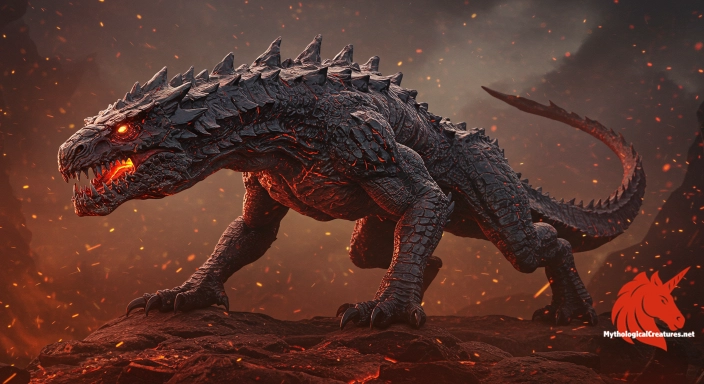
Gangcheori: Gangcheori is a dragon-shaped monster from Korean mythology, known for its destructive fire-breathing abilities.
Gangcheori
Gangcheori - Gangcheori serves as a symbol of destructive natural forces and the transformative power of fire in Korean folklore.
Origins & First Encounters
Gangcheori emerges as a striking figure in Korean mythology, renowned for its draconic form and volatile, fiery nature. Born from the rich tapestry of 17th-century folklore, this creature has captured imaginations long before modern times. Its early documentation in texts such as the Jibong Yuseol illustrates the deep roots of its legend within Korean cultural memory. Over time, Gangcheori became emblematic of both nature’s destructive forces and its capacity to renew. The multiple names it bears—Gangcheol, Kkangcheol, and Ggoangcheol—reflect the layered interpretations and regional nuances that have grown around it. Local anecdotes vividly recount how its passage was believed to transform the landscape, evoking the rejuvenating freshness of spring even when the season suggested decline. Intriguingly, Gangcheori is celebrated in rural wisdom as much as it is feared, representing a dual power that cleanses and renews. Its myth encapsulates the perennial cycle of decay and rebirth, resonating with a people intimately connected to the rhythms of nature and the passage of time.
Source Texts & Tale Variants
The earliest known mention of Gangcheori appears in the Jibong Yuseol from 1614, a record that immediately set the tone for its fierce reputation. Over the centuries, a wealth of folktales and oral traditions have added layers to its story, each version offering subtle variations on its fearsome attributes. Numerous regional storytellers have provided alternative names and descriptive details, effectively weaving a multifaceted tapestry of narratives. Some variants focus on its capacity to induce a vernal transformation wherever it treads, a notion that has been immortalised in local proverbs. In several manuscripts and compiled folk histories, Gangcheori is portrayed not merely as a destroyer but also as an unpredictable harbinger of change. These texts often emphasise the creature’s ability to alternate between devastation and regeneration. The diversity of sources—ranging from early literary works to impassioned rural recitations—demonstrates the fluidity of its myth over time. Each rendition contributes to the evolving legacy of Gangcheori, ensuring that even centuries after its first mention, the creature retains a compelling and enigmatic presence in the collective imagination.
Form & Powers
Descriptions of Gangcheori portray it as a majestic, dragon-like entity with a lengthy, sinuous body that exudes both elegance and menace. Its scales, often depicted in the vibrant hues of burning embers and molten metal, create a visual impression of ever-present flame. Multiple horns crown its head, curving gracefully to enhance its formidable silhouette. The creature’s intense, burning eyes suggest an inner fire that reflects both malice and ancient wisdom. Powerful limbs, ending in razor-sharp claws, are said to carve a path of fiery destruction, leaving scorched earth in their wake. A long, whip-like tail trails behind it, often described as a living torch that continues its blazing journey. Artistic renditions sometimes incorporate wisps of smoke and shimmering heat around its form, further accentuating its elemental nature. Across various accounts, minor differences emerge, yet all agree on its overwhelming presence that combines beauty with peril. Such detailed physical portrayals not only underscore its legendary might but also symbolise the intricate balance between creation and destruction.
Regional Faces
Across Korea, the portrayal of Gangcheori reflects the local cultural and geographical landscapes, resulting in a variety of interpretations. In mountainous regions, it is often depicted as a spirit that dwells among rugged terrains, where its fiery essence is seen as both a guardian and a warrior disrupting the old to forge the new. Coastal and rural areas sometimes imbue the creature with additional characteristics that draw parallels with local natural phenomena, such as sudden, destructive forest fires or the fierce energy of seasonal storms. Variations in the creature’s name—ranging from Gangcheol to Kkangcheol—mirror the linguistic diversity present in different regions. In the north, where the severity of winter demands a symbolic cleansing, Gangcheori's destructive path is viewed as a precursor to the promise of spring. Southern legends tend to celebrate its transformative power, presenting it as an agent that burns away decay to herald new beginnings. Urban retellings also exist, adapting the traditional imagery to modern narratives while preserving the mystique and elemental power of the original myth. This regional richness not only enhances the creature’s legend but also illustrates how local lore can adapt and transform a singular myth into a multitude of culturally resonant stories.
Cultural Parallels
Gangcheori occupies a distinctive niche in the broader world of mythological dragons, standing alongside celebrated creatures from both Eastern and Western traditions. Its fiery disposition and regenerative symbolism find echoes in the Chinese Lung, albeit with a uniquely Korean twist that blends terror with renewal. Similar to the fire-drake motifs found in European folklore, Gangcheori embodies the dual roles of destroyer and purifier, an archetype that resonates across cultures. The creature’s ability to effect transformative change has prompted comparisons with other legends where catastrophic events lead to rebirth or new cycles of prosperity. Its cross-cultural parallels highlight a universal human fascination with the forces that govern nature’s cycles, from the devastation of wildfires to the cleansing rain that follows. Moreover, while many dragon myths focus solely on might and menace, Gangcheori’s narrative uniquely captures the hope and new beginnings that emerge from the ashes. This comparison not only amplifies its mythic stature but also enriches our understanding of how different cultures interpret the themes of destruction and regeneration. The dialogue between these diverse traditions reveals a shared mythological language that continues to influence modern perceptions of nature and myth.
Legacy & Modern Evolution
The legacy of Gangcheori has undergone a profound transformation since its early 17th-century origins, evolving from a terrifying myth into a symbol of regeneration and cultural continuity. Initially feared as a wild, uncontrollable force, the creature gradually became reinterpreted as a potent emblem of nature’s cyclical ability to purge the old and foster the new. Over time, artists, writers, and modern folklorists have reimagined Gangcheori within contemporary frameworks, blending timeless myth with modern concerns. In modern media, its fiery image has been used to represent the renewal that follows societal and natural disasters, bridging ancient myth with current events. The evolution in its depiction—from a straightforward harbinger of destruction to a more nuanced metaphor for transformation—mirrors broader shifts in cultural narratives within Korea. This reinterpretation is evident in visual arts, literature, and even popular films where Gangcheori is portrayed with both ferocity and a touch of benevolence. Its enduring power in the collective cultural memory attests to the ability of ancient myths to adapt in an ever-changing world. Today, Gangcheori continues to inspire a wide range of creative expressions and remains a compelling testament to the dynamic interplay between myth, nature, and modernity.
Interesting Fact
An old saying claimed that 'Where Gangcheori goes it is like spring, even if it is fall,' highlighting the paradoxical impact of its destructive power.
Support the directory
Promote your myth project and fund more research
Sponsor placements help keep this directory growing and free to use while giving your work a focused, relevant audience.
Learn how sponsorship worksQuick Creature Info
Origin:
Features:
Associations:
Our Mythic Legendary Rating:

Also Sometimes Known As:
Habitat:
Supernatural Powers:
Physical Attributes:
Abilities:
Behavior:
Lore:
Related Creatures, Tales or Lore
- IImoogi
- YYong
- BBakunawa
References
Discover Another Mythical Legend You May Not Have Heard Of?
Uncover the mysteries of ancient folklore and expand your knowledge of legendary beings from cultures around the world.
Dare to Meet the Bergmönch....
Curated by the Mythological Creatures Team
Series editor: Mythological Creatures Directory
Primary desk: Asian & Pacific Myth Cycles Desk
(rev. November 2025)