
Geryon: Geryon is a fearsome giant from Greek mythology known for his unusual multi-bodied and/or multi-headed form and his famed cattle.
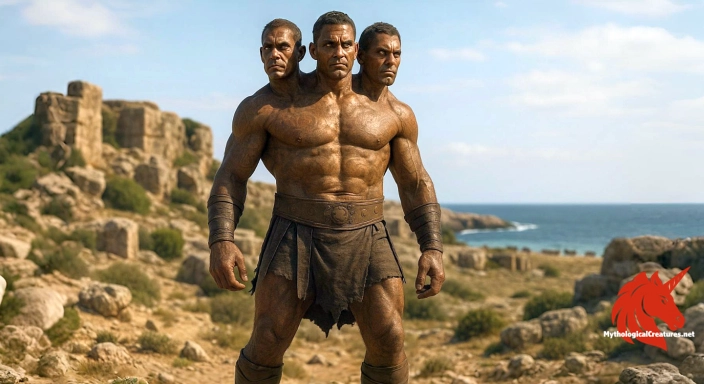
Geryon
Geryon - Embodies the formidable obstacles heroes face in Greek myth.
Origins & First Encounters
Geryon emerges from the rich tapestry of Greek mythology as a striking figure whose very nature challenges conventional boundaries between the mortal and the monstrous. Born of Chrysaor and Callirrhoe, his mythic lineage is further elevated by ties to Medusa and Pegasus, embedding him in a network of legendary connections. His earliest attestations locate him on the fabled island of Erytheia, a remote and enigmatic place at the edge of the known Mediterranean world. This setting, emblematic of uncharted frontiers, underscores the Greeks’ fascination with what lies beyond civilisation. In the heroic cycle of Greek lore, Geryon is best known for his formidable role in one of Hercules’ famed labours, where his unique form and guarded cattle present a daunting challenge. The narratives that recount his deeds intertwine themes of cosmic order with the wild forces of nature. His story reflects an ancient cultural context in which the encounter with the unknown was both a literal and symbolic ordeal. By straddling the line between human and beast, Geryon came to represent the otherworldly obstacles a hero must conquer. Thus, his myth serves as a powerful metaphor for the struggle against the chaotic and unfamiliar forces lurking at the periphery of human experience.
Source Texts & Tale Variants
Ancient literary traditions capture a spectrum of portrayals of Geryon, offering varied insights into his character and deeds. He appears in fragments of early Greek literature that describe his monstrous attributes with both awe and trepidation. Some narratives focus on his multi-bodied or multi-headed form, highlighting the complexity of his physical nature. There are accounts that specify he possesses three separate bodies or, alternately, a singular body with three heads, each iteration adding to his enigmatic reputation. Later texts, including those by chroniclers of heroic deeds, recount his role in the labours of Hercules with subtle variations in detail. The myth is further enriched by versions found in later periods, where regional adaptations reframe his identity and origin. These diverse accounts not only underline the plasticity of myth but also show how the story of Geryon was shaped by the evolving needs of storytellers. Despite the differences in detail, a common thread of formidable challenge and exotic strangeness unites these sources. In every version, the narrative of Geryon endures as a testament to ancient imaginings of monstrous might and heroic conquest.
Form & Powers
Ancient descriptions of Geryon imbue him with an eerie and formidable physicality that has captivated imaginations over the centuries. He is most famously depicted as a creature with either three bodies or an atypical combination of three heads and a single body, making him an anomaly among mythic beings. His enormous stature and robust, muscular form evoke the image of a giant whose physical presence dominates any landscape. Certain accounts suggest that his form was further enhanced by additional features such as wings or a heightened sense of grace, despite his monstrous overall appearance. Even as he defies natural anatomical norms, Geryon retains a recognisable humanoid essence, bridging the realms of man and myth. Visual portrayals in ancient vase paintings and sculptures reveal a being whose multiple forms express both symmetry and chaotic multiplicity. Each head or body element seems to command its own distinct identity, contributing to a composite image of supernatural strength. The striking combination of familiar human features with surreal, oversized attributes speaks to a deeper ancient fascination with hybridity. His enduring image as both human and beast continues to inspire modern artistic reinterpretations of mythic form.
Regional Faces
Though his origins lie in the heart of Greek myth, Geryon’s legend radiates diversity as it migrates across regional cultures. His abode, the island of Erytheia, was long considered a remote gateway to the exotic, wild fringes of the Mediterranean. In later traditions, some identified this far-flung locale with Tartessos in southern Iberia, thereby merging myth with localized geography. These regional reinterpretations allowed Geryon to be seen not just as a monster, but also as an emblem of distant, untamed lands. Local adaptations of his myth sometimes shift the focus from his fearsome physical characteristics to his function as a guardian of precious cattle, revealing a nuanced layer of economic symbolism. Artistic depictions in various Mediterranean cultures have colourfully highlighted aspects of his triple form, adapting it to fit local imaginations about the mysterious and the otherworldly. The evolving narrative across regions reflects the blend of imported myth with indigenous folklore, creating a tapestry of interpretations. Each community emphasised different attributes—be it monstrosity, guardianship, or exoticness—thus ensuring that his story resonated with local cosmologies. Through these variations, Geryon’s myth remains a dynamic fusion of universal legend and regional identity.
Cultural Parallels
Geryon occupies a unique space in the realm of myth, sharing intriguing characteristics with other multi-headed and multi-bodied entities across varied cultural traditions. The motif of multiplicity in his form finds echoes in other Greek figures such as Cerberus, whose three heads similarly evoke the notion of barriers between worlds. Comparative mythology reveals that many cultures have conceived of beings whose unusual anatomies symbolise the complex interplay between order and chaos. In Eastern traditions, for instance, creatures with multiple forms often embody the fragmentation of power or the manifold challenges a hero must face. His triple structure resonates with a universal archetype, appearing in diverse myths as a metaphor for overwhelming obstacles. While Geryon is firmly rooted in the heroic narratives of Greece, his essence parallels legendary figures found in both European fairy tales and modern fantasy literature. Such parallels suggest that the symbolic power of multiple forms transcends geographical and temporal boundaries. The recurrence of these themes across myths highlights an enduring human preoccupation with the confrontation of the uncanny. Ultimately, Geryon’s composite form stands as a mirror to our collective imagination, reflecting a cross-cultural celebration of the extraordinary and the multifaceted nature of heroic challenges.
Legacy & Modern Evolution
The myth of Geryon has traversed the centuries, evolving in its interpretation while maintaining an unmistakable aura of the formidable and the exotic. In antiquity, his terrifying form and the epic challenge he posed to Hercules captured the collective imagination, symbolising the peril that lurked at the fringes of the known world. During the Renaissance, artists and writers revisited his legend, imbuing his image with a new elegance that blended classical grandeur with creative innovation. In modern times, Geryon has re-emerged in literature, film, and art as a multifaceted emblem of otherness and the perennial struggle against chaos. Contemporary adaptations often portray him as both a relic of ancient myth and a living metaphor for the complexities of modern existence. His multi-headed, multi-bodied form has inspired designers in fantasy gaming and science fiction, where his image is reimagined with both awe and redefined terror. The evolution of his character reflects broader cultural shifts, embodying a dialogue between tradition and reinterpretation. Modern storytellers explore his symbolism as a representation of fragmented identity and the multiplicity of challenges in a complex world. In this way, Geryon’s legacy endures, continually reshaped by new generations while remaining a timeless figure in the mythic landscape.
Interesting Fact
The varied depictions of Geryon’s anatomy, whether as a three-headed or three-bodied giant, have spurred diverse artistic interpretations throughout history, underlining the fluid nature of myth.
For indie creators
Give your myth project a permanent home
Indie authors, artists, small studios, and makers can secure an annual, non-intrusive sponsor slot that meets readers where they explore.
Obtain more informationQuick Creature Info
Origin:
Features:
Associations:
Our Mythic Legendary Rating:

Also Sometimes Known As:
Habitat:
Supernatural Powers:
Physical Attributes:
Abilities:
Behavior:
Weaknesses:
Lore:
Related Creatures, Tales or Lore
- EEnceladus
- AAntaeus
- PPolyphemus
References
Discover Another Mythical Legend You May Not Have Heard Of?
Uncover the mysteries of ancient folklore and expand your knowledge of legendary beings from cultures around the world.
Dare to Meet the Chickcharney....
Curated by the Mythological Creatures Team
Series editor: Mythological Creatures Directory
Primary desk: Hellenic & Ancient Mediterranean Desk
(rev. November 2025)