
Halie: Halie is a multifaceted sea nymph from Greek mythology, recognized for her various incarnations ranging from an ox-eyed Nereid to a progenitor of royal and serpent-born lineages.
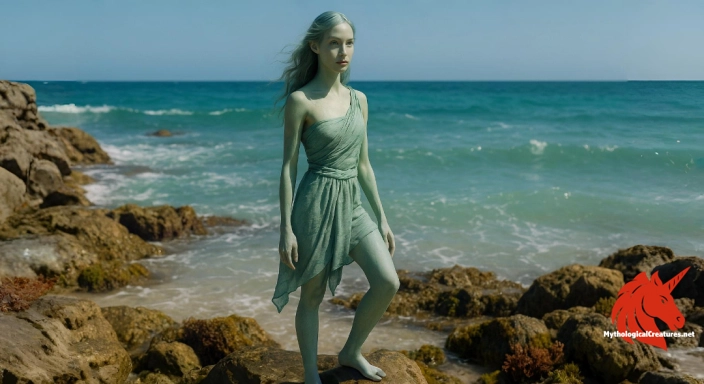
Halie
Halie - Highlights the multifaceted nature of ancient Greek myth where a single name can represent diverse but interconnected mythic figures associated with the sea.
Origins & First Encounters
Halie emerges in Greek mythology as a multifaceted symbol of the sea’s mystique, frequently portrayed as a dweller in briny waters and an embodiment of both divine beauty and tragic fate. Her name, meaning ‘the dweller in the sea’, is linked to several mythic figures, each reflecting a rich array of maritime lore. In one tradition she is revered as the ‘ox-eyed’ Nereid, whose luminous presence graced pivotal moments in the tales of gods and heroes. Another narrative casts her as the nymph whose life was intertwined with an island later named Rhodes, where she nurtured her daughter Rhodos and several sons in the company of Poseidon. A further variant recounts her fated encounter in a sacred grove, where an overwhelming serpent produced an otherworldly clan. Yet another strand integrates her into the early royal lineage of Lydia, underscoring her role in human as well as divine histories. Her multifarious origins not only reflect diverse local cults and traditions but also underscore the ancient Greeks’ fascination with the sea’s unpredictable nature. Over the centuries, Halie’s stories have come to represent both the benevolence and capriciousness of marine life, a duality that continues to captivate audiences. Her enduring presence in myth serves as a testament to the timeless interplay between nature, divinity, and human destiny.
Source Texts & Tale Variants
Ancient literary traditions have woven together the many narratives of Halie, drawing from a mixture of epic poetry, local cult traditions, and genealogical records. The portrayal of Halie as an ‘ox-eyed’ Nereid is echoed in classical texts and artistic depictions, where she appears among the revered daughters of Nereus. In another variant, her identity is celebrated in island-centric lore, particularly in accounts that recount her role as the progenitor of Rhodos, a narrative that underscores the intrinsic connection between geography and myth. Localised sources also preserve the story of her encounter with a formidable serpent in a sacred grove of Artemis, highlighting the interplay between nature’s wonders and divine intervention. Genealogical fragments from Lydia further catalogue her as a matriarch in early royal traditions, linking her myth to historical identities and regional power structures. Diverse manuscript traditions, though scattered and at times fragmentary, suggest that her myth was a common motif discussed in various Hellenic contexts. The recording and reordering of her tale in different sources reveal a landscape of mythic reinterpretation, where themes of hospitality, vengeance, and metamorphosis recur. Even as individual accounts differ in detail, the collective influence of these sources underlines the rich and multifaceted character of Halie. Such diversity in narrative not only highlights regional variations but also reinforces the fluidity and adaptability that are hallmarks of ancient mythology.
Form & Powers
The visual depiction of Halie is as varied as the mythic traditions that celebrate her, with her physical appearance shifting subtly between each account. In her manifestation as a Nereid, she is often depicted with striking 'ox-eyed' features that evoke an intense, otherworldly beauty. Artists have traditionally rendered her with flowing, diaphanous garments and graceful contours that mirror the undulating lines of the sea. Her skin is frequently shown with a luminous quality reminiscent of moonlight dancing upon water, while her hair is illustrated as cascading like sea foam. In the island myth, Halie is portrayed with a maternal serenity and dignified presence, suggesting a blend of earthly attributes with celestial refinement. Some depictions even include ornamental elements such as crowns fashioned from delicate seaweed or coral, symbolising her dominion over the marine realm. The combination of human elegance and the fluid dynamism of water imbues her with an ethereal quality that has long captured the imagination of sculptors and painters. Each regional representation, whether emphasizing her divine austerity or her nurturing warmth, utilises a palette of visual symbolism to articulate her essential connection to the ocean. Over time, these varied portrayals have enriched her character, ensuring that every physical rendering invites viewers to glimpse both the beauty and mystery of the sea.
Regional Faces
The myth of Halie exhibits a remarkable adaptability that reflects the specific cultural and geographical contexts of ancient Greece and its neighbouring regions. In the Aegean and broader Greek world, she is most prominently featured as one of the many Nereids, emblematic of the ocean’s bounty and caprice. The island tradition, wherein she is celebrated as the matriarch of the island later named Rhodes, demonstrates how local communities shaped her character to reinforce regional identity and sacred geography. In parts of Lydia, her role as a progenitor of kings interlaces divine myth with early historical narratives, thereby cementing her importance in the founding myths of specific communities. Further afield, in ritual spaces dedicated to deities like Artemis, her fateful encounter with a serpent introduces themes of both punishment and metamorphosis that resonate with local wilderness lore. Her name, used in the plural form to describe marine nymphs, also reveals how the local imagination extended her persona to encompass a broader spectrum of sea deities. These regional adaptations not only highlight the interplay between myth and place but also underscore the flexible nature of ancient storytelling where a single figure could embody multiple local values. The variations in her myth serve as cultural signposts, illustrating how communities invested natural phenomena with divine meaning. Thus, Halie’s richly layered depiction is a mirror of the diverse ways in which eastern Mediterranean cultures engaged with the mystery of the sea.
Cultural Parallels
When compared with other mythological figures throughout the ancient world, Halie provides a striking example of how marine deities encapsulate the complexity of nature and divinity. Her varying depictions, from the luminous Nereid to the island nymph and even a progenitor of royal bloodlines, resonate with similar multi-dimensional sea figures found in other cultural traditions. Like the Roman depiction of Neptune’s attendants or currents in Near Eastern water cults, Halie embodies the dual nature of the sea, capable of bestowing both nurturing abundance and destructive fury. Her myth shares common threads with other Mediterranean water deities, such as the Phoenician Atargatis, who symbolised fertility and the transformative power of water. Furthermore, the thematic interplay of hospitality, retribution, and transformation in her stories parallels the broader narrative motifs seen in comparative mythology. While her narratives have intermingled with those of Leucothea or Ino in Hellenic lore, Halie maintains her unique regional touch and fluid identity. This interweaving of mythic functions underscores recurring universal themes while imbuing each tale with local distinctiveness. The cross-cultural comparisons bring to light how ancient societies, though separated by geography, shared a common language of symbols when it came to the mesmerizing and unpredictable force of the sea. Thus, Halie’s myth serves as a bridge linking the divine with the mortal, the local with the universal, and ancient tradition with modern inquiry.
Legacy & Modern Evolution
The legacy of Halie has been a dynamic tapestry woven through centuries of myth, art, and cultural reflection. In antiquity, her evolving identity as both a divine sea-nymph and a progenitor of local dynasties mirrored the complex relationship the ancient Greeks had with their maritime world. As the centuries unfolded, her figure was reinterpreted in art and literature, capturing the eternal allure and inherent volatility of the sea. During the Renaissance, classical themes were revived, and her myth was transformed into a symbol of both majestic beauty and the eternal struggle between man and nature. Modern reinterpretations have often aligned her story with themes of environmental consciousness and the unpredictable transformations wrought by natural forces. Contemporary artists and writers have drawn upon her layered persona to explore ideas of metamorphosis, loss, and renewal in a world where the sea remains both a source of sustenance and an ever-changing frontier. In academic circles, her narrative continues to spark discussion on the integration of local cult practices and pan-Hellenic mythology, affirming the timeless relevance of ancient myth-making. The continual evolution of her myth exemplifies how timeless stories can be adapted to reflect new cultural anxieties and aspirations. Halie’s enduring image, with its blend of beauty, tragedy, and mystery, serves as a vibrant reminder of the sea’s profound imprint on both ancient and modern cultural consciousness.
Interesting Fact
An interesting aspect of Halie's mythos is the multiplicity of her identities, which illustrates how ancient Greek mythology often merged local traditions with pan-Hellenic narratives, allowing one figure to simultaneously represent natural phenomena, divine retribution, and the origins of both royal and snake-related lineages.
For serious mythcraft
Your project belongs among the legends
If your work deepens how people understand, play with, or teach mythology, a sponsor placement here keeps it in front of the right readers all year.
Submit a sponsorship enquiryQuick Creature Info
Origin:
Associations:
Our Mythic Legendary Rating:

Also Sometimes Known As:
Habitat:
Supernatural Powers:
Physical Attributes:
Abilities:
Behavior:
Lore:
Related Creatures, Tales or Lore
- TThetis
- LLeucothea
- NNereid Sisters (e.g., Amphitrite)
References
Discover Another Mythical Legend You May Not Have Heard Of?
Uncover the mysteries of ancient folklore and expand your knowledge of legendary beings from cultures around the world.
Dare to Meet the Bashe....
Curated by the Mythological Creatures Team
Series editor: Mythological Creatures Directory
Primary desk: Hellenic & Ancient Mediterranean Desk
(rev. November 2025)