
Hanbi: Hanbi, also known as Hanpa, is a demon lord from Mesopotamian mythology, revered as the lord of evil.
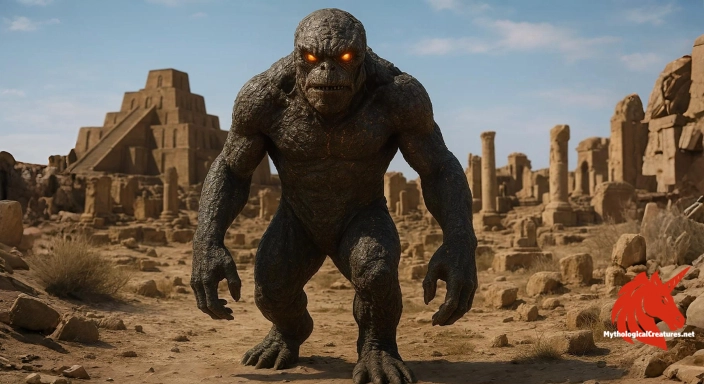
Hanbi
Hanbi - Hanbi's role as the progenitor of Pazuzu and embodiment of evil underscores the Mesopotamian interpretation of primordial malevolence.
Origins & First Encounters
Hanbi, also known as Hanpa in some renditions, occupies a shadowy space in the ancient Mesopotamian pantheon as the lord of evil and the progenitor of malevolent forces. His origins lie in the very fabric of Sumerian and Akkadian myth, where complex forces of good and evil were interwoven into the cosmic order. Although his myth is fragmentary, Hanbi was revered and feared as a figure who presided over the chaotic and uncontrolled aspects of the supernatural. Early attestations suggest that his name was invoked in rituals meant to counteract the misfortunes that beset communities. His role as the overseer of the udug, or evil forces, marked him as an indispensable counterpart to the benevolent deities of his time. The limited records hint at a deity whose presence was felt through the very fabric of Mesopotamian daily life, embodying the unpredictable nature of calamity. His connection to Pazuzu, one of the more vividly depicted demonic figures, further underscores the foundational role he played in a mythic framework where the origins of evil were as significant as the deeds of the gods. Over time, his elusive nature captured the imagination of those who sought to understand the origins of malevolence and the forces that disrupted the natural order.
Source Texts & Tale Variants
The primary sources mentioning Hanbi are few and largely fragmentary, derived from ancient cuneiform tablets and ritual incantations. Although explicit narratives about him are sparse, the indirect allusions found in various texts provide a window into his character and influence. Hanbi is primarily known through his connection to Pazuzu, a demon whose role in protective magic and calamity is well chronicled in later sources. Some of the incantation texts and exorcism rituals of Mesopotamia refer to a paramount evil force, which scholars have confidently identified as Hanbi. In the absence of detailed mythic cycles, his identity is reconstructed from the symbolic language of these ritual texts. Archaeological findings from sites in ancient Sumer and Akkad have occasionally hinted at a deity of darkness, further linking Hanbi to the broader motif of evil. Over the centuries, incidental references in assorted administrative and magical documents have kept his memory alive as part of a larger narrative on malevolent spirits. Thus, while the literary corpus dedicated entirely to Hanbi is limited, comparative studies within the corpus of Mesopotamian demonic entities offer valuable insights into his character.
Form & Powers
The corporeal representation of Hanbi remains largely a matter of scholarly conjecture due to the scant artistic records specifically attributed to him. Artists of ancient Mesopotamia often did not depict him in a consistent manner, which has led to a tapestry of imagined features rather than a definitive iconography. In some interpretations, his form is envisaged as an imposing, shadow-like presence, a silhouette that conveys both dread and uncontrollable power. His appearance is sometimes speculated to incorporate hints of both human and beast, reflecting the dual nature of order and chaos that he embodied. Certain artistic fragments and later depictions associated with his offspring, Pazuzu, suggest that his features may have included exaggerated limbs and a distorting, monstrous face. These speculative traits are emblematic of many deities associated with evil, where the emphasis lies in evoking terror rather than portraying beauty. The potential variability in his size and form—ranging from a towering figure to a more abstract, nebulous shape—reinforces the idea that his image was ever-adaptable to the needs of ritual and myth. In essence, Hanbi’s physical description serves less as a detailed portrait and more as a conceptual representation of malevolence in an ancient world fraught with uncertainty.
Regional Faces
The figure of Hanbi, while quintessentially Mesopotamian, underwent various regional adaptations as the myths spread across different city-states and neighbouring cultures. In Sumer and Akkad, his name was associated with pure malevolence and the chaotic elements of the supernatural, whereas later interpretations in Babylon and Assyria subtly shifted his attributes to align with emerging religious and cultural paradigms. Some local traditions incorporated regional deities and spirits into the tapestry of evil, blending Hanbi’s character with indigenous beliefs on the forces that disrupt order. In areas where the influence of Mesopotamian mythology was felt, such as in parts of Syria and even in the peripheries of the ancient Near East, his attributes were occasionally merged with local understandings of demonic power. These adaptations were not always literal, and in several instances, Hanbi’s identity became a conceptual emblem for the personification of evil rather than a strictly defined deity. Local exorcism rituals and magical texts in various regions sometimes invoke his name or refer implicitly to his qualities. Over time, the cross-regional dialogue of myth allowed for an enriched reinterpretation of evil, where Hanbi’s mythic presence was reframed to resonate with regional concerns of divine protection. This fluidity in regional interpretation underscores not only the complexity of Mesopotamian religious thought but also the adaptability of its mythic narratives across diverse cultures.
Cultural Parallels
When considered alongside similar figures from other cultural traditions, Hanbi emerges as a compelling archetype of primordial evil. His role as the father of Pazuzu draws a parallel with other mythological lineages where a progenitor gives rise to a host of malevolent spirits, similar to the way chaos gives birth to monsters in Greek mythology. Comparisons may be drawn with entities such as the Norse Jotnar or even the more abstract personifications of destruction in Eastern myth, highlighting a universal motif of evil emerging from primal origins. Much like Ahriman in Zoroastrian belief, Hanbi represents a counterforce to the order imposed by the gods, a necessary embodiment of chaos against which cosmic balance is achieved. The thematic similarities extend to iconographic motifs as well, where features like contorted limbs, wild expressions, or a shadowy presence become shared symbols among diverse cultures. These parallels serve to illuminate the universal human fascination with the origins of malevolence and the ways in which different societies visualise and conceptualise it. In many traditions, the idea of an ultimate evil figure has been instrumental in explaining the unpredictable and often destructive forces of nature. Hanbi, in this wider context, fits into a cross-cultural pattern where supreme evil is cast as a precursor to more tangible forms of demonic power, bridging ancient myth with broader thematic constellations found throughout world folklore.
Legacy & Modern Evolution
Over the courses of millennia, Hanbi’s legacy has evolved from an obscure figure in early Mesopotamian texts to a symbolic precursor of later demonological portrayals in both art and literature. Although his direct worship diminished as the pantheon of deities was re-ordered in successive Mesopotamian empires, his influence persisted through his connection to Pazuzu and the broader concept of evil. In medieval and modern reinterpretations, Hanbi often appears as a background figure whose enigmatic nature invites reinterpretation and scholarly debate. The fragmentary records left by ancient scribes have stirred imaginations in contemporary literature, where his character is occasionally reimagined as a symbol of the eternal struggle between order and chaos. Modern visual arts and occults have drawn upon the vague yet powerful essence of Hanbi to evoke themes of terror, mystery, and the unknowable forces that underpin our existence. His myth, though not as extensively documented as that of other deities, continues to attract attention in academic circles where efforts to reconstruct ancient belief systems are ongoing. Adaptations in popular culture occasionally echo the malevolent aura of Hanbi, linking his distant origins with current portrayals of demonic figures in film and literature. In this way, his legacy endures as a testament to the enduring human need to personify and confront the darker aspects of life.
Interesting Fact
Despite being the progenitor of one of the most infamous demons, Pazuzu, Hanbi remains a largely enigmatic figure with very few surviving details about his true nature.
For indie creators
Give your myth project a permanent home
Indie authors, artists, small studios, and makers can secure an annual, non-intrusive sponsor slot that meets readers where they explore.
Obtain more informationQuick Creature Info
Origin:
Features:
Our Mythic Legendary Rating:

Also Sometimes Known As:
Habitat:
Supernatural Powers:
Abilities:
Behavior:
Lore:
References
Discover Another Mythical Legend You May Not Have Heard Of?
Uncover the mysteries of ancient folklore and expand your knowledge of legendary beings from cultures around the world.
Dare to Meet the Negret....
Curated by the Mythological Creatures Team
Series editor: Mythological Creatures Directory
Primary desk: Hellenic & Ancient Mediterranean Desk
(rev. November 2025)