
Heryshaf: Heryshaf is an ancient Egyptian creator and fertility deity often depicted as a ram or a man with a ram's head.
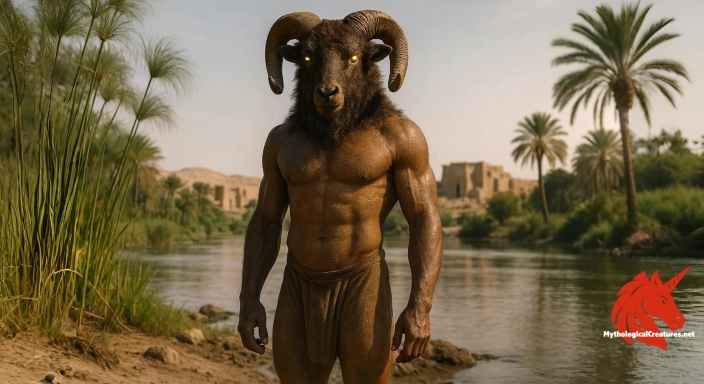
Heryshaf
Heryshaf - Heryshaf was a central deity in Heracleopolis Magna, representing creation, fertility, and the life-giving properties of the Nile. His identity was later syncretized with major gods such as Ra, Osiris, Dionysus, and Heracles, underscoring his multifaceted role in ancient religion.
Origins & First Encounters
Heryshaf is an ancient Egyptian deity celebrated as a ram god of creation and fertility whose origins lie in the mystic embrace of the Nile's primordial waters. His earliest worship can be traced to the grand city of Heracleopolis Magna, where his cult quickly established itself as a vital part of local religious life. Born from a tradition that revered water as the giver of life, he came to embody the cyclical nature of creation and rebirth. His name, which translates to 'He who is on His Lake,' reflects not only his aquatic origins but also his deep association with the life-sustaining floodwaters of the Nile. Over time, the deity’s character was interwoven with the narratives of other eminent gods, drawing parallels with both Ra and Osiris as well as with later Greek figures. The evolving mythology surrounding Heryshaf showcases a rich tapestry of religious thought, blending elements of creative power with the fertility of the earth. His cult underscored key Egyptian values, linking cosmic creation with the everyday sustenance of society. As the deity’s story was handed down through generations, Heryshaf remained a symbol of transmutation and the eternal cycle of life.
Source Texts & Tale Variants
Ancient temples and inscriptions provide much of the evidence for Heryshaf’s worship, capturing varied accounts of his myth across different eras. Records preserved on stone and papyrus offer glimpses into a complex narrative where he emerges from the primordial waters as a life-giving force. Ritual texts celebrated his creative abilities and described his role in ensuring the fertility of both land and riverbanks. Over time, stories of Heryshaf were documented in various local liturgies, each lending unique detail to his character. Some accounts merge his identity with that of other deities, highlighting his kinship with the solar and underworld gods. Variants of the myth suggest that his portrayal was adapted to meet the spiritual needs of communities facing agricultural challenges. Even fragmentary texts allude to ceremonial practices that underscored his importance in the cosmic order. These diverse sources, while not uniform, collectively emphasise his standing as a pillar in the mythological framework of ancient Egypt.
Form & Powers
In artistic depictions, Heryshaf most commonly appears with the unmistakable head of a ram, complete with elegantly curved horns that signify both strength and fertility. His representation often merges human form with animal features, symbolising a bridge between the divine and the natural world. Statues and temple reliefs capture his robust physique, hinting at a deity whose power and vitality resonate with the life force of the Nile. Detailed carvings accentuate the texture of his ram’s wool and the intricate contours of his facial expression, imbuing him with both regality and a sense of nurturing authority. Variations in scale and posture in different regions provide insight into the evolving interpretative styles of ancient artists. Such imagery not only underlines his virility but also his role as a protector of the fertile lands. The physical representations of Heryshaf often include symbolic elements—a scepter or an emblematic disc—that reinforce his divine status. Overall, each portrayal is a visual testament to the deific qualities attributed to him, blending artistry with sacred symbolism.
Regional Faces
The primary centre for Heryshaf’s worship was Heracleopolis Magna, where his role as a creator and fertility god was most pronounced. Regional traditions across Egypt, however, offered their own nuances to his myth, adapting his character to local spiritual and environmental needs. In some areas, his connection to the life-giving Nile was accentuated through rituals held at riverbanks, making him a guardian of flood cycles. Other regions highlighted his combative and protective nature, aligning him with the themes of strength and resilience. Variations in temple iconography reveal that local communities sometimes incorporated additional symbols into his depiction, reflecting diverse cultural interpretations. These adaptations underscore the flexibility inherent in ancient Egyptian religion, where deities could be reshaped to echo regional ethos. The blend of indigenous and imported traits in his worship illustrates the dynamic interplay between local traditions and broader mythological currents. Such regional diversities enhance our understanding of how Heryshaf’s narrative was continuously refined to mirror the lived experiences of his devotees.
Cultural Parallels
Heryshaf occupies a fascinating place in the wider context of ancient mythologies, sharing attributes with several other deities renowned for their creative and regenerative powers. His role as a life-bringer resonates closely with the narratives surrounding Ra and Osiris, both of whom similarly embody the cycles of death and rebirth. Beyond the Egyptian context, his later identification with Greek figures such as Dionysus and Heracles highlights a fluid interchange of religious ideas in the ancient world. This syncretism is a vivid reminder of how cultural interactions can lead to the merging of distinct mythic traditions. His representation as a ram deity finds echoes in other cultures where the animal symbolises fertility, virility, and protection. The capacity of Heryshaf to transcend regional boundaries suggests that his attributes were universally appealing, making him comparable to other horned gods in the Mediterranean basin. In examining these cross-cultural parallels, one sees how themes of creation and regeneration serve as a common language in diverse mythological traditions. Ultimately, his myth reinforces the concept that divine power is often communicated through symbols that resonate across different peoples and eras.
Legacy & Modern Evolution
The legacy of Heryshaf has evolved remarkably from his ancient origins to his presence in modern cultural expressions. Throughout the centuries, images of the ram god have inspired contemporary art, literature, and film, where his symbolisms of strength and fertility continue to captivate. Modern reinterpretations often blend classic iconography with new artistic visions, perpetuating his myth in fresh and evocative ways. His early associations with Ra and Osiris have enriched his narrative, weaving a complex tapestry that reflects both cosmic creation and earthly renewal. Recent archaeological discoveries and scholarly studies have reignited interest in his cult and its ritual practices, offering deeper insights into his historical significance. In modern spiritual and metaphysical circles, Heryshaf is sometimes invoked as a symbol of rebirth and the transformative power of nature. The enduring nature of his myth is also evident in the way contemporary artists and writers explore ancient themes through the lens of modern existential questions. His continuing relevance demonstrates that even the gods of antiquity can speak to the enduring human fascination with creation, power, and the cyclic nature of life.
Interesting Fact
An intriguing aspect of Heryshaf is his dual identity, merging human intellect with animalistic power, which symbolises the harmony between nature and divinity.
For authors, artists, and makers
Created something from the realm of myth?
If your book, deck, game, or artwork draws from legendary creatures and lore, you can showcase it here in a tasteful, year-round placement.
Share your projectQuick Creature Info
Origin:
Associations:
Our Mythic Legendary Rating:

Also Sometimes Known As:
Habitat:
Supernatural Powers:
Physical Attributes:
Abilities:
Behavior:
Lore:
Related Creatures, Tales or Lore
- KKhnum
- BBanebdjedet
References
Discover Another Mythical Legend You May Not Have Heard Of?
Uncover the mysteries of ancient folklore and expand your knowledge of legendary beings from cultures around the world.
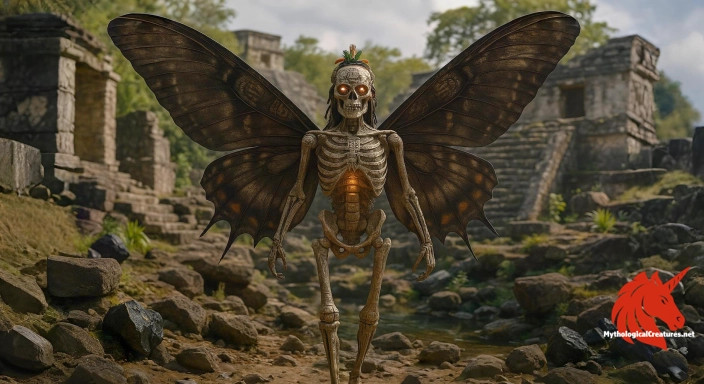
Dare to Meet the Ītzpāpālōtl....
Curated by the Mythological Creatures Team
Series editor: Mythological Creatures Directory
Primary desk: Hellenic & Ancient Mediterranean Desk
(rev. November 2025)