
Khnum: Khnum is one of the oldest Egyptian deities, revered as the creator god who fashioned human bodies from clay.
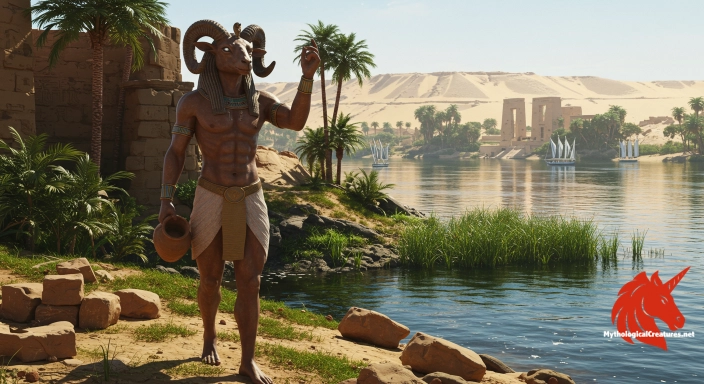
Khnum
Khnum - One of the earliest-known Egyptian deities; his creative power and control over the Nile underscore his role in fertility, rebirth, and the natural order.
the legend in five swipes.
the legend in five swipes.
The Origin Story of Khnum
Khnum is one of the most ancient deities in Egyptian mythology and has been venerated since the early dynastic periods in Upper Egypt. His origins lie in the mystique of the Nile, where his power was closely intertwined with the life-sustaining floodwaters that brought fertility to the land. He is celebrated as a creator god, famously depicted as a potter shaping clay on a wheel to fashion both human bodies and the very essence of life. In this capacity, Khnum embodies the eternal cycle of birth, regeneration, and transformation. The god’s association with the annual inundation of the Nile underscores his control over nature’s critical processes and the sustenance of civilization. His early worship, focussed primarily in Middle Egypt at Herwer, gradually spread, reflecting his growing importance in the Egyptian religious landscape. With a role that seamlessly blends creation and natural order, Khnum became a pivotal figure in both myth and ritual practice. The enduring reverence for his creative power is evident in temple inscriptions and artistic depictions that highlight his influence on human existence and the cosmos. His myth has resonated through millennia, symbolising the delicate balance between the divine and the natural world.
How many versions of the Khnum story are there?
Ancient records such as temple inscriptions, hieroglyphic texts, and relief carvings provide a window into the multifaceted narratives surrounding Khnum. These texts, dating back to the Early Dynastic Period, reveal his integral role in creation and the regulation of the Nile’s inundation. In many accounts, Khnum is portrayed as the divine artisan who moulds human forms from clay, a role that is echoed in various sacred narratives. Different versions of his myth describe him working in concert with other deities, highlighting a collaborative aspect in the formation of life. Notably, cultic sites at Elephantine, Herwer, and Esna offer distinct local interpretations of his functions and attributes. The diversity in these ancient sources illustrates how regional traditions enriched his character and theological significance. Funerary texts and ritual documents further elaborate on his association with rebirth and regeneration, using his imagery as a metaphor for the cyclical nature of existence. Variants of his myth can sometimes be found in agricultural and seasonal narratives, reflecting the pervasive influence of the Nile flood on everyday life. These primary sources collectively weave a complex portrait of a deity whose creative energy was central to the Egyptian worldview. The surviving accounts continue to provide valuable insights into both the mythological and cultural context of ancient Egypt.
Khnum: Size, Shape and Strange Features
Iconographically, Khnum is depicted with a striking blend of human and animal features that symbolise his creative and potent nature. His most prominent attributes include the horns of a ram, which originally appear in a horizontal spiral design inspired by the extinct corkscrew-horned sheep. Over time, this imagery evolved to feature the down-turned horns akin to those of Ammon, reflecting a refined association with fertility and transformation. In some artistic renditions, Khnum is shown with the head of a crocodile, underscoring his close connection to the mighty and life-giving Nile. His facial expressions, often rendered with a dignified serenity, capture both the precision of a divine craftsman and the primal force of nature. He is regularly adorned with regal headgear such as the atef crown, ornamented with two elegant feathers that denote his high status among deities. Additional depictions include the use of the white crown of Upper Egypt, a symbol of his regional sovereignty. Every element of his iconography has been carefully chosen over centuries, merging symbolic significance with evolving artistic styles. This detailed portrayal not only communicates his mythological functions but also reflects the broader cultural and religious shifts within ancient Egyptian society.
How does the Khnum legend change from place to place?
The cult of Khnum demonstrated notable regional variations, each casting him in a slightly different light consistent with local traditions and environmental influences. In Herwer, one of his earliest cult centres, his role as a life-giver and regulator of the Nile was emphasised through straightforward, ritualistic depictions. On the island of Elephantine, his significance deepened as he came to be seen as the principal deity, with local artistic styles accentuating his dominion over the First Cataract of the Nile. Here, elements such as his distinctive horns and association with riverine symbolism were adapted to reflect the unique geography of the region. Esna, another important site south of Thebes, contributed its own flavour to his myth through inscriptions that intertwined his creative prowess with the rhythms of local inundation cycles. Variations in temple reliefs and ritual objects across these regions speak to a rich interplay between pan-Egyptian religious ideas and local cultural practices. The adaptive nature of his iconography allowed Khnum to remain central to the spiritual life of diverse communities. Regional adaptations also meant his myth was often tailored to align with local environmental challenges and agricultural cycles. Thus, the regional manifestations of Khnum’s worship offer a fascinating glimpse into how a single deity could embody both a universal creative force and a locally nuanced symbol of life’s renewal.
Khnum: Related Figures Across Cultures
Khnum’s portrayal as a divine potter who moulds life from clay invites intriguing comparisons with creator figures in other mythologies. The motif of crafting human beings from earth is echoed in ancient Mesopotamian narratives, where deities like Enki are similarly credited with the formation of humanity. This common thread reflects a universal archetype of creation through manual artistry and transformation. In the Greek context, while figures such as Hephaestus are primarily known for their craftsmanship, Khnum’s creative act carries an additional layer of symbolism through its association with natural cycles. His depiction, replete with animal features and potent natural imagery, serves a dual purpose as both a literal creator and a metaphor for the regeneration of the natural world. Such parallels underscore how different cultures have utilised the imagery of the wheel and clay to symbolise the transition from chaos to order. The cross-cultural resonance of these themes highlights an underlying universal quest to explain the origins of life and the forces of nature. While direct equivalence between deities is uncommon, the similarities in their mythic roles foster a broader comparative understanding of creation myths. In drawing these comparisons, one observes that Khnum’s legacy is part of a wider, interconnected dialogue on divine creativity and the transformation of the cosmos.
The Lasting Influence of Khnum
The depiction and interpretation of Khnum have evolved significantly from the early dynastic period to modern times, reflecting shifts in both artistic style and cultural perception. Initially, his iconography featured the distinctive spiralled ram’s horns, a design that was later modified to incorporate the down-turned horns inspired by Ammon, signalling a nuanced evolution in his mythological attributes. Temple reliefs and papyrus texts from the New Kingdom illustrate this transformation, encapsulating the changing religious ethos of ancient Egypt. During the Greco-Roman period, his myth was absorbed into syncretic traditions that blended native Egyptian imagery with emerging cultural narratives. In modern scholarship, Khnum is increasingly seen not only as a creator deity but also as a symbol of the interconnectedness between humanity and the natural world. Contemporary interpretations frequently emphasise his role in symbolising the cyclical nature of life, regeneration, and the transformative power inherent in the natural order. His image has also inspired artists and writers, who often draw upon the rich symbolic heritage of his myth to explore themes of creation and rebirth. Khnum’s enduring legacy reflects both an appreciation for ancient spiritual insights and a modern sensibility towards ecological and creative renewal. As notions of environmental sustainability gain prominence today, his myth continues to resonate, inviting renewed reflection on the harmonious relationship between man and nature.
Interesting Fact
Khnum is uniquely depicted with a potter's wheel—a symbol not only of creation but also of the cyclic and regenerative nature of the Nile flood, which was vital to Egypt's agricultural prosperity.
Mythological Treasures
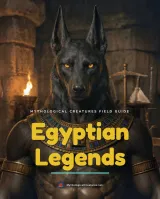
Egyptian Legends: A field guide to the gods and monsters of ancient Egypt
Guardians of the living and devourers of the dead, with the role each played in judgement.
Norse Sagas: A field guide to the beasts of the Viking world
Drawn from the saga accounts themselves, with the powers, weaknesses and doom of each being set out.
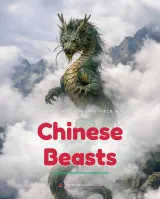
Chinese Beasts: A field guide to the dragons and demon kings of Chinese myth
From river dragons to demon kings, with the legends that shaped five thousand years of storytelling.
the legend in five swipes.
Support the directory
Promote your myth project and fund more research
Sponsor placements help keep this directory growing and free to use while giving your work a focused, relevant audience.
Learn how sponsorship worksQuick Creature Info
Origin:
Associations:
Our Mythic Legendary Rating:

Also Sometimes Known As:
Habitat:
Supernatural Powers:
Physical Attributes:
Abilities:
Behavior:
Lore:
Related Creatures, Tales or Lore
- AAtum
- PPtah
- AAmun-Ra
References
Discover Another Mythical Legend You May Not Have Heard Of?
Uncover the mysteries of ancient folklore and expand your knowledge of legendary beings from cultures around the world.
Dare to Meet the Schrat....
The Mythological Creatures Book Series
Yokai, Greek, Norse, Egyptian & Chinese. Five illustrated field guides to the creatures the old stories either warned or told you about.

Curated by the Mythological Creatures Team
Series editor: Mythological Creatures Directory
Primary desk: Hellenic & Ancient Mediterranean Desk
(rev. November 2025)