
Hieromneme: Hieromneme is a minor naiad from Greek mythology, embodying the sacred memory of holy rites.

Hieromneme
Hieromneme - Hieromneme embodies the memory of sacred rituals, highlighting the connection between water, divinity, and remembrance in ancient Greek culture.
Origins & First Encounters
Hieromneme emerges in the ancient Greek pantheon as a captivating and enigmatic naiad whose very name, blending the sacred word hieros with mnéma, encapsulates the memory of holy ceremonies. She is portrayed as a water spirit intimately connected to the rejuvenating springs of Asia Minor, a region where folklore and religious ritual converged to sanctify nature. Her presence in myth appears to be interwoven with beliefs in the divinity of water, symbolising both purification and the preservation of ancestral traditions. Although she is considered a minor deity compared to the Olympian gods, she occupies a unique niche by embodying the continual remembrance of sacred rites. Cultural practices in her native region celebrated her as a guardian of ritual memory, through which the essence of age-old ceremonies was maintained. The early Greek world, with its emphasis on ritual and memory, found in Hieromneme a divine link between the ephemeral and the eternal. Myths about her likely originated from local water cults where natural springs were deemed to have healing and inspirational virtues. Even if her name appears only sparingly in surviving texts, the symbolic power it conveys contributes to her lasting interest among myth enthusiasts. The blending of natural beauty with ceremonial remembrance in her figure has continued to inspire interpretations that seek meaning in both nature and religious tradition. Her mystique speaks to an enduring legacy where even the most minor divinities serve as vessels for cultural memory and spiritual continuity.
Source Texts & Tale Variants
The literary and epigraphic evidence concerning Hieromneme is notably sparse, yet her fleeting mentions provide intriguing hints of a once vibrant cultic importance. Early compendiums of water deities and local lexicons record her name among the naiads, hinting at a modest but dedicated regional following. Some ancient scholia and commentaries on myth offer fragmented references that suggest she was integrated into the broader tapestry of water spirits celebrated across Asia Minor. There exist variant interpretations in the scant inscriptions that have survived, where her role sometimes overlaps with that of local healing and purification deities. In a few lost Hellenistic fragments, Hieromneme is alluded to in the context of sacred rites, thus reinforcing the connection between water and ritual memory. Byzantine-era texts, too, whisper of her presence, underscoring an enduring though understated relevance in later religious thought. Oral traditions preserved in isolated villages continue to inspire subtle echoes of her myth, even if written records remain elusive. Despite the lack of extensive narratives, the sources collectively attest to the layered significance of her name and the role it played in ancient community rites. These varying testimonies, though limited, invite scholars to reconstruct a figure whose purpose was tightly bound to the remembrance of divine ceremonies and local sacred customs. The mosaic of sources thus presents Hieromneme as an emblem of both natural and ritualistic memory within the grand scheme of Greek myth.
Form & Powers
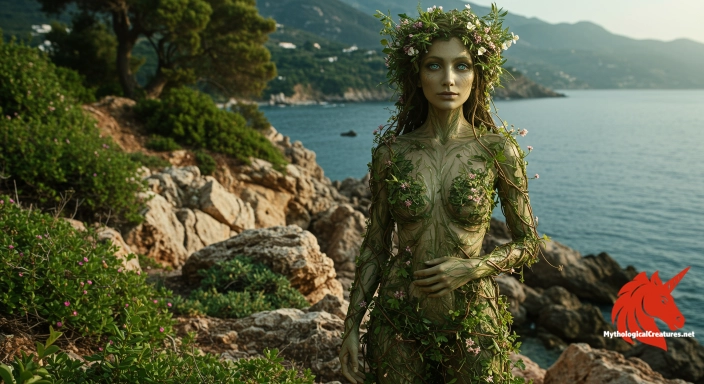
Artistic portrayals and literary hints suggest that Hieromneme possessed an ethereal beauty, emblematic of the purity of spring water and the delicate grace of nature. She is typically envisaged as a luminous figure with shimmering, translucent skin that reflects the soft glow of a moonlit stream. Her hair, imagined to flow like a cascade of water, is often interlaced with silvery threads that evoke the sparkle of dewdrops. The eyes attributed to her are said to mirror the clear, reflective surface of a tranquil pool, capturing the quiet depth of ancient memories. In depictions that have come down to us through artistic tradition, her forms are modest yet profound, reflecting the transient yet vital essence of water. Attire in portrayals of Hieromneme is rendered with flowing garments that emulate the gentle curves of a meandering river, often embellished with motifs reminiscent of water lilies and native flora. Such imagery underscores her intimate association with natural water sources and the sanctity they imbue. Although she is considered a minor deity in stature, her physical attributes are elevated by an aura of mysticism and purity. The delicate, almost unearthly nature of her appearance serves as a visual metaphor for the fragility and enduring quality of ritual memory. These subtle details collectively reinforce the notion of Hieromneme as a divine personification of both natural beauty and sacred remembrance.
Regional Faces
Hieromneme’s myth travelled beyond a single local tradition, adapting its nuances to resonate with the diverse cultural landscapes of Asia Minor. In some regional traditions, she was revered not solely as a water nymph but also as a healing spirit whose presence brought fertility and restored harmony to local communities. Rural cults sometimes integrated her worship with seasonal festivals, where offerings and prayers were made at natural springs and wells believed to be touched by her sacred essence. In the rugged terrains of Asia Minor, villagers adapted her story to blend local indigenous beliefs with the dominant Hellenic religious framework, resulting in variations that highlighted her beneficent powers. Some communities painted her as a patron of both natural water sources and communal rites, a dual role that reinforced the interdependence between nature and cultural memory. Her iconography, too, varied with local artistic traditions, sometimes featuring distinctive adornments or symbols that reflected indigenous climatic and environmental conditions. Maritime and inland settlements alike contributed their unique modifications to her myth, each emphasising regional interpretations of water’s life-giving and purifying roles. These regional adaptations reveal a dynamic religiosity that allowed Hieromneme to become a mutable symbol across different communities. The localised narratives ensure that, despite her relatively modest standing on the mythological stage, her influence permeated the everyday ritual practices of diverse groups. In this way, Hieromneme’s legacy was continuously reworked, mirroring the rich tapestry of cultural exchange in ancient Asia Minor.
Cultural Parallels
The figure of Hieromneme, with her blend of water symbolism and sacred memory, invites comparison with other mythological entities across cultures. Her role echoes that of Mnemosyne, the Titaness of memory, albeit in a far more focused, ritualistic manifestation linked intimately with the natural element of water. Similar to other Hellenic naiads like Arethusa or Pegaea, she personifies the restorative and purifying aspects of freshwater, yet her specific connection to the recollection of holy rites sets her apart. In comparison to the Roman tradition, where minor water deities were often subsumed under broader categories such as the nymphs of specific springs or rivers, Hieromneme’s name foregrounds a unique emphasis on remembrance and ritual. Beyond the Greco-Roman world, echoes of her archetype can be discerned in Celtic and other Indo-European mythologies, where local water spirits also serve as custodians of sacred natural sites. In the Near Eastern tradition, similar elements manifest in goddesses associated with fertility and the continuity of ancient customs, though rarely do they combine the themes of water and memory as distinctly as Hieromneme. These comparative insights reveal that while many cultures revere water deities, the specific mnemonic function attributed to Hieromneme remains particularly distinct. Her myth bridges the realms of the tangible, life-sustaining element of water and the intangible, enduring power of ritual and ancestral memory. Such cross-cultural interconnections enrich our understanding of how societies have historically interwoven natural phenomena with expressions of cultural identity. In this way, Hieromneme stands as a singular example of the complex interplay between physical nature and the metaphysical dimensions of memory.
Legacy & Modern Evolution
Over successive centuries, the perception of Hieromneme has evolved from a modest local naiad into a symbol rich with allegorical resonance. In early mythic traditions, her fleeting mention was enough to capture the imagination of those steeped in ritual and nature worship, allowing her to persist in the collective consciousness of ancient communities. As the classical world gave way to new cultural and religious paradigms, her image was gradually absorbed into broader narratives that celebrated the sacred qualities of natural phenomena. Renaissance and later artistic endeavours occasionally resurrected her image, imbuing it with fresh layers of meaning linked to the transient beauty and timeless nature of water. Modern literary and scholarly work has rediscovered figures like Hieromneme as representations of the intricate bonds between ritual, memory, and nature. Contemporary interpretations often view her as a metaphor for the preservation of cultural heritage and environmental sanctity. In art installations and poetry, her figure serves as a reminder of how ancient traditions can inform current attitudes toward natural conservation. The evolution of her myth mirrors the broader trend of revaluing minor deities as conduits of cultural memory and artistic inspiration. Today, Hieromneme inspires a diverse array of reinterpretations that blend historical reverence with modern ecological and cultural concerns. Her enduring legacy, although rooted in ancient rituals, continues to find new relevance in an era that increasingly recognises the intrinsic connections between nature, memory, and tradition.
Interesting Fact
Her name uniquely encapsulates both holiness and remembrance, emphasizing water’s dual role as a life-sustaining force and a sacred symbol in ancient Greek culture.
For myth educators and toolmakers
Built a resource for mythology learners?
If you offer courses, teaching tools, or research platforms focused on myth and folklore, consider a discrete placement on our reference pages.
Introduce your resourceQuick Creature Info
Origin:
Associations:
Our Mythic Legendary Rating:

Habitat:
Supernatural Powers:
Physical Attributes:
Abilities:
Behavior:
Weaknesses:
Lore:
References
Discover Another Mythical Legend You May Not Have Heard Of?
Uncover the mysteries of ancient folklore and expand your knowledge of legendary beings from cultures around the world.
Dare to Meet the Psalacantha....
Curated by the Mythological Creatures Team
Series editor: Mythological Creatures Directory
Primary desk: Hellenic & Ancient Mediterranean Desk
(rev. November 2025)