
Htibyuhsaung Medaw: Htibyuhsaung Medaw is a revered Burmese nat known as the Royal Mother of Htibyuhsaung.
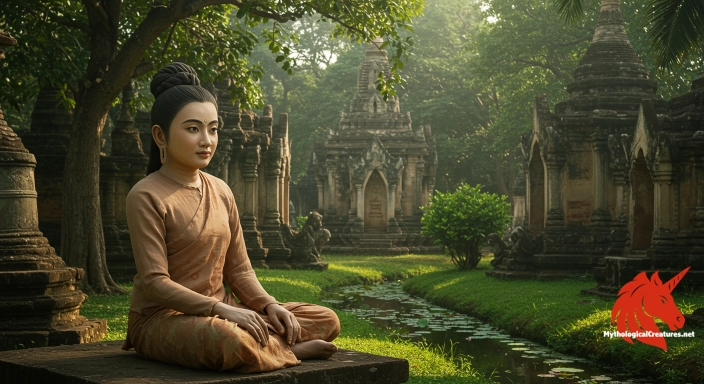
Htibyuhsaung Medaw
Htibyuhsaung Medaw - As the grandmother of King Anawrahta, she embodies the link between royal lineage and spiritual guardianship in Burmese culture.
the legend in five swipes.
the legend in five swipes.
What culture created Htibyuhsaung Medaw?
Htibyuhsaung Medaw emerges as a profoundly significant figure in the Burmese pantheon of nats, celebrated for her royal lineage and maternal sanctity. Born from the tapestry of ancient Pagan traditions, her legacy is intricately woven into the early history of Burma. As the revered Royal Mother of Htibyuhsaung, she embodies both the grace and hardships of mortals elevated to divine status. Her narrative, interlacing personal suffering with regal duty, resonates deeply with communities who value themes of resilience and compassion. The story of her life, marked by a fatal illness that led to her deification, imbues her with a humane quality that appeals to devotees. Through her familial connection as the grandmother of King Anawrahta, she symbolises the continuity between human lineage and spiritual prowess. Generations have passed down her tale in oral and written traditions, each retelling reinforcing her esteemed role. Her presence in the pantheon not only reflects historical truths but also transcends them, offering moral and cultural guidance. The enduring veneration of Htibyuhsaung Medaw is a testament to her impact on Burmese cultural identity and spiritual life.
Where can you read about Htibyuhsaung Medaw?
The narrative of Htibyuhsaung Medaw is preserved in a variety of ancient texts and oral traditions that have shaped Burmese myth. Historical chronicles, temple inscriptions, and folklore compilations have all contributed fragments to her extensive legacy. Multiple manuscripts and nat hagiographies recount her transformation from a mortal figure burdened by illness to a revered maternal spirit. While some accounts focus on her familial connections to the Pagan dynasty, others emphasise her personal virtues and the tragedy of her early demise. Diverse story variants illustrate how her life has been interpreted to reflect both royal grandeur and human frailty. In rural communities, her tale is often intermingled with local legends, further enriching her mythos. As collectors of folklore have revisited her story over the centuries, subtle variations have emerged, each version adding layers to her persona. These primary sources, though diverse, collectively underscore her importance as a symbol of maternal strength and historical continuity. The blend of documented history and oral narrative continues to inspire new interpretations of her life, ensuring her story remains dynamic and ever relevant.
The Appearance and Powers of Htibyuhsaung Medaw
Artistic depictions of Htibyuhsaung Medaw consistently capture her serene and dignified countenance, reflecting both nobility and vulnerability. Traditional images portray her with her hair elegantly knotted and dangling, symbolising the intertwining of royal grace and natural simplicity. She is often shown sitting with her knees neatly folded and one hand resting gently on her lap, a posture that conveys calm introspection and regality. The attire rendered in these depictions is rich with cultural symbolism, often showcasing garments reminiscent of the historic period of Pagan. Delicate embellishments and intricate patterns decorate her clothing, further emphasising her elevated status. Some artistic renditions highlight subtle variations in facial features, with soft, empathetic eyes and a gentle smile that hint at her human origins. Variability in size and presence can be noted in different portrayals, yet the essence of maternal care and divine authority remains consistent. The aesthetic choices made by traditional artists serve to fuse historical context with spiritual iconography, creating a timeless visual narrative. Her physical representation stands as a bridge between the tangible history of Burmese royalty and the ethereal realm of the nats.
Where in the world is Htibyuhsaung Medaw known?
While Htibyuhsaung Medaw is a central figure in Burmese nat tradition, regional interpretations of her mythology have enriched her story in distinct ways. In the heartland of Myanmar, she is portrayed with an air of solemn dignity that reflects the profound reverence held by urban devotees. Peripheral regions often infuse her image with local colour and vivacity, adapting her story to complement regional festivals and communal beliefs. Variations in artistic style can be observed, with some communities opting for more vibrant depictions that highlight her nurturing qualities and historical ties. Rural retellings may emphasise her role as a protector of families and a symbol of continuity, integrating traditional rites into modern celebrations. These local adaptations have allowed her myth to evolve, ensuring that it resonates with the diverse cultural tapestry of the country. The regional diversity in her portrayal underscores how folklore can be both preserved and transformed across geographical landscapes. In each locale, local customs and historical memories shape her image uniquely, blending the universal appeal of maternal strength with indigenous narratives.
Which figures are similar to Htibyuhsaung Medaw?
In a broader mythological framework, Htibyuhsaung Medaw shares thematic resonances with maternal and ancestral deities found throughout Southeast Asia. Her role as a guardian of lineage and nurturer of royal destiny draws parallels with similar figures in neighbouring traditions, where the divine feminine is revered for its protective and benevolent nature. Comparisons can be drawn with certain Thai and Lao spiritual archetypes that also embody the qualities of compassion, wisdom, and enduring resilience. These cross-cultural parallels illustrate a shared ethos in regional mythologies that honours the sanctity of maternal figures. In many traditions, figures like her are celebrated not only for their historical connections but also for their timeless virtues of care and sacrifice. Her attributes, such as a calm, authoritative presence and a blend of human suffering with divine grace, can be seen reflected in goddesses who serve as both protectors and custodians of cultural heritage. The shared motifs of nurturing, sacrifice, and supernatural intervention serve as a unifying thread among diverse mythological systems. By exploring these comparative aspects, one gains deeper insight into the universal patterns that inform how cultures understand and celebrate maternal divinity.
Why is Htibyuhsaung Medaw still popular?
The legacy of Htibyuhsaung Medaw has undergone significant evolution, echoing broader shifts in Burmese society and cultural expression. Her story, rooted in ancient royal history, continues to be a source of inspiration and reflection for contemporary audiences. Over the centuries, the emotive narrative of a mortal mother elevated to divine status has been reinterpreted through various artistic, literary, and performance traditions. Modern depictions in theatre, film, and visual arts have reimagined her character, often emphasising themes of resilience, compassion, and the enduring strength of maternal guardianship. Contemporary festivals and ritual celebrations keep her memory alive, with community rituals that revere her historical and spiritual significance. These modern adaptations not only preserve her myth but also allow for a dialogue between tradition and modern cultural identity. Her evolving representation reflects changing societal values while maintaining the core attributes that have made her an enduring icon. As new generations engage with her story, Htibyuhsaung Medaw continues to symbolise the interconnection of history, myth, and the universal experience of love and loss.
Interesting Fact
Her veneration in Burmese nat festivals illustrates the profound cultural integration of ancestral and spiritual elements in Myanmar.
Mythological Treasures
Egyptian Legends: A field guide to the gods and monsters of ancient Egypt
Guardians of the living and devourers of the dead, with the role each played in judgement.
Chinese Beasts: A field guide to the dragons and demon kings of Chinese myth
From river dragons to demon kings, with the legends that shaped five thousand years of storytelling.
Japanese Yokai: A field guide to the spirits and demons of Japanese folklore
Fifteen spirits, with the signs to watch for and what the old tales say to do if you meet one.
the legend in five swipes.
For authors, artists, and makers
Created something from the realm of myth?
If your book, deck, game, or artwork draws from legendary creatures and lore, you can showcase it here in a tasteful, year-round placement.
Share your projectQuick Creature Info
Origin:
Our Mythic Legendary Rating:

Also Sometimes Known As:
Habitat:
Supernatural Powers:
Physical Attributes:
Abilities:
Behavior:
Lore:
Related Creatures, Tales or Lore
- MMyay Medaw
- SShin Saw Pu
- MMin Kyawzwa
References
Discover Another Mythical Legend You May Not Have Heard Of?
Uncover the mysteries of ancient folklore and expand your knowledge of legendary beings from cultures around the world.
Dare to Meet the Zaratan....

The Mythological Creatures Book Series
Yokai, Greek, Norse, Egyptian & Chinese. Five illustrated field guides to the creatures the old stories either warned or told you about.



Curated by the Mythological Creatures Team
Series editor: Mythological Creatures Directory
Primary desk: Asian & Pacific Myth Cycles Desk
(rev. November 2025)