
Hue-tsiau: Hue-tsiau is a legendary firebird from Taiwanese folklore known for its destructive fire-causing powers.
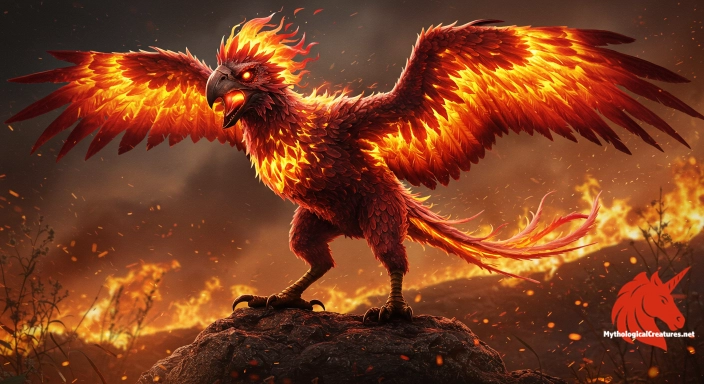
Hue-tsiau
Hue-tsiau - Hue-tsiau serves as a cautionary symbol warning against the uncontrollable destructive power of fire.
Origins & First Encounters
Hue-tsiau, known in Chinese as 火鳥 and pronounced Hué-tsiáu, emerges from Taiwanese folklore as a striking symbol of fire and transformation. Its mythic genesis appears intertwined with the island’s rich tapestry of indigenous beliefs and Chinese cultural influences, reflecting a history steeped in the awe of natural phenomena. Rather than embodying the regenerative qualities of the phoenix, Hue-tsiau is remembered for its capacity to ignite fires and provoke both reverence and trepidation. Early tales suggest that its appearance was often perceived as a portent of significant change, where nature’s raw power would manifest in unpredictable flames. The narrative surrounding this fiery avian has evolved over time, adapting to shifts in societal attitudes toward the natural world. Many accounts highlight its dual nature, where the sparks it leaves in its wake serve as both a warning and a call for caution. The vivid imagery associated with Hue-tsiau reinforces the enduring human fascination with the elemental force of fire. Its continued presence in stories and art over generations underscores the bird’s unique role in symbolising the volatile interplay between creation and destruction.
Source Texts & Tale Variants
Stories of Hue-tsiau have been carefully preserved through an array of oral traditions and sporadic written records in local Taiwanese communities. Early mentions often appear in temple archives and regional folktale compilations where the bird is depicted as an omen whose fiery presence signals imminent change. Verbal narrations passed through generations have tailored its character into various dynamic forms across different areas. In some renditions, Hue-tsiau appears at night, its blazing feathers lighting the horizon before a sudden outbreak of fire disrupts everyday life. Other variants focus on the bird’s role in orchestrating natural cleansing, albeit in a manner that leaves communities cautious and vigilant. The creature’s portrayal undergoes subtle changes, dependent on the storyteller’s emphasis on either its destructive might or its connection to a purifying, albeit perilous, force. Interviews with folklore practitioners and collectors during the late 19th and early 20th centuries have recorded these diverse versions, each carrying hints of regional sentiment. This rich tapestry of sources reveals a creature whose myth is as multifaceted as the historical and environmental challenges faced by its people.
Form & Powers
Hue-tsiau is traditionally depicted as a bird of formidable presence, its body ablaze with an array of fiery colours that range from deep scarlet to shimmering gold. The bird’s plumage appears to flicker and dance like live flames, giving it an almost supernatural radiance against the dark skies. Its wings, often illustrated as broad and sweeping, seem capable of scattering sparks and embers with every powerful beat. Observers in tales have noted that its eyes glow with an intense, almost otherworldly light, reflective of the heat it embodies. The beak is sharply curved, adding a predatory edge to its otherwise mystical appearance. Some narratives describe the Hue-tsiau as varying in size, at times as large as a majestic eagle, while other accounts offer a more compact depiction that enables stealthy passage. The layered texture of its feathers is reminiscent of the chaotic interplay of heat and air, further enhancing its enigmatic allure. Artists, through centuries of reinterpretation, have consistently imbued the bird with a blend of both elegant beauty and an inherent, untamed power.
Regional Faces
Within Taiwanese folklore, the image of Hue-tsiau takes on diverse nuances that often mirror the distinctive cultural and environmental contexts of different regions. In mountainous rural settlements, the firebird is sometimes seen as a mysterious spirit whose sudden appearance heralds moments of communal uncertainty and awe. Coastal areas, influenced by the clash of land and sea, weave in local maritime omens that blend the imagery of fire with that of surging tides and tempestuous weather. Urban retellings add another layer of reinterpretation, where the bird is occasionally depicted as a spectral figure dancing amidst the modern glow of city lights. Some communities craft versions of the myth that attribute a purifying force to its flames, suggesting that the fires it ignites clear away corruption or bring renewal. In contrast, other regional stories focus solely on its devastating impact, resonating with local experiences of uncontrollable blazes. Variations in artistic portrayals further underscore these differences, with rural depictions tending towards more mystic and atmospheric imagery. The regional adaptations of Hue-tsiau illustrate how local environments and collective memories shape the storytelling around this fearsome firebird.
Cultural Parallels
The myth of Hue-tsiau encourages an insightful comparison with other legendary birds found in diverse cultural traditions, particularly those that embody the element of fire. Unlike the phoenix, which symbolises rebirth and regeneration, Hue-tsiau is consistently associated with the destructive and unpredictable aspects of flame. Parallels can also be drawn with the Russian Firebird, a creature that similarly captivates with its luminous beauty while simultaneously invoking caution through its fiery nature. In several cultures, firebirds serve as metaphors for nature’s ambivalence—capable of both nourishing life and causing sudden devastation. The hue-tsiau’s role as an omen that foretells chaos contrasts with more benevolent mythic symbols, reinforcing a thematic divergence in how fire is interpreted across traditions. Its narrative, woven with threads of both allure and dread, illustrates the universal human tendency to mythologise the raw power of elemental forces. These comparative insights highlight an enduring cross-cultural motif: the perception of fire as a dual force that is as much a creator as it is a destroyer. Such cross-cultural reflections deepen our understanding of how communities encode their experiences of natural ferocities into enduring legends.
Legacy & Modern Evolution
The evolution of Hue-tsiau’s myth mirrors broader shifts in the way societies interpret natural phenomena and navigate the boundary between myth and modernity. Historically, this firebird has transitioned from a straightforward symbol of destructive fire to a multifaceted emblem that encapsulates the duality inherent in nature. Over the years, its portrayal has been reshaped by evolving cultural landscapes, adapting to the narratives of environmental change and technological progress. Modern reinterpretations often blend the traditional awe of elemental fire with contemporary concerns about climate change and urbanisation. In artistic circles, Hue-tsiau inspires a range of creative expressions, from paintings and sculptures to digital media, where its image is both a cautionary tale and a call for respect toward nature’s power. Local festivals and cultural events in Taiwan have embraced the legend, using the firebird as a dramatic focal point to explore themes of renewal and destruction. This sustained legacy not only honours the creature’s storied past but also reinvigorates its role as a symbol that straddles ancient myth and present-day reality. The enduring appeal of Hue-tsiau serves as a vivid reminder that the legends of old continue to resonate and evolve in the modern world.
Interesting Fact
Unlike its more revered mythological counterparts, Hue-tsiau is remembered solely for its capacity to bring destruction through fire rather than for symbols of rebirth or renewal.
Sponsor this space
Tasteful, fixed-fee placements for myth projects
No bidding wars or flashing banners. We offer simple placements for a small set of creators and brands aligned with our readers.
Request further detailsQuick Creature Info
Features:
Associations:
Our Mythic Legendary Rating:

Also Sometimes Known As:
Habitat:
Supernatural Powers:
Physical Attributes:
Abilities:
Behavior:
Lore:
References
Discover Another Mythical Legend You May Not Have Heard Of?
Uncover the mysteries of ancient folklore and expand your knowledge of legendary beings from cultures around the world.
Dare to Meet the Hobgoblin....
Curated by the Mythological Creatures Team
Series editor: Mythological Creatures Directory
Primary desk: Asian & Pacific Myth Cycles Desk
(rev. November 2025)