
Iapetus: Iapetus is a Titan from Greek mythology, famed as the father of Atlas, Prometheus, Epimetheus, and Menoetius.
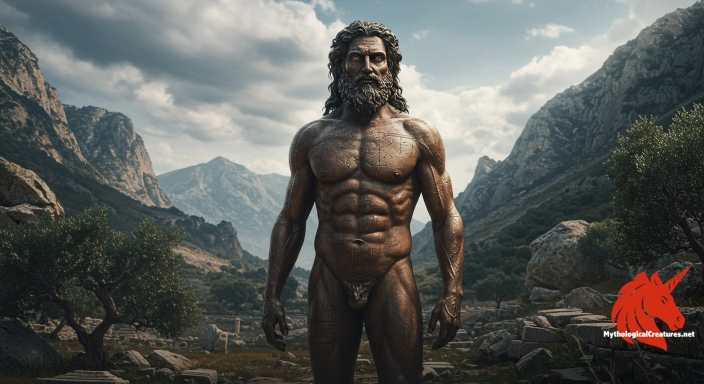
Iapetus
Iapetus - Iapetus is central to Greek myth as the father of Atlas, Prometheus, Epimetheus, Menoetius, and in some accounts, Buphagus and Anchiale; his legacy bridges divine lineage with early interpretations of human ancestry.
Origins & First Encounters
Iapetus emerges from the primordial canvas of Greek mythology as a Titan of remarkable renown, his origins deeply embedded in the union of Uranus and Gaia. His mythic inception is one of the earliest in the ancient Greek tradition, where he occupies a pivotal role among the cosmic progenitors. The legacy he bears is vast, being the father to some of the most storied figures such as Atlas, Prometheus, Epimetheus, and Menoetius, each of whom has their own influential narrative. His character embodies both the raw elemental power of creation and the tragic inevitability of fate, as reflected in the turbulent lives of his descendants. Over time, Iapetus has been interwoven with broader mythological themes, serving as a symbol of paternal authority and the generational transmission of divine qualities. His story, steeped in both awe and foreboding, continues to captivate with its blend of cosmic grandeur and personal hardship. The myth of Iapetus further extends into a fascinating cross-cultural dialogue by linking with the biblical figure Japheth, suggesting a shared ancestry and universal mythic resonance. His enduring presence in ancient lore not only highlights the complexities of the Titan lineage but also reinforces his role as a bridge between the mortal and the divine.
The nuanced portrayal of Iapetus invites a contemplation of cosmic order and the nature of legacy, making him a timeless figure in the narrative of mythological ancestry.
Source Texts & Tale Variants
The narratives surrounding Iapetus are chiefly drawn from the corpus of early Greek literature, where seminal works such as Hesiod’s Theogony provide a foundational portrayal of his lineage and progeny. His presence is woven into the fabric of mythic genealogies that detail the rise and fall of the Titans, offering a context that is as varied as it is profound. Ancient scholars and poets often refer to his myth in a way that underlines the generational impact of divine beings on the human condition. In addition to the canonical texts, later compilations like those by Apollodorus have contributed subtle variants and reinterpretations, adding layers to his mythic persona. The interplay between these sources and their retellings lends Iapetus a dynamic presence in mythological studies. Curiously, his conflation with Japheth, a figure from Biblical narratives, highlights an intriguing cross-cultural dialogue that spans continents and eras. This synthesis has been scrutinised by historians who observe how name similarities and thematic overlaps have blurred the boundaries between purely mythological and proto-historical identities. The multiplicity of sources not only ensures the survival of his story but also invites modern readers to explore the rich tapestry of interpretations that have emerged over time.
Each retelling, whether in poetic verses or narrative anecdotes, reinforces the lasting impression of Iapetus as a major touchstone in the realm of ancient myth.
Form & Powers
Although explicit physical descriptions of Iapetus are sparse in early texts, the scant references that endure paint a picture of an imposing, statuesque figure emblematic of Titan majesty. He is often imagined as possessing a robust physique that mirrors the elemental forces of creation from which he sprang. The imagery of Iapetus is typically imbued with a sense of timeless strength and a solemn aura, reflective of his role in a cosmic hierarchy. Later artistic interpretations have afforded him an almost sculptural quality, with a visage that blends aspects of both dignity and an underlying melancholy. The lack of detailed physical attributes in the canonical sources has allowed later generations to fill in the gaps with idealised representations of ancient greatness. Some classical artworks and fragments hint at an attire that is symbolic rather than literal, further enhancing the enigmatic quality of his form. His stature, as envisaged by artists and storytellers alike, suggests not only physical power but also an inner gravitas indicative of millennia of mythic heritage. This artistic liberty in depicting Iapetus underscores the evolving nature of myth, where physical form often mirrors metaphysical significance.
The collective visual interpretations of Iapetus continue to resonate with those who seek an embodiment of both heroic might and the poignant weight of ancestral destiny.
Regional Faces
The figure of Iapetus, while rooted in Greek myth, has experienced a fascinating range of regional reinterpretations as his legend spread across different cultures and epochs. In the heart of Greek tradition, he is primarily seen as a Titan whose very existence symbolizes the primordial struggle of the divine order. As his myth crossed into the Roman sphere, subtle shifts in his portrayal began to emerge, blending the austere legacy of the Greek Titans with the distinct narrative sensibilities of Roman lore. Beyond the Mediterranean, the striking similarity between Iapetus and the biblical Japheth allowed his identity to be further adapted in the context of Middle Eastern ancestral legends. These adaptations often recast him as a progenitor whose lineage was responsible for the spread of diverse peoples and cultural practices. Localised myth-making frequently incorporated Iapetus’s story into broader origin myths, aligning it with unique ethnic and regional narratives. This cross-cultural fertilisation not only enriched the original myth but also allowed local communities to assert a connection to the grand traditions of antiquity. Such regional variations highlight how Iapetus’s myth has been malleable enough to serve as a symbol of both universal origin and specific cultural identity.
The regional reconfigurations of his narrative underscore the adaptability of myth, illustrating how ancient figures can take on new meanings in the light of different historical and cultural contexts.
Cultural Parallels
In a comparative context, Iapetus can be juxtaposed with several mythic archetypes whose stories echo the themes of ancestry, legacy, and cosmic order. His role as the forefather of key mythic figures in Greek lore bears similarities to the progenitors found in other ancient traditions, where the act of creation and the subsequent division of power become central motifs. Much like the Norse giants or the ancient deities of Mesopotamian myth, Iapetus embodies the interplay between generational succession and inevitable decline. The narrative overlap with the biblical Japheth provides an intriguing point of convergence, inviting comparisons between Greek myth and the broader tapestry of Near Eastern genealogies. Both figures serve as symbolic bedrocks for understanding human origins and the diffusion of cultural identities. Additionally, while Cronus and Uranus are more directly concerned with the cycle of power eclipsing and reverting, Iapetus's legacy is primarily told through the actions and fates of his progeny. His subtle but significant imprint on myth exemplifies the cross-cultural allure of ancestral figures tasked with imparting both wisdom and warning. This analysis brings to light recurring themes of hubris, punishment, and the eternal struggle between order and chaos.
Thus, the character of Iapetus stands as a testament to the shared human fascination with the forces that govern creation and the passage of time, establishing deep-rooted connections between diverse mythological traditions.
Legacy & Modern Evolution
Over the centuries, the myth of Iapetus has undergone a profound transformation, reflecting shifts in cultural attitudes and artistic expression. In classical antiquity, his figure was inextricably tied to the grand narrative of the Titans, symbolising the inexorable march of time and the consequences of divine hubris. The Renaissance witnessed a revival of classical ideals, and Iapetus was reimagined in literature and art as a venerable symbol of both creation and decay. This period of rediscovery linked his image with the broader humanistic exploration of ancient wisdom, inspiring a host of new interpretations that echoed timeless philosophical themes. In later eras, especially with the advent of modern astronomy, the name Iapetus was immortalised as a celestial body orbiting Saturn, cementing his legacy in both myth and science. Contemporary artistic and literary renditions have often cast him as a poignant figure whose generational impact speaks to societal questions of destiny, responsibility, and the enduring nature of myth. Modern audiences engage with his story in a way that bridges the ancient with the modern, blending traditional motifs with fresh, reinterpretative insights. The legacy of Iapetus is thus a dynamic amalgam of myth, art, and scientific homage, testifying to the continual evolution of ancient narratives in the collective cultural imagination.
This ongoing reinterpretation ensures that Iapetus remains a resonant symbol, inviting new generations to explore the mysteries of the ancient world and their enduring impact on contemporary thought.
Interesting Fact
The conflation of Iapetus with Japheth exemplifies how ancient scholars merged disparate cultural legends to explain the origins of nations and human diversity.
For serious myth projects
Feature your work alongside the legends
From academic works to story-rich games, we highlight projects that respect world mythologies. Talk to us about a measured, long-term placement.
Start a conversationQuick Creature Info
Origin:
Our Mythic Legendary Rating:

Also Sometimes Known As:
Habitat:
Supernatural Powers:
Abilities:
Behavior:
Lore:
References
Discover Another Mythical Legend You May Not Have Heard Of?
Uncover the mysteries of ancient folklore and expand your knowledge of legendary beings from cultures around the world.
Dare to Meet the Tsul 'Kalu....
Curated by the Mythological Creatures Team
Series editor: Mythological Creatures Directory
Primary desk: Hellenic & Ancient Mediterranean Desk
(rev. November 2025)