
Irer: Irer is an ancient Egyptian god whose name translates to 'sight.
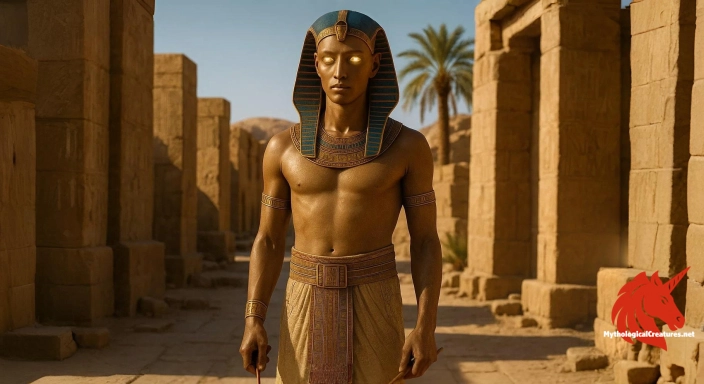
Irer
Irer - Irer represents the divine aspect of sight and the critical role of recording cosmic events. As one of the creative forces among the gods, he underpins the ancient Egyptian belief in the power of knowledge, vision, and cosmic order.
Origins & First Encounters
Irer emerges as a singular embodiment of divine sight within the vast tapestry of ancient Egyptian spirituality, his name evoking the clarity essential to both creation and cosmic insight. He is recognised as a pivotal creative force, joining Sedjem, Hu, and Sia to articulate the subtle mechanisms of the universe. His origin is embedded in the ceremonial and intellectual pursuits of Egypt, where the power of observation and the act of recording were held in high esteem. Irer’s first known manifestations are found in the majestic temple inscriptions at Abydos, during the reigns of Seti I and Ramesses II, where he is portrayed as a celestial scribe. The inscriptions reflect a nuanced conception of divine documentation, signifying not only the act of seeing but also the immortalisation of knowledge. His role bridges the gap between the spiritual and the tangible, illustrating how the Egyptians perceived the force of vision as elemental to order and creation. The deity’s function as a recorder of cosmic events positions him as both an observer and a mediator between the human realm and the divine. Artistic depictions and religious texts alike underscore his importance in maintaining the sacred balance and ensuring that the creative powers of the gods were faithfully transmitted. His presence in the pantheon, though subtle, underscores an enduring reverence for the act of sight as a path to enlightenment. Ultimately, Irer exemplifies the intricate links between perception, memory, and the unfolding of cosmic order in Egyptian thought.
Source Texts & Tale Variants
Ancient temple inscriptions and reliefs stand as the primary sources that shed light on Irer’s enigmatic role, offering rare glimpses into his divine duties. Carved along the walls of Abydos temples, these records associate him firmly with the ritualistic practices of record keeping and the preservation of cosmic order. His early depictions as a scribe alongside Sedjem point to a specialised narrative that interweaves visual perception with the act of inscription. In some accounts, Irer is depicted as a silent chronicler, capturing the gestures and events that echo the primordial forces of creation. Variations in the surviving hieroglyphic texts hint at subtle reinterpretations of his role as time and society evolved. Temple reliefs and stelae provide clues that his character might have absorbed differing attributes over successive reigns. The rare textual evidence complements these artistic interpretations, combining to outline a deity embodying patience and unwavering vigilance. Other narrative fragments suggest that his function extended beyond mere recording, signalling as well the underlying process of creative thought. The multiplicity of variants across sources points to a dynamic and layered myth, in which Irer’s contribution to cosmic regeneration was continuously re-envisioned. These ancient documents, though fragmented, continue to inspire modern scholarship and a deeper understanding of his role in Egyptian theology.
Form & Powers
In the visual tradition of ancient Egypt, Irer is depicted with a refined elegance that distinguishes him as a divine scribe of unparalleled precision. He is typically rendered with serene, unruffled facial features, symbolising an inner calm that underlies his extraordinary capacity to perceive. His eyes are often the focal point of his imagery, meticulously crafted to convey the depth of insight and the clarity of vision attributed to him. Adorned in a traditional kilt and ceremonial regalia, his attire reinforces both his ritualistic functions and his noble character. In many artistic depictions, he is shown holding a papyrus scroll or an inscription tool, reinforcing his role in recording cosmic events. The scale of his portrayals in temple reliefs is delicately balanced, reflecting his supportive yet essential position in the divine hierarchy. Subtle hieratic gestures, such as a measured tilt of the head or a deliberate extension of the hand, underline the precision associated with his divine task. His iconography is further enriched by accompanying inscriptions that detail his divine attributes and his connection to the act of sight. Variations in the exact details of his portrayal across monuments suggest a flexible iconographic schema designed to highlight different facets of his character. Through his physical representation, Irer is immortalised as a symbol of insight and the sacred responsibility of witnessing the unfolding of creation.
Regional Faces
Regional expressions of Irer’s divine character illustrate a fascinating interplay between centralised myth and local interpretation. In Abydos, where his earliest representations were discovered, his image is closely aligned with the role of a faithful scribe, deeply integrated into temple ritual. In contrast, depictions in more northern regions occasionally incorporate additional symbols of light and vision, emphasising his name that translates to ‘sight’. Such local variations allowed communities to adapt his symbolism to their regional religious ceremonies and artistic traditions. In some locales, the interplay between Irer and other wisdom deities was highlighted to strengthen the communal narrative of cosmic order. The variations in hieroglyphic inscriptions from different regions not only accentuate regional artistic flourishes but also reveal differential emphases on his creative capacities. Local craftsmen sometimes merged elements of his iconography with those of other deities, creating hybrid images that resonated with the spiritual sensibilities of the community. These diversified portrayals reflect a broader Egyptian tendency to let divine figures evolve organically with regional customs and interpretations. The dynamic nature of his regional depictions offered a sense of continuity and adaptability in the face of shifting theological paradigms. Ultimately, the regional evolution of Irer’s image underscores the richness and flexibility inherent in ancient Egyptian myth-making.
Cultural Parallels
A comparative exploration of mythological traditions reveals that Irer’s association with divine sight finds intriguing parallels around the world. His role in recording and witnessing cosmic events resonates with similar deities in other cultures, where the power of vision is closely linked with wisdom and creative potency. In Egyptian thought, as in other traditions, the act of seeing transcends the mere physical, emerging as a metaphor for inner enlightenment and the preservation of sacred truth. The character of Irer can be loosely compared to figures such as the Mesopotamian god Nabu, who similarly functioned as a celestial scribe and nurturer of divine memory. Across cultures, the motif of an all-seeing entity appears, drawing connections with the symbolic eyes found in various religious iconographies. Such parallels are also evident in the Greek reverence for deities whose visions spanned both mortal life and celestial realms. The evocation of internal and cosmic vision in Irer aligns with broader themes present in Eastern philosophical systems as well, where sight is emblematic of higher knowledge. Comparative mythology thus presents Irer as part of a universal narrative celebrating the transformative power of perception and record. The cross-cultural dialogue on divine vision underscores the shared human aspiration to capture and comprehend the mysteries of existence. By drawing these connections, Irer’s role is cast in a wider light, highlighting the timeless significance of insight in the human quest for understanding.
Legacy & Modern Evolution
The legacy of Irer has evolved considerably from his early attestations in monumental temples to modern reimaginings in art and literature. Initially anchored in the sacred rituals of Abydos during the New Kingdom, his function as a divine scribe has provided a subtle yet compelling counterpoint to the more prominent deities in that era. Over time, the attributes of divine sight and perceptive clarity have grown to symbolise intellectual pursuit and the recording of life’s transient moments. In later periods, as Egyptian religious thought underwent significant transformations, his role was reinterpreted to align with broader mystical and philosophical currents. This evolution allowed later generations to see him as a symbol of inner vision and an emblem of the eternal quest for knowledge. In modern artistic and spiritual circles, Irer is sometimes invoked as a metaphor for the clarity of perspective and the importance of documenting truth. Contemporary explorations of ancient Egyptian symbolism have sparked renewed interest in minor deities like Irer, leading to reinterpretations that blend traditional iconography with modern sensibilities. His enduring imagery continues to influence a range of cultural productions, from visual art to literature, encapsulating the universal appeal of divine insight. The subtle power of sight, as personified by Irer, has resonated with modern audiences who seek both creative inspiration and philosophical depth. Thus, his historical evolution and modern legacy serve as a testament to the timeless human fascination with the interplay between perception, knowledge, and cosmic order.
Interesting Fact
Irer uniquely embodies the connection between sight and wisdom in Egyptian mythology, highlighting the ancient understanding that vision is essential to the preservation and creation of cosmic order.
Mythology-aligned partners
Showcase your myth-friendly brand here
Run a store, studio, or platform that lives in the world of myth and folklore? A curated sponsor panel on these pages may fit.
Explore partnership optionsQuick Creature Info
Origin:
Associations:
Our Mythic Legendary Rating:

Habitat:
Supernatural Powers:
Physical Attributes:
Abilities:
Behavior:
Lore:
References
Discover Another Mythical Legend You May Not Have Heard Of?
Uncover the mysteries of ancient folklore and expand your knowledge of legendary beings from cultures around the world.
Dare to Meet the Valac....
Curated by the Mythological Creatures Team
Series editor: Mythological Creatures Directory
Primary desk: Hellenic & Ancient Mediterranean Desk
(rev. November 2025)