
Israfil: Israfil is an archangel in Islamic tradition known for signaling the Day of Judgment by blowing a trumpet.
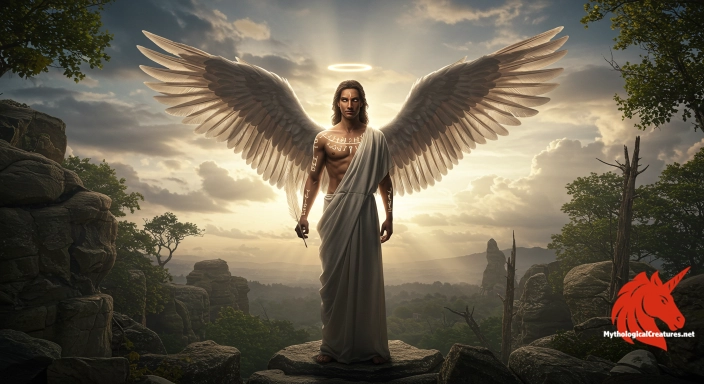
Israfil
Israfil - Israfil is revered as the archangel who will blow the trumpet to signal the resurrection and judgment of all souls.
Who first told stories about Israfil?
Israfil emerges as one of the most revered archangels in Islamic tradition, celebrated for his solemn duty of heralding the approaching Day of Judgment with a divine trumpet blast. His narrative took shape in the early stages of Islamic thought, where stories of celestial duties evolved into profound symbols of divine justice and mercy. Despite his absence from the Quran, later theological works and mystical traditions enriched his character, rendering him as the custodian of destiny and the cosmic order. Ancient accounts detail his status as the eldest among the angels, a testament to his timeless and enduring role. His myth intertwines both the inevitability of divine reckoning and the hope embedded in the renewal of creation. Israfil’s sacred task of recording and signalling fate has encouraged believers to reflect on the balance between human free will and predestined cosmic order. This blend of mystery and purpose has secured his place in Islamic eschatology as well as in the broader realm of spiritual symbolism. By encapsulating themes of transformation and divine intervention, his legend continues to echo through centuries of religious and cultural discourse.
Israfil in the Historical Record
Primary reflections of Israfil’s existence are scattered throughout early Islamic traditions and later mystical literature, where he is repeatedly portrayed as the angel whose trumpet summons the final hour. Although he is not directly mentioned in the Quran, hadith literature and oral traditions have significantly contributed to his established role as the divine herald. Ancient narratives, including references in texts sometimes termed the “Book of Dead,” have underlined his status as the oldest among the celestial beings. Through medieval commentaries and scholarly exegeses, diverse story variants arose, each elaborating on his responsibility for recording divine decrees with his sacred pen. These varied accounts impart nuances that highlight both his apocalyptic purpose and his intrinsic connection to human destiny. In several narrative strands, Israfil is depicted as a solitary figure in the heavenly host, whose actions resonate with themes of divine mercy and inevitable judgement. The spread of his myth can be seen in the differing ritualistic and theological treats found in regional literature. The wealth of these sources not only enriches his narrative but also reinforces his enduring prominence within Islamic eschatology.
Israfil: Powers, Strengths and Vulnerabilities
Descriptions of Israfil’s form seamlessly blend poetic imagery with a profound sense of celestial mystery. He is most often envisioned with enormous, radiant wings that span vast expanses of the heavenly realm, symbolising both power and grace. In enigmatic portrayals, one wing is charged with the sacred task of holding the divine pen that inscribes the destiny of humankind, while the other is used to conceal his face in a gesture of humility before the Divine. Such allegorical depictions suggest that his physical form is not merely a representation of strength but also of the ineffable nature of spiritual truth. His visage, shrouded in an otherworldly glow, speaks to an existence that transcends mortal perception, evoking both awe and veneration. Although traditional art in Islamic culture often refrains from detailed representations, literary descriptions paint him as an embodiment of radiant splendour and mystery. His physical attributes serve as metaphors for deeper truths: the interplay of light and shadow reflects the dual nature of divine justice and mercy. These poetic portrayals continue to inspire reinterpretations in both classical literature and modern visual arts, keeping his enigmatic presence vividly alive in the cultural imagination.
Israfil: Local Variations in the Story
Across various regions of the Islamic world, Israfil’s depiction has been nurtured and transformed by local cultural and artistic influences. In Arab lands, his identity remains closely interwoven with eschatological themes, emphasising the imminent call of the trumpet as the harbinger of cosmic transformation. Persian literary traditions, meanwhile, often celebrate his mystical qualities through flowing poetry and elaborate metaphors that enhance his symbolic beauty. In the Ottoman and Mughal realms, chroniclers and artists adapted his image to reflect refined aesthetics and an elevated sense of divine duty. Regional narratives have occasionally merged his celestial role with local folklore, adding layers of spiritual symbolism that resonate with indigenous beliefs about fate and renewal. Despite these regional adaptations, a core emphasis on his function as the recorder of destiny and bellower of judgement continues to unite disparate traditions. Each cultural retelling enriches his character while maintaining the inherent themes of divine oversight and temporal transition. Thus, whether portrayed in the lyrical verses of Persian poets or in the solemn narratives of Arab theologians, Israfil’s portrayal remains a potent emblem of cosmic order across diverse regions.
The Global Cousins of Israfil
Israfil’s mythological persona invites illuminating comparisons with other archangelic figures found in diverse religious traditions. His role as the angel destined to sound a trumpet at the end of days establishes a clear parallel with the concept of divine heralds, reminiscent in part of figures like Gabriel in Judeo-Christian lore. This capacity to signal pivotal cosmic moments is echoed in the role of Raphael, with whom he is sometimes contrasted regarding the guiding of and healing for humankind. Comparative perspectives often note that the motif of a celestial musician or trumpeter appears across multiple cultures, reflecting a shared human preoccupation with the sound heralding transformation and final judgement. Such cross-cultural resonances underline a universal archetype—an intermediary between divine decrees and mortal existence. Israfil’s mystique, characterised by his partly concealed face and the dual functions of his wings, mirrors themes present in other traditions where divine beings are both revered and enigmatic. The blending of physical symbolism with metaphysical purpose places him alongside other transcendent figures whose roles have evolved to encompass both cosmic warning and gentle guidance. These cultural parallels enrich his narrative, demonstrating how a single mythic figure can bridge disparate spiritual and artistic traditions through common symbols of destiny and divine power.
How has Israfil changed over time?
Over the centuries, Israfil has evolved from a figure deep-rooted in eschatological lore to one that continues to inspire modern artistic and cultural expressions. His image, initially conveyed in religious treatises and oral traditions, has been reinterpreted in various artistic media, from classical calligraphy to contemporary digital art. The act of blowing his trumpet, emblematic of the final reckoning, has been transformed into a metaphor for transition, renewal, and the timeless cycle of fate. Traditional narratives emphasizing his role in recording destiny have given way to modern interpretations that explore the interplay of fate, free will, and cosmic order. His enduring symbolism transcends strict religious boundaries, resonating with modern audiences grappling with the fundamental questions of existence and morality. As academic studies and popular media revisit ancient myths, Israfil’s story has been reimagined in literature, film, and visual arts, each new rendition adding a layer of complexity to his character. This evolution reflects a broader cultural dialogue wherein ancient myth and modern thought merge to offer fresh perspectives on the nature of divine intervention. Today, Israfil stands not only as a messenger of the divine but also as a symbol of the perpetual human quest for understanding the mysteries of life and the cosmos.
His legacy endures as a bridge between past and present, inviting continual reinterpretation and reaffirming the indelible impact of myth on collective consciousness.
Interesting Fact
Israfil's portrayal, with one wing bearing a sacred pen and the other concealing his face, uniquely symbolises the profound mystery and awe of divine revelation in Islamic tradition.
Partner with us
Sponsor this space
Reach thousands of mythology enthusiasts with a curated placement on our creature pages.
Learn about sponsorshipQuick Creature Info
Origin:
Features:
Associations:
Our Mythic Legendary Rating:

Also Sometimes Known As:
Habitat:
Supernatural Powers:
Physical Attributes:
Abilities:
Behavior:
Lore:
Related Creatures, Tales or Lore
- GGabriel
- MMichael
- RRaphael
References
Discover Another Mythical Legend You May Not Have Heard Of?
Uncover the mysteries of ancient folklore and expand your knowledge of legendary beings from cultures around the world.
Dare to Meet the Myiagros....

Curated by the Mythological Creatures Team
Series editor: Mythological Creatures Directory
Primary desk: Hellenic & Ancient Mediterranean Desk
(rev. November 2025)