
Išḫara: Iššubara is an ancient goddess originally worshipped in Ebla, Syria during the third millennium BCE.
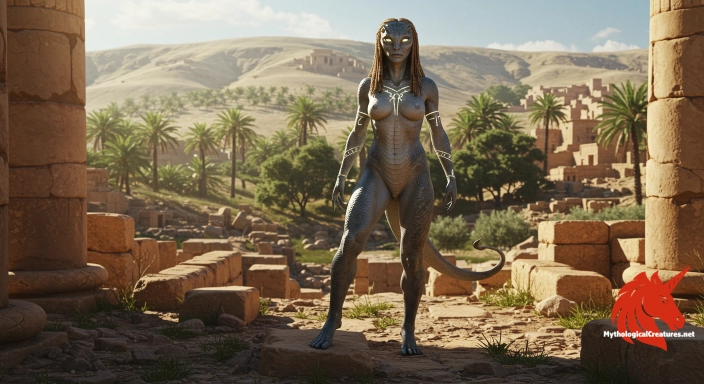
Išḫara
Išḫara - Her worship underscored the importance of marital and royal institutions, influencing a wide array of ancient Near Eastern cultures.
Origins & First Encounters
Iššbara emerged from the vibrant religious landscape of ancient northern Syria as a goddess of considerable stature and complexity. Her early worship in Ebla and surrounding settlements during the third millennium BCE positions her as a pivotal divine figure in early urban civilisation. She was revered not only as a tutelary deity overseeing the royal family but also as an influential spirit governing love and marital union. The goddess’s association with both sacred marriage and erotic passion highlights her multifaceted role in society and the personal lives of her devotees. Her enigmatic name, with uncertain etymological origins, points to a linguistic substrate that hints at deeper, possibly pre-existing cultural narratives. Over time, the layers of her divine persona expanded to incorporate elements of oath-taking and divination, thereby integrating her into a broader cosmic order. Iššbara’s figure exemplified the merging of political power and intimate human relationships in a period of transformative myth and ritual. She stands as a testament to how early religious traditions could embody both the regal and the personal, reflecting the values and uncertainties of ancient Near Eastern societies.
Source Texts & Tale Variants
The textual record surrounding Iššbara is impressively varied, drawing from an array of ancient documents and mythological compositions. Eblaite archives furnish some of the earliest and most detailed evidence, where her role was intricately recorded alongside other major deities. Her presence in texts from Emar, with references to festivals like the kissu and zukru, underscores her long-standing and widespread cultic significance. Mythical narratives from both Mesopotamian epics, such as the stories of Gilgamesh and Atrahasis, incorporate her as a divine agent of marriage and protection. In Hurrian literature, particularly in the Song of Release, Iššbara is portrayed with a distinctive narrative voice that contrasts with her portrayals in other regions. The Song of Kumarbi further embeds her within a network of deities invoked to bear witness to cosmic tales, indicating her integral role in universal mythic cycles. Numerous theophoric names found in Mari, Tuttul, and other ancient cities attest to personal devotion that transcended geographical boundaries. The diversity of these sources, spanning ritual inscriptions, epic narratives, and onomastic evidence, paints a picture of a goddess whose myth and cult adapted to a variety of cultural contexts.
Form & Powers
Although direct depictions of Iššbara in anthropomorphic form are rare, her visual representation is rich in symbolic imagery. In later Mesopotamian art, particularly during the Kassite and Middle Babylonian periods, she was almost exclusively represented by her scorpion symbol rather than by human form. This non-human iconography was complemented by associations with reptiles, notably the mythical bašmu and ʿbulmiṭṭu, which were emblematic of both danger and transformative power. Artists and worshippers alike employed these animal motifs to evoke her protective and enigmatic nature without resorting to a standard divine visage. The choice to represent her through these symbols underscores the ancient preference for abstract representation when dealing with deities whose realms extended beyond the purely human. The scorpion, as an emblem, carried connotations of both potency and subtle lethality, qualities that resonated with her functions in love, marriage, and divination. Despite this symbolic approach, hints of her divine presence also emerged in ritual contexts where her attributes were invoked through verbal and material offerings. The evolution of her representation—from the subtle interplay of animal symbolism in early art to its more formalised appearance in later periods—offers valuable insights into the shifting paradigms of divine depiction in the ancient Near East.
Regional Faces
Iššbara’s cult underwent significant transformations as it spread from her early Eblaite origins to neighbouring cultural spheres. In Ebla and the immediate northern Syrian region, she was primarily venerated as the protector of the royal house and as a guardian of marital vows. Moving to the middle Euphrates and Mesopotamia, her character became interwoven with that of Ishtar, resulting in overlapping yet distinct attributes that resonated with local conceptions of love and fertility. In Emar, her prominence is evident in the records of specialised festivals, which suggest that regional rituals provided her with a unique ceremonial identity. In the north, areas like Assyria adapted her worship to stress the symbolic power of her scorpion motif, indicating a distinct visual and theological reinterpretation. Similarly, in Anatolia, particularly within Hittite and Kizzuwatna contexts, local traditions absorbed and reshaped her attributes to align with indigenous ritual practices. Hurrian religious texts also reveal her integration into a pantheon where she was linked with deities such as Allani, reflecting a local reinterpretation of her esoteric functions. Ultimately, the regional variations in both her iconography and cultic practices underscore the adaptability of her myth, revealing a flexible divine persona that could incorporate the nuances of diverse local traditions.
Cultural Parallels
When examined alongside her neighbours in the ancient pantheon, Iššbara reveals fascinating parallels and divergences with other deities of love and covenant. Her domain over marriage and oaths invites comparisons with the more widely known Ishtar, yet the two goddesses retained distinct ritual roles and iconographic methods despite their overlapping spheres. Elements of her character resonate with the dual nature of Inanna, particularly in terms of balancing aspects of passion with a sense of divine order. Both deities illustrate how the ancient Near Eastern mind could accommodate complex and multifaceted divine personas. The animal symbolism associated with Iššbara, especially her scorpion emblem, finds echoes in other traditions where non-human forms embody protective and transformative qualities. This mode of representation contrasts with more anthropomorphic portrayals seen in other goddesses, highlighting a deliberate emphasis on abstract power over familiar human form. The varied depictions across regions further reinforce a cross-cultural dialogue in which each society articulated its own understanding of divine intervention in matters of love and legitimacy. Such comparative analysis underscores the fluidity with which sacred symbols could traverse cultural boundaries, enriching the mythological tapestry of the ancient world.
Legacy & Modern Evolution
The historical trajectory of Iššbara reflects a continuous evolution in religious thought and artistic expression across millennia. Initially revered in Ebla, her cult expanded eastwards to Mesopotamia and northwards into Assyrian and Anatolian traditions, displaying a remarkable capacity to adapt. Over time, her representations shifted from potentially anthropomorphic images to distinctive abstract symbols such as the scorpion, mirroring broader trends in ancient iconography. Her mythic functions—encompassing protection of the royal house, affirmation of marital bonds, and oversight of divination—remained resilient even as political landscapes transformed. Later periods saw her integration into more comprehensive pantheons, where her specific attributes were reinterpreted to align with evolving cultural and theological discourses. Modern scholarship has begun to reappraise Iššbara’s legacy, recognising her as a crucial link between early state formation, ritual practice, and symbolic art. Contemporary interpretations, whether in academic discourse or cultural revival movements, often highlight her as an emblem of empowerment and enigmatic continuity. Her enduring symbolism continues to inspire re-enactments and reinterpretations in modern literature and neo-pagan practices, ensuring that the echoes of her ancient cult persist into the present day.
Interesting Fact
Despite her extensive worship and profound cultural influence, Iššubara is rarely depicted in anthropomorphic form in later periods, with her scorpion symbol serving as her unique and enduring icon.
Limited sponsor opportunity
One slot, carefully chosen partners
We only feature a small number of relevant sponsors at any time. If you create serious myth content, we would like to hear from you.
Partner with usQuick Creature Info
Origin:
Features:
Associations:
Our Mythic Legendary Rating:

Habitat:
Supernatural Powers:
Physical Attributes:
Abilities:
Behavior:
Lore:
Related Creatures, Tales or Lore
- IIshtar
- AAstarte
- NNinkarrak
References
Discover Another Mythical Legend You May Not Have Heard Of?
Uncover the mysteries of ancient folklore and expand your knowledge of legendary beings from cultures around the world.
Dare to Meet the Theia....
Curated by the Mythological Creatures Team
Series editor: Mythological Creatures Directory
Primary desk: Hellenic & Ancient Mediterranean Desk
(rev. November 2025)