
Kydoimos: Kydoimos is the personification of the chaotic din and confusion of battle in Greek mythology.
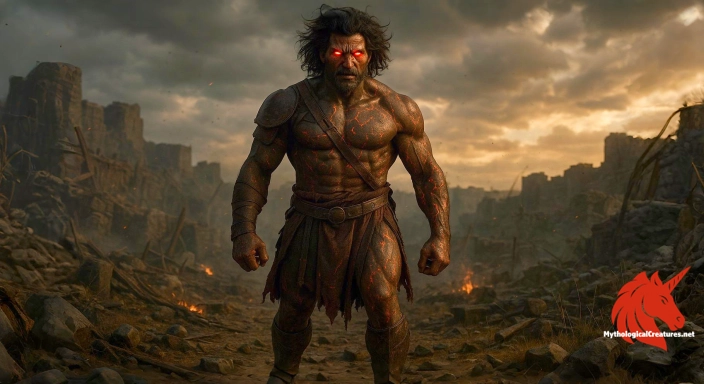
Kydoimos
Kydoimos - Represents the chaotic and overwhelming sensory experience of battle, highlighting the role of noise and confusion in warfare.
Origins & First Encounters
Kydoimos emerges from the tapestry of Greek mythology as a distinctive embodiment of the clamor and confusion that accompanies the chaos of battle. His origins are woven into the fabric of ancient warfare, where the bellows of combat were not merely physical but also imbued with a spectral, almost divine significance. He is best known as a personification of the uproar, a living manifestation of the disordered soundscape that enveloped ancient battlefields. His earliest attestation is found in the comic plays of Aristophanes, where his presence highlights the absurdity and overwhelming nature of war. The cultural context of his myth emphasises the belief that every element of combat, even the cacophony, was governed by its own supernatural forces. Kydoimos, though less celebrated than major deities like Ares, played a crucial role in symbolising the sensory and psychological impact of war. His character illustrates that conflict was not only a struggle of physical might but also an experience profound in its auditory and emotional turmoil. The ancient Greeks recognised that the disordered sounds of battle carried an almost tangible power, enabling Kydoimos to stand as both a personification and a warning of the uncontrollable forces at play.
Source Texts & Tale Variants
The principal mention of Kydoimos occurs in Aristophanes’ Peace, where the playwright uses his character to evoke the chaotic spirit of warfare with a blend of satire and underlying respect. Although primary sources are sparse and largely limited to this theatrical reference, later scholia and commentaries have hinted at his inclusion among the Makhai, the daimones of battle. The scant narrative details provided in original texts leave much to the interpretative imagination of later mythographers. Some ancient fragments subtly associate his character with the sensory overload of combat, suggesting that the Greeks conceived of war not only as a physical confrontation but also as an overwhelming auditory experience. Additional mentions in lesser-known texts and regional inscriptions, while fragmentary, indicate that his myth was part of a broader understanding of battle noise as a force in its own right. These variations in his depiction underscore the multifaceted nature of Greek myth, where even minor figures could encapsulate complex ideas. Over time, interpreters have sought to reconcile these brief descriptions with the broader context of warfare mythology in the ancient world. Despite the limited primary sources, the enduring symbol of Kydoimos continues to evoke discussions on the intersection of sound, chaos, and conflict. His role as an embodiment of auditory chaos has been a focal point for scholars interpreting the psychological dimensions of ancient warfare.
Form & Powers
Though ancient texts offer few explicit descriptions of his physical form, the symbolic essence of Kydoimos invites imaginative reconstructions. One may envision him as an ephemeral figure whose features are as shifting and tumultuous as the clamor he embodies. His visage is likely imagined with wild, frenzied eyes and transient features that mirror the ever-changing soundscape of combat. In artistic portrayals, he might appear draped in mist or shadow, his form dissolving into a swirl of chaotic energy. This lack of fixed form serves to underline his nature as a personification rather than a corporeal god. Some depictions suggest he could wear a crown or mantle that seems to be fashioned from the very noise and disarray of battle. His overall presence is thought to be both awe-inspiring and intimidating, evoking a sense of unavoidable disorder. The blending of human attributes with abstract, formless elements enabled ancient artists to symbolise the eerie and pervasive impact of tumult during conflict. Thus, Kydoimos’s appearance, ever fluid and indefinable, perfectly encapsulates the essence of battle-induced hubbub and confusion.
Regional Faces
Regional interpretations of Kydoimos reveal an intriguing adaptability that allowed his myth to merge with local cult practices throughout the Greek world. In the urban centres, his role was sometimes subsumed under the broader spectrum of war deities, while rural communities often maintained a distinct and personal reverence for his chaotic influence. Variations in his portrayal can be seen in the subtle differences in local artistic depictions, where the emphasis might shift from mere auditory chaos to a more comprehensive embodiment of battle’s disruptive energy. In some regions, his characteristics were blended with those of other minor spirits, resulting in a multifaceted figure that both warned of and celebrated the tumult of combat. Local traditions occasionally venerated him during military rituals, considering his presence as a necessary counterbalance to the order imposed by military discipline. This syncretism allowed him to be both a symbol of uncontrollable disorder and a cautionary figure within the broader martial pantheon. Differences in dialect and regional narrative styles further colour his myth, adapting his abstract attributes to fit local perceptions of war. Despite such variations, the core notion of Kydoimos as the personification of battle din remains consistent. The regional adaptations highlight how Greek mythology could flexibly accommodate diverse interpretations of elemental forces, reinforcing the universal experience of war’s chaotic impact.
Cultural Parallels
Kydoimos shares intriguing similarities with other mythological personifications of conflict found across various cultures. Much like the Norse spirits that embody the frenzy and tumult of battle, his existence is intertwined with the sensory chaos that accompanies violent confrontations. In Roman mythology, while figures like Bellona represent the ferocity of war, Kydoimos distils the auditory and psychological disarray in a manner all his own. The personification of sound in warfare is a recurring theme across cultures, indicating a universal human attempt to capture the intangible effects of combat. His abstract nature, which transcends the simple dichotomy of good versus evil, parallels the multifaceted depictions of battle deities around the world. Comparative analysis reveals that many societies have embraced a similar archetype—a being that encapsulates both the physical and emotional disturbances of conflict. Such parallels underscore the universal recognition of war’s capacity to unsettle and alienate through sensory overload. These comparisons not only highlight the cross-cultural resonance of chaotic battle imagery but also serve to enrich our understanding of how ancient peoples experienced and mythologised the realities of conflict. In this way, Kydoimos stands as part of a broader global tradition that seeks to personify and ritualise the unpredictable nature of warfare.
Legacy & Modern Evolution
Over the centuries, Kydoimos has evolved from a fleeting figure in a single play to an enduring symbol of the disordered clamor of battle. Initially rooted in the tangible experiences of ancient warfare, his myth later became a vehicle for exploring the intangible qualities of conflict in art and literature. During the Hellenistic and Roman periods, his representation merged with the general iconography of chaos, reflecting the evolving perceptions of war and its effects. In modern times, scholars and artists have rediscovered Kydoimos as a metaphor for the psychological disarray wrought by violent conflict. His association with sensory overload and disruption resonates with contemporary discussions on the impact of modern warfare. The abstract nature of his myth allows for flexible reinterpretations, making him a favourite subject in both academic debates and creative explorations. Modern reinterpretations sometimes cast him as both a cautionary figure and a symbol of the uncontrollable aspects of human aggression. His enduring legacy is evident in the sporadic reappearances of his motif in literature, visual arts, and even popular culture. Each new interpretation reaffirms his place as a timeless emblem of the chaos that inevitably accompanies armed conflict. Thus, Kydoimos continues to serve as a powerful reminder of the complex interplay between noise, chaos, and the human experience of war.
Interesting Fact
Despite being an abstract personification, Kydoimos serves as a potent reminder of how the ancient Greeks attributed supernatural qualities to the chaotic elements of battle.
Advertising opportunity
Showcase your mythology project
We offer limited sponsor placements for books, courses, games, and creators aligned with our audience.
View partnership optionsQuick Creature Info
Origin:
Our Mythic Legendary Rating:

Also Sometimes Known As:
Habitat:
Supernatural Powers:
Physical Attributes:
Abilities:
Behavior:
Lore:
Related Creatures, Tales or Lore
- AAlala
- PPhobos
- DDeimos
References
Discover Another Mythical Legend You May Not Have Heard Of?
Uncover the mysteries of ancient folklore and expand your knowledge of legendary beings from cultures around the world.
Dare to Meet the Thriae....
Curated by the Mythological Creatures Team
Series editor: Mythological Creatures Directory
Primary desk: Hellenic & Ancient Mediterranean Desk
(rev. November 2025)