
Leigong: Leigong, also known as Leishen, is the Chinese god of thunder who enforces divine justice on both mortals and evil spirits.
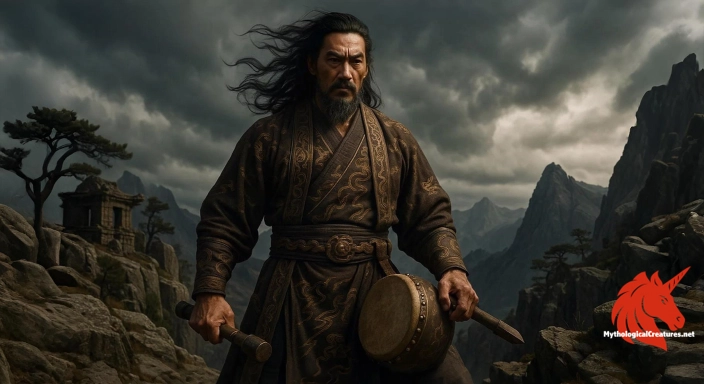
Leigong
Leigong - Leigong is revered for maintaining cosmic justice and his control over thunder and weather, making him a cornerstone figure in Chinese mythology.
Origins & First Encounters
Leigong is a formidable deity whose presence in Chinese mythology is both awe‐inspiring and deeply symbolic of the natural forces that govern the cosmos. His origins are rooted in ancient Chinese folk religion and Taoism, where his role as the Lord of Thunder was established to enforce moral and cosmic order. He emerged from a period when the forces of nature were seen as direct manifestations of divine will and human accountability. His narratives articulate a cosmic balance in which the heavens intervene against mortal wrongdoing and spiritual malevolence. Over time, his image transformed into a symbol of retributive justice, illustrating the interplay between celestial power and earthly conduct. Ancient mythic texts and oral traditions alike have preserved stories of his thunderous interventions, reinforcing his stature as both a punisher and a guardian. The early records, though fragmentary, attest to his function as an arbiter between the human and the supernatural realms. His enduring appeal in literature and temple art speaks to the profound impact of his myth on cultural ethics. Leigong’s character encapsulates the primordial fear and respect for nature’s might, a theme that has resonated through successive generations. His myth continues to inspire both reverence and scholarly intrigue in contemporary interpretations of ancient spiritual wisdom.
Source Texts & Tale Variants
Ancient manuscripts and temple inscriptions form the bedrock of Leigong’s myth, offering glimpses into a diverse narrative tradition. Multiple regional accounts and Taoist scriptures reveal varied versions of his exploits that have evolved through centuries of oral transmission. Early literary sources depict him as an uncompromising executor of divine retribution, a motif that was later enriched by local folklore. Narrative traditions recount episodic tales in which Leigong wields his drum and mallet to unleash thunder upon those condemned by the heavens. Story variants often merge his character with other elemental deities, reflecting complex religious interconnections. Local festivals and ritual dramas have preserved these powerful images, ensuring that his legacy is both living and adaptable. Despite variations, the core elements of his myth consistently underscore the themes of judgement and cosmic order. Some texts focus on his interactions with his celestial entourage while others emphasise the severity of his punishments. This multiplicity of voices has contributed to a layered, multifaceted portrayal that remains vibrant in the cultural imagination. His story, passed down through generations, continues to be a subject of reinterpretation and recontextualisation in modern spiritual discourses.
Form & Powers
Leigong is traditionally depicted with a commanding physique that mirrors the overwhelming force of the storm he embodies. His countenance is often stern, marked by intense eyes and a wild, unruly beard that symbolises the chaotic energy of thunder. His attire is richly decorated with intricate motifs that invoke images of lightning, clouds, and rain, reflecting his dominion over the sky. Artistic renditions frequently show him holding a heavy drum and mallet, instruments without which the very sound of thunder would be incomplete. The vivid imagery of his chisel highlights his role as an executor of divine punishment, carving justice into the annals of both mortal and immortal worlds. In some portrayals, his robust form is softened by a dignified calm that belies his fierce power. Variations in his depiction sometimes present him as an older, sagely figure or as a vigorous, battle-ready warrior astride his celestial chariot. His physical appearance is accentuated by the dynamic presence of his companions, each adding a complementary element to his overall depiction. The visual language used to describe him combines elements of brutal strength and meticulous craftsmanship, making his iconography uniquely compelling. His image is an enduring symbol of how physical form and divine duty can be intricately interwoven in mythological art.
Regional Faces
Across the vast cultural landscape of China, regional interpretations of Leigong have led to strikingly diverse portrayals. In northern traditions, he is sometimes depicted with a more austere, martial aspect that mirrors the severity of local climates. Southern regions, by contrast, may imbue his figure with a benevolent quality, highlighting his role as a moral regenerator who tempers chaos with order. Local festivals often celebrate his myth through dramatic reenactments that blend indigenous customs with overarching Taoist themes. In rural communities, his thunderous character is interwoven with local legends that address both environmental phenomena and social justice. Visual arts in various provinces have adapted his iconography to include regional symbols, tempering universal thunder motifs with local cultural aesthetics. His image in coastal areas has occasionally been merged with maritime legends, illustrating the interplay between stormy seas and the heavens. The adaptability of his portrayal underscores a regional flexibility that allows his myth to remain relevant across differing local narratives. Communities have embraced his diverse representations, which reflect not only his divine attributes but also the cultural and climatic realities of their environment. In this way, Leigong serves as a mirror for regional identity and the timeless human quest for order amid nature’s unpredictability.
Cultural Parallels
When contrasted with thunder deities from other cultures, Leigong’s persona reveals a unique blend of retributive justice and elemental power. Unlike Zeus in Greek mythology, whose thunderbolts symbolise both authority and regal sovereignty, Leigong is primarily an agent of moral rectitude and cosmic punishment. His role shares common ground with figures such as Thor from the Norse pantheon and Indra from Indian lore, all of whom command natural forces through divine weaponry. However, Leigong’s narrative often places a greater emphasis on the ethical consequences of natural phenomena, setting him apart in his function as a moralistic enforcer. His entourage, which includes the goddess of lightning and other elemental spirits, echoes the collaborative divine retinues found in many other cultures. This ensemble of deities mirrors the structured pantheons of Japan and Southeast Asia, though with a distinctly Chinese flavour. Comparative analysis reveals that while other thunder gods may also preside over elements of fertility or kingship, Leigong is singularly dedicated to the punishment of transgression. His myth not only encapsulates the raw power of nature but also serves as a cultural touchstone for understanding ancient Chinese conceptions of justice. Through these cross-cultural comparisons, the universality of invoking the tempest as a symbol of divine power becomes evident. Leigong thereby occupies a unique position among thunder gods, distinguished by his steadfast commitment to inscrutable cosmic order.
Legacy & Modern Evolution
Throughout history, the myth of Leigong has continually evolved, reflecting transformations in religious thought and artistic expression. In ancient times, his intimidating persona underscored a worldview in which divine retribution was both inevitable and essential to societal order. Over the centuries, his depiction has shifted from a purely fearsome figure to one that embodies complex themes of justice, responsibility, and the natural cycles of the world. Modern reinterpretations in literature, cinema, and visual arts have reimagined him as a bridge between the mythical past and contemporary concerns with ethics and the environment. His image is frequently featured in temple iconography, preserving the ancient rituals while simultaneously engaging modern audiences. Cultural festivals and theatrical performances continue to celebrate his legacy, often blending age-old traditions with current visual and narrative styles. Academic and artistic circles have reexamined his story in light of modern ecological and social paradigms, finding in his myth a timeless commentary on humanity’s relationship with the forces of nature. The enduring symbolism of his thunderbolts and celestial authority has inspired both scholarly debate and popular artistic expression. His myth remains a living tradition that adapts to changing cultural sensibilities while retaining its core message of cosmic order and justice. In this way, Leigong’s legacy demonstrates the power of myth to transcend time, continually offering fresh insights into the eternal interplay between nature and morality.
Interesting Fact
Despite his formidable and fearsome reputation, Leigong’s role as the enforcer of heavenly justice reflects the ancient Chinese belief that even the most violent natural phenomena are intertwined with moral order and cosmic retribution.
Advertising opportunity
Showcase your mythology project
We offer limited sponsor placements for books, courses, games, and creators aligned with our audience.
View partnership optionsQuick Creature Info
Features:
Associations:
Our Mythic Legendary Rating:

Also Sometimes Known As:
Habitat:
Supernatural Powers:
Physical Attributes:
Abilities:
Behavior:
Lore:
References
Discover Another Mythical Legend You May Not Have Heard Of?
Uncover the mysteries of ancient folklore and expand your knowledge of legendary beings from cultures around the world.
Dare to Meet the Beast of Gévaudan....
Curated by the Mythological Creatures Team
Series editor: Mythological Creatures Directory
Primary desk: Asian & Pacific Myth Cycles Desk
(rev. November 2025)