
Lou Carcolh: Lou Carcolh is a large, slimy, snail-like serpent from French folklore.
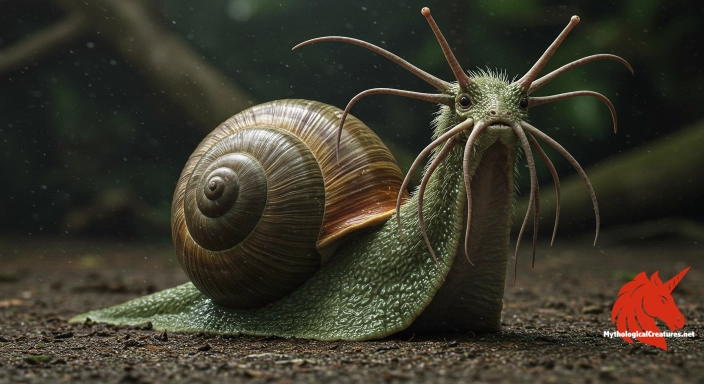
Lou Carcolh
Lou Carcolh - Serves as a cautionary tale and symbol of danger in local folklore
Origins & First Encounters
Lou Carcolh is an enigmatic creature embedded within the rich tapestry of French folklore, captivating imaginations with its unique blend of reptilian and molluscan traits. It is conceived as a monstrous, snail-like serpent whose origins are as mysterious as the dark caverns it inhabits. Believed to dwell beneath the ancient town of Hastingues in the Les Landes region of southwestern France, the legend dates back to a time when oral traditions illuminated the wonders and terrors of nature. Its first attestation appears in local narratives, where the creature served both as a cautionary tale and a symbol of nature’s unpredictable powers. Over time, storytellers have woven details of its bizarre anatomy and ominous presence into the myth. The creature’s reputation as a silent predator who leaves a trail of slime has added to its fearful mystique. Its story reflects a cultural milieu that sought to explain mysterious phenomena and the dangers lurking beyond the familiar. By blurring the boundaries between real-world hazards and mythic allegory, Lou Carcolh has captivated audiences for generations. The enduring narrative encourages reflection on the interplay between human society and the untamed forces of nature. In every retelling, the legend evolves, affirming its role as both a warning and a profound emblem of the unknown.
Source Texts & Tale Variants
Primary mentions of Lou Carcolh are found in a variety of rural French folktale collections, where its eerie presence was detailed with vivid precision. Early chroniclers in the Les Landes region captured local rumours that imbued the beast with an aura of looming danger. Much of what is known about the creature comes from oral traditions later committed to writing by travellers and local historians. Variants of the story proliferated over time, with each version presenting slightly different facets of the monster’s characteristics. In some retellings, the creature’s tentacles are depicted as ensnaring its victims with relentless efficiency, while other accounts hint at a supernatural origin. The process of transforming spoken lore into written records helped preserve not only the creature’s fearsome persona but also the cultural context that nurtured its myth. Later folklore studies have noted how different narrators adapted the legend to reflect regional anxieties and local environmental features. Each recorded variant adds a layer to the creature’s mystique, ensuring that its narrative remains as mutable as the traditions which sustain it. Over decades, the evolving accounts of Lou Carcolh have solidified its stature in the broader corpus of French myth. This tapestry of sources reinforces the idea that the legend is as much a cultural artefact as it is a creature of frightful imagination.
Form & Powers
The physical description of Lou Carcolh is a perplexing amalgamation of snail and serpent, a combination that defies ordinary zoological classifications. Its body is long and sinuous, cloaked in a slick, glistening film of slime that both repels and mesmerises onlookers. Dominating its form is a large, spiralling shell that lends an almost armour-like appearance, evoking memories of ancient marine creatures. From its unusual anatomy extend hairy, tentacle-like appendages, which are depicted as both agile and supremely dangerous. These flexible limbs are often portrayed as instruments for capturing unsuspecting passers-by, further heightening the creature’s fearsome allure. Observers have remarked on the contrast between the soft, damp tissues and the resilient, almost otherworldly nature of its shell. An occasional mention of piercing, unyielding eyes adds a final note of menace to its overall demeanour. Varying in size according to different local narratives, Lou Carcolh is sometimes described as a towering menace that dwarfs its surroundings. These detailed observations collectively evoke an image of a creature that embodies both repulsion and a strange, forbidding majesty. Every aspect of its form, from the mucus to the textured carapace, contributes to a portrayal of primordial horror. In its very appearance, the legend invites an almost Lovecraftian sense of dread and fascination.
Regional Faces
Although Lou Carcolh is most famously associated with the cavern beneath Hastingues, its legend has permeated neighbouring regions with fascinating local twists. In parts of southwestern France, the creature is sometimes revered as a spectral guardian, while in other areas it retains its reputation as a relentless predator. Folk narratives have adapted its appearance to reflect local topography, occasionally merging its traits with aquatic or coastal motifs. Some villages recount a version in which the beast is less of a vicious monster and more of a mysterious force ensuring the balance of nature. Regional storytellers have interwoven local customs and environmental features, resulting in a diverse spectrum of depictions. These adaptations reflect the community’s own relationship with the natural world and its ever-present dangers. In certain retellings, Lou Carcolh has even been attributed benevolent qualities, serving as a warning to preserve natural sanctuaries. The creature’s portrayal is thus consistently modified to suit local superstitions and the unique geography of the area. This dynamic retelling process has allowed the legend to maintain vitality across the varied cultural landscape. The regional variations serve as a mosaic that enriches the myth, each version adding its own layer to the creature’s enigmatic appeal.
Cultural Parallels
Lou Carcolh occupies a distinct niche within the constellation of European mythological creatures, with its bizarre mix of reptilian and molluscan features. Its appearance draws natural comparisons to other legendary beasts in French folklore, such as the renowned Gargouille, which also functioned as a cautionary emblem. The creature’s hybrid nature is reminiscent of classic myths where elements of multiple animal forms merge to represent the unpredictable forces of nature. In many ways, Lou Carcolh is akin to the Hydra of ancient lore, where the multiplicity and fluidity of its form symbolise the ever-changing threats of the natural world. Its gradual, slime-marked approach mirrors other mythic portents where natural phenomena forewarn the arrival of something otherworldly. The fusion of land and sea traits in its description invites reflection on the universal archetype of chaotic guardianship found throughout European traditions. Comparisons are also drawn with other folkloric figures who embody nature’s dual capacity for protection and peril. These shared motifs underscore a long-standing human impulse to personify the unknown and arcane. Such cross-cultural parallels highlight how myth-making transcends local boundaries, melding diverse strands of fear and respect for nature. In analysing these narratives, one finds that Lou Carcolh not only stands alone but also as part of a broader network of cautionary myths. This intricate interplay of similarities enhances our understanding of how different cultures confront the enigmatic forces surrounding them.
Legacy & Modern Evolution
Over time, the portrayal of Lou Carcolh has evolved from a simple, terrifying spectre of dark caverns to a multifaceted emblem of regional identity and mythic power. In its early incarnations, the creature was a literal monster designed to instil caution in those who ventured too close to treacherous, shadowed places. As centuries passed, the legend accrued layers of allegorical meaning, reflecting deeper societal concerns about the natural world and the unseen dangers lurking within it. Medieval depictions cast the beast as a personification of nature’s chaotic elements, a warning against the incursion of the unknown into the ordered life of a community. In more recent times, artists and writers have reinterpreted Lou Carcolh, infusing the narrative with both horror and subtle humour to comment on modern fears and ecological uncertainties. Contemporary portrayals in graphic novels and independent films have breathed fresh life into the legend, transforming it into a symbol that balances terror with cultural heritage. This evolution from superstition to a celebrated cultural icon underscores the changing ways in which communities engage with their past. Lou Carcolh continues to feature in local festivals and cultural exhibitions, serving as a reminder of the enduring power of myth. Modern reinterpretations celebrate not only the creature’s scare factor but also its role as a metaphor for transitional states and the blurring of boundaries between the natural and supernatural. By reimagining the beast for a new audience, the legend remains responsive to contemporary anxieties. Its rich historical evolution is a testament to the dynamism of folklore, where ancient fears can be recast as modern allegories. Ultimately, Lou Carcolh endures as a potent symbol that bridges the gap between past and present, forever enshrined in the collective imagination of its people.
Interesting Fact
The name 'Lou Carcolh' is also used as a nickname for the town of Hastingues, signifying the deep cultural impact of this mythical creature in the region.
For serious mythcraft
Your project belongs among the legends
If your work deepens how people understand, play with, or teach mythology, a sponsor placement here keeps it in front of the right readers all year.
Submit a sponsorship enquiryQuick Creature Info
Associations:
Our Mythic Legendary Rating:

Also Sometimes Known As:
Habitat:
Supernatural Powers:
Physical Attributes:
Abilities:
Behavior:
Lore:
References
Discover Another Mythical Legend You May Not Have Heard Of?
Uncover the mysteries of ancient folklore and expand your knowledge of legendary beings from cultures around the world.
Dare to Meet the Ljubi....
Curated by the Mythological Creatures Team
Series editor: Mythological Creatures Directory
Primary desk: Hellenic & Ancient Mediterranean Desk
(rev. November 2025)