
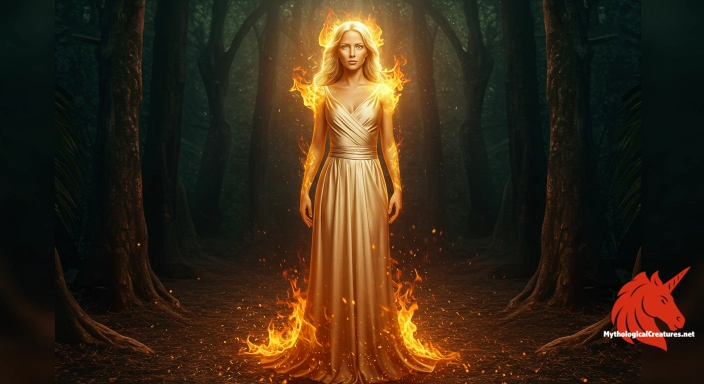
Mãe-do-Ouro: Mãe-do-Ouro is a Brazilian mythological figure known as the 'Mother of Gold' who appears as either a beautiful blonde woman in a silk dress or as a glowing fireball.
Mãe-do-Ouro
Mãe-do-Ouro - Serves as a divine warning against the exploitation of gold and mineral resources, embodying nature's retribution.
Origins & First Encounters
Mãe-do-Ouro emerges from the vibrant reservoir of Brazilian folklore as a captivating figure embodying both allure and admonition. Her presence is rooted in a tradition that spans the interior regions of Southeast, Northeast, and Centre-West Brazil, reflecting a melding of indigenous, colonial, and African cultural influences. Myths surrounding her often hint at mysterious origins, with her earliest mentions found in the oral histories of rural communities. The legend conveys a dual nature that is both benevolent and forewarning, serving as a reminder that nature's treasures come with a price. Her very name, meaning 'Mother of Gold', symbolises the irresistible pull of wealth juxtaposed with nature’s inherent vulnerability. The narratives surrounding her have been passed down through generations, each iteration enriched by local lore and the changing landscape of Brazil’s cultural identity. In these stories, her extraordinary form invites admiration while warning of the perils that lie in heedless exploitation. The enduring charm of her myth reflects the complex relationship between humans and the natural resources they seek to command. Her legend continues to resonate, not only as a figure of myth but also as a cultural emblem of caution and reverence.
Source Texts & Tale Variants
The early records of Mãe-do-Ouro’s legend are found in the rich oral traditions of remote communities where folklore was traditionally transmitted by word of mouth. Over time, these narratives have been compiled in various local anthologies and collections of Brazilian myths that capture the evolving perception of her persona. In certain documented versions, she is portrayed as a luminous fireball capable of transitioning into a striking blonde woman adorned in a silk dress, while other tales maintain her enigmatic form as purely spectral. Chroniclers of folklore during the early twentieth century collected numerous variants that emphasised her role as both a guardian of nature and a harbinger of dire warnings. Each version carries subtle differences, reflecting the diverse regional settings and the varying degrees of natural splendour and threat portrayed in the tales. Rural storytellers emphasise the mystical quality of her appearance, linking it directly to unexploited mineral-rich grounds. The multiplicity of these sources conveys a layered myth where each retelling adds intricate moral and environmental nuances. Despite the scarcity of formal written records, the enduring oral tradition has sculpted a vivid picture of a figure who continues to challenge the boundaries between myth and warning. This intricate tapestry of accounts ensures that her story remains robust and ever-expanding as it is adapted by successive generations.
Form & Powers
Mãe-do-Ouro is invariably depicted with an ethereal presence that blurs the line between human beauty and elemental force. Many accounts portray her as a stunning, blonde woman whose luminous hair and radiant skin evoke the glimmer of freshly refined gold. In a striking display of her supernatural abilities, she is sometimes seen as a fiery orb that gracefully transforms into a delicate human form. Her attire is often described as a silk dress that shimmers with hues reminiscent of dawn light and golden treasure. The physical details of her appearance suggest an exquisite blend of elegance and otherworldly vitality, where every gesture is imbued with both seduction and latent warning. Observers have noted the surreal interplay between her soft, almost tangible human features and the fierce energy that seems to emanate from her very being. Her eyes, in particular, are said to mirror the flickering brilliance of precious metals, captivating those who dare to confront her gaze. This dynamic duality in her form, shifting fluidly between material and ethereal states, makes her one of the most visually compelling figures in folk tradition. The richly detailed descriptions of her form have allowed artists and storytellers alike to celebrate her as an icon of both beauty and caution.
Regional Faces
Across Brazil, interpretations of Mãe-do-Ouro vary widely, reflecting the distinctive cultural and environmental landscapes of each region. In the Southeast, legends commonly depict her as a striking, beautiful woman whose appearance clearly marks areas where gold and precious minerals abound yet should remain untouched. Conversely, in the Northeast, her form is often wrapped in an aura of otherworldly energy, occasionally manifesting as a dazzling fireball with the power to transform. In the Centre-West, indigenous influences lend her character an added mystical depth, merging natural reverence with cautionary tales of resource exploitation. Variations in her portrayal are not limited to her physical form but also extend to the moral lessons interwoven into the narratives. Local communities imbue her presence with specific warnings about the consequences of avarice and environmental disregard. Artistic renditions and oral recountings alike have adapted her image to align with regional values and the pressing concerns of local populations. Each regional version encapsulates a unique facet of Brazilian cultural heritage, where the myth serves both as a guide and a deterrent. The collective diversity found in these varied narratives enriches the overall myth and underscores its importance as a shared cultural asset.
Cultural Parallels
Mãe-do-Ouro invariably finds herself placed in dialogue with other mythological figures who guard nature's wealth and serve as omens against unchecked exploitation. Her dual identity as both a luminous woman and a capricious fireball has echoes in legends across Europe and beyond, where similar spirits serve as symbolic custodians of natural bounty. The figure shares similarities with Celtic folklore, where fairies and elemental beings often appear as beautiful yet forewarning presences. Her transformative powers are reminiscent of shape-shifters found in various cultural narratives, combining the allure of human form with the unpredictability of natural elements. Such cross-cultural parallels highlight a universal theme; many societies have crafted narratives around supernatural protectors whose beauty hides a stern warning against misappropriation of nature’s gifts. Like the guardians of sacred waters and forests found in diverse traditions, she embodies both the promise and the peril inherent in the pursuit of wealth. Comparative analysis reveals that these myths continuously serve to caution society about unsustainable practices. The recurrent motif of a beguiling yet dangerous female guardian underscores a widespread cultural awareness of the delicate balance between human desire and ecological preservation. In this way, Mãe-do-Ouro stands as a prominent figure in the global mosaic of myth, transcending local boundaries while echoing universal truths.
Legacy & Modern Evolution
Over the centuries, the legend of Mãe-do-Ouro has undergone significant evolution, reflecting shifts in societal values and environmental concerns. Originally rooted in the oral traditions of rural communities, her character was primarily seen as a natural omen that both rewarded and punished those who dared exploit the earth’s treasures. With the passage of time, her image was reimagined in literary and artistic circles, gaining layers of interpretation that spoke to modern audiences. Contemporary depictions often focus on her role as an environmental sentinel, a symbol of the natural world’s resilience against unbridled exploitation. In modern Brazilian culture, her myth is frequently invoked in discussions about sustainable resource use and the ethical management of natural wealth. Urban legends, film adaptations, and visual arts have all embraced her multifaceted persona, blending traditional imagery with a modern sensibility. Present-day retellings sometimes cast her in a more benevolent light, while others preserve her ominous warning to those who pursue riches without respect for nature. The adaptability of her legend ensures its continued relevance, serving as a cultural touchstone for both admiration and caution. Ultimately, the enduring legacy of Mãe-do-Ouro illustrates a broader narrative about humanity’s long-standing and complex relationship with the natural world.
Interesting Fact
An intriguing aspect of Mãe-do-Ouro is her ability to seamlessly shift from a mesmerizing human form to a blazing fireball, symbolising the dual nature of beauty and danger inherent in natural wealth.
Support the directory
Promote your myth project and fund more research
Sponsor placements help keep this directory growing and free to use while giving your work a focused, relevant audience.
Learn how sponsorship worksQuick Creature Info
Origin:
Associations:
Our Mythic Legendary Rating:

Habitat:
Supernatural Powers:
Physical Attributes:
Abilities:
Behavior:
Lore:
Related Creatures, Tales or Lore
- BBoitatá
- CCurupira
- IIrish Leprechaun
References
Discover Another Mythical Legend You May Not Have Heard Of?
Uncover the mysteries of ancient folklore and expand your knowledge of legendary beings from cultures around the world.
Dare to Meet the Sea-griffin....
Curated by the Mythological Creatures Team
Series editor: Mythological Creatures Directory
Primary desk: Americas & Indigenous Traditions Desk
(rev. November 2025)