
Malakbel: Malakbel is an ancient Palmyrene sun god revered in the Syrian city of Palmyra.
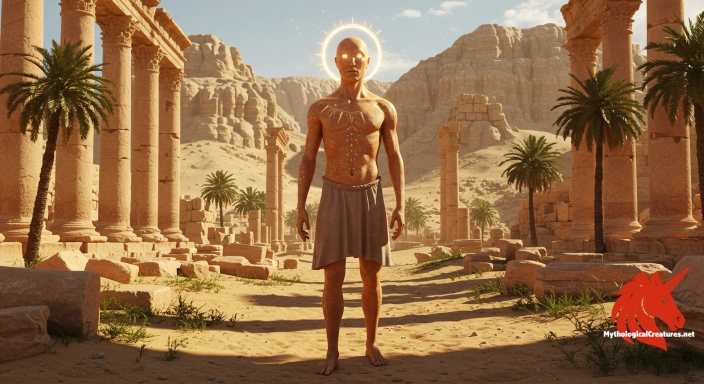
Malakbel
Malakbel - Embodies the life-giving power of the sun and represents divine order in Palmyrene cosmology
Origins & First Encounters
Malakbel emerges as a prominent sun god deeply embedded in the spiritual life of ancient Palmyra, symbolising the vibrant energy and glaring brilliance of the day. His origins appear intertwined with the multifaceted cultural milieu of Syria, where a fusion of Semitic, Greco-Roman, and Eastern influences created a distinctive religious tradition. He is historically recognised from early inscriptions and dedications found in Palmyrene sanctuaries, which underscore his significant role in the local pantheon. The deity was celebrated for his radiant power and was frequently depicted as integral to the celestial order, exemplifying the authority of the sun over the cosmos. Malakbel’s name itself resonates with divine majesty, invoking notions of rulership and luminescence that captivated his worshippers. His position within a divine trinity, alongside the moon god Aglibol and the sky god Baalshamin, further emphasises the structured hierarchy of Palmyrene theology. The interplay of these gods symbolised the harmonious balance between day and night as well as the connection between the heavens and the earth. Over time, the cult of Malakbel stood as a testament to the broader spiritual complexities and regional identities of the ancient Near East.
Source Texts & Tale Variants
The primary attestations of Malakbel are found among the archaeological remains and inscriptions of Palmyra, where his image was meticulously carved into stone altars and temple walls. Numerous dedicatory texts, composed in Palmyrene Aramaic, invoke his name as a god of light, underscoring his revered status among contemporaries. Distinct literary fragments and iconographic elements provide evidence of his association with other deities, particularly within the structure of the Palmyrene trinity. Ancient accounts, though fragmentary, hint at ritual practices that celebrated his solar attributes through seasonal festivals and public ceremonies. Variants of his myth circulated in local lore where narratives of cosmic order and divine rulership were articulated in symbolic language. In some sources, his divine presence is interwoven with that of Aglibol and Baalshamin, suggesting a tightly-knit mythological narrative that strove to explain the rhythms of nature. The preservation of these traditions is largely due to the monumental inscriptions that have withstood the passage of time, offering scholars invaluable insights into Palmyrene spiritual life. Despite gaps in the textual record, the surviving artefacts underscore a dynamic tradition that invoked Malakbel as a personification of the sun’s life-giving force.
Form & Powers
Artistic representations of Malakbel capture the essence of solar brilliance with an emphasis on dynamic, radiant imagery. He is often depicted as a dignified figure adorned with a luminous diadem and a halo that evokes the intense light of the midday sun. In sculpture and bas-relief, his form is portrayed with graceful, elongated features that blend classical ideals with distinct Near Eastern stylistic elements. His eyes and countenance reflect both wisdom and the relentless energy of the celestial fire, attributes that allude to his role as a bearer of light and vitality. Many depictions show him holding a scepter or other regalia that symbolise authority and divine power, further cementing his status among the gods. Variants in his iconography include the integration of solar discs, rays, and occasionally mythologically significant ornaments that are unique to the Palmyrene style. Differences in artistic detail across various artefacts also suggest a dynamic evolution in his portrayal over the centuries. The physical depictions contribute to an enduring visual legacy that encapsulates both the aesthetic and symbolic qualities of the ancient sun deity.
Regional Faces
The worship and representation of Malakbel exhibited intriguing regional variations that echo the diverse cultural influences of the ancient Near East. In Palmyra, he was firmly established within a local religious framework, closely associated with the city’s identity and its cosmological outlook. However, as trade networks and cultural exchange flourished, his worship extended beyond Palmyra, adapting to neighbouring regions with Hellenistic and Roman influences. In some areas, artistic and religious interpretations blended his attributes with those of more widely recognised solar deities such as Helios and Sol Invictus, leading to composite images that resonated with a broader audience. These regional adaptations allowed for subtle shifts in iconography and ritual practices, reflecting local tastes and religious expectations. In certain neighbouring cultures, Malakbel’s solar aspect was emphasised through the integration of native symbols of rebirth and renewal, while in others, his association with divinity was enriched by references to celestial phenomena. The adoption of his myth in diverse geographical contexts highlights the fluidity of ancient religious narratives and the capacity of local traditions to reshape pan-regional deities. Such variations illustrate how Malakbel served as a conduit for the transmission of complex religious ideas across different cultural landscapes.
Cultural Parallels
Malakbel shares many similarities with other solar deities in ancient mythologies, and his role within a trinity invites comparisons with triadic structures found across various cultures. His radiant attributes echo those of Shamash in Mesopotamia, where the sun also represented justice, order, and life. The integration of a sun deity into a structured pantheon is a recurring theme that appears in Greek, Egyptian, and even early Roman religious systems, establishing a comparative framework that underscores the universality of solar worship. Like Helios or Apollo, Malakbel was not merely a personification of the sun but also a symbol of cosmic order and divine benevolence. Comparative analysis reveals that while each culture tailored their solar god to meet local spiritual and social needs, the essential motif of light overcoming darkness remained consistent across mythologies. This interconnection is further underscored by the way Malakbel’s iconography aligns with established artistic conventions in representing the divine through radiant halos and luminous regalia. His inclusion in local triads mirrors similar triadic forms in Egyptian (such as Ra, Osiris, and Horus) and Hellenistic mythologies, where the balance of cosmic elements was central. Ultimately, Malakbel occupies a unique yet parallel space in the ancient world, embodying both specific regional characteristics and universal motifs of solar sanctity.
Legacy & Modern Evolution
The historical evolution of Malakbel’s worship reflects the broader transformations that shaped the ancient Near East and later cultural landscapes. As Palmyra rose to prominence, his cult developed a rich ceremonial tradition that celebrated the interplay of light and divinity, a tradition that eventually imparted its influence on neighbouring civilizations. Over time, the iconography and attributes associated with Malakbel were absorbed into the evolving religious narrative of the Roman Empire, where syncretism allowed for the integration of local deities into a unified imperial theology. With the advent of Christianity and the subsequent decline of traditional polytheistic temples, his worship diminished, though his legacy continued through the surviving inscriptions and artistic depictions. Modern archaeological discoveries have rekindled academic and public interest in his myth, prompting renewed scholarship that reveals the depth of Palmyrene religious practice. Contemporary artistic reinterpretations and cultural restorations offer fresh perspectives on Malakbel’s enduring significance as a symbol of radiant power and cosmic order. In many ways, his evolving legacy encapsulates the dynamic interplay between tradition and transformation, where ancient myths are continually reimagined by successive generations. Today, Malakbel stands as both a historical figure and a muse in the modern cultural imagination, inspiring a reassessment of ancient heritage and its relevance to contemporary spiritual enquiry.
Interesting Fact
Malakbel's trinitarian association with the moon and sky gods highlights the intricate blending of divine attributes in Palmyrene cosmology.
Sponsor this space
Tasteful, fixed-fee placements for myth projects
No bidding wars or flashing banners. We offer simple placements for a small set of creators and brands aligned with our readers.
Request further detailsQuick Creature Info
Associations:
Our Mythic Legendary Rating:

Habitat:
Supernatural Powers:
Physical Attributes:
Abilities:
Behavior:
Lore:
References
Discover Another Mythical Legend You May Not Have Heard Of?
Uncover the mysteries of ancient folklore and expand your knowledge of legendary beings from cultures around the world.
Dare to Meet the Trasgu....

Curated by the Mythological Creatures Team
Series editor: Mythological Creatures Directory
Primary desk: Hellenic & Ancient Mediterranean Desk
(rev. November 2025)