
Móðguðr: Móðguðr is a formidable guardian spirit from Norse mythology, known as the 'Furious Battler'.
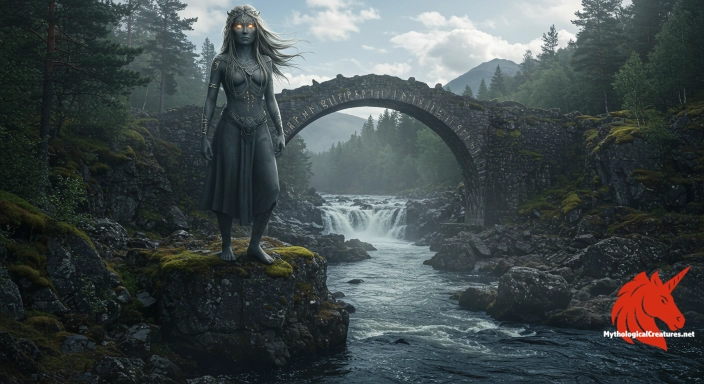
Móðguðr
Móðguðr - Her role is crucial in maintaining the order between the realms of the living and the dead by regulating the passage across Gjöll.
Origins & First Encounters
Móðguðr emerges in Norse lore as a formidable guardian whose role blurs the boundaries between the realms of the living and the dead. Her name, meaning 'Furious Battler', hints at an underlying martial spirit and an intensity that pervades her myth. She is celebrated as the sentinel of the bridge over the river Gjöll, a vital passage for souls transitioning from life to the mysterious afterlife. Rooted in ancient Scandinavian traditions, her origins trace back to a time when the movement between worlds was as sacred as it was feared. She silently enforces the cosmic order by ensuring that only those with rightful intent cross into the other realm. The earliest mentions of Móðguðr in medieval texts suggest a character both enigmatic and indispensable. While her narrative appears in brief poetic mentions, the themes of guardianship and threshold protection are unmistakably central. Her story reflects the deep Norse preoccupation with fate and the inexorable march toward the unknown. In the tapestry of Norse cosmology, she stands as a reminder of the enduring intersection between mortal existence and the mystical beyond.
Source Texts & Tale Variants
The narrative of Móðguðr is primarily drawn from the sporadic yet evocative legacy of Norse mythological texts. Mentions of her can be found in assorted medieval sagas and poetic fragments that explore the passage of souls after death. These ancient sources, though limited, establish her as the vigilant guardian of Gjöll’s bridge. The Prose Edda and various skaldic verses offer foundational insights into her role. In these texts, the emphasis is on the ritualistic nature of crossing from the world of the living to that of the dead. The poetic imagery used in these accounts often blends themes of retribution with a solemn duty to maintain cosmic balance. Over time, oral traditions and later folklore have enriched her character by adding layers of nuance and moral complexity. Some manuscript variants even hint at a dual aspect of both compassion and uncompromising authority. This mosaic of primary sources, despite its fragmentary quality, continues to inspire modern interpretations of her myth.
Form & Powers
Although explicit physical descriptions of Móðguðr are scarce in the ancient texts, later artistic interpretations have imagined her as a statuesque and commanding figure. Her visage is often rendered with piercing eyes that reflect the steely resolve of one who must judge the souls of the departed. Imagined with austere yet arresting features, she is frequently shown adorned in armour-like garments that echo the battle-ready essence of her name. Some visual depictions suggest that her long, flowing hair mirrors the dark, uncertain waters of Gjöll, adding to her spectral quality. Her facial expression, marked by intensity and quiet authority, often serves as a visual manifestation of the threshold she guards. Elements of traditional Norse battle attire, complete with intricate runic motifs, sometimes feature in portrayals of her. Even in modern reconstructions, artists strive to capture the blend of martial strength and otherworldly grace that defines her presence. Her physical form, though primarily the product of imaginative retellings, symbolises the fusion of warrior spirit and mystical duty. Overall, Móðguðr is envisioned as a potent embodiment of both physical resilience and ethereal guardianship.
Regional Faces
Across the varied landscapes of Scandinavia, Móðguðr’s character adapts subtly to local cultural sensibilities, reflecting diverse approaches to the afterlife. In Icelandic traditions, her persona is often imbued with a delicate balance of stern judgement and unexpected compassion. Danish and Swedish narratives tend to place greater emphasis on her formidable prowess and unwavering commitment to cosmic order. Local legends depict her presence in correlation with regional rituals, where the bridge over Gjöll becomes a site of transformative significance. In these areas, artistic representations might include specific local symbols, connecting her image with indigenous elements of nature and myth. Some communities present her as a spectral figure whose vigilance prevents the chaos of the dead from overwhelming the living. These regional variations underscore the adaptability of her myth, echoing broader Scandinavian attitudes toward life, death, and the mystical boundaries that separate them. Although the core of her mandate remains unchanged, the local adaptations enrich her story with unique colours and textures. Ultimately, her regional portrayals offer a window into how different cultural contexts shape and reaffirm age-old mythological themes.
Cultural Parallels
Móðguðr’s role as the guardian of a crucial passage finds compelling parallels in mythological traditions spanning the globe. Her function bears resemblance to gatekeepers such as the Greek ferryman who escorts souls across the river Styx, though her depiction is distinctly imbued with a warrior’s intensity. Unlike the male figures in some mythologies, her character underscores the importance of a feminine force in maintaining spiritual order. Comparative myths from Egyptian and Celtic traditions also feature entities tasked with the control of souls entering the netherworld, highlighting a universal theme of threshold guardianship. The recurring motif of a guardian at the boundary between life and death serves as a symbolic reminder of mortality and the mysteries that lie beyond. In many cultural narratives, figures like her are portrayed as both protectors and arbiters, ensuring that the sacred order is not disturbed. Through these cross-cultural lenses, Móðguðr can be seen as part of a broader archetypal tradition that spans continents and eras. Her presence in Norse mythology adds a distinct flavour to this recurring theme, merging martial vigor with spiritual duty. Thus, the comparative analysis underscores the universal appeal of boundary figures in myth and the deep human need to symbolise the passage from life to death.
Legacy & Modern Evolution
Over the centuries, Móðguðr has transitioned from a fleeting mention in ancient texts to a resonant symbol in contemporary reinterpretations of Norse myth. Modern creative works have revived her story, emphasising her role not merely as a gatekeeper but as a complex figure embodying the inevitability of change. Contemporary literature, visual arts, and even digital media explore her dual identity as both a warrior and a protector of mystical boundaries. In many modern retellings, she is celebrated as an emblem of resilience, reinforcing themes of transformation in the face of mortality. Her evolving depiction often reflects current cultural dialogues about the intersection of strength, femininity, and the boundaries between life and death. Artistic reinterpretations have expanded her narrative, portraying her in a style that blends traditional Norse iconography with modern aesthetic sensibilities. As scholars and enthusiasts continue to delve into the less-explored facets of Norse cosmology, Móðguðr’s myth is increasingly seen as a poignant commentary on the human condition. New adaptations in literature and visual media ensure that her figure remains a powerful metaphor for transitions and the enduring intrigue of the afterlife. In this way, her legacy continues to inspire and provoke thought, securing her place as a timeless guardian of mythic thresholds.
Interesting Fact
Interestingly, Móðguðr's role as a bridge guardian not only signifies her control over the boundary between life and death, but also reflects the Norse fascination with liminal spaces and transitional realms.
Partner with Mythological Creatures
Bring your myth-based world into ours
From game settings to narrative worlds, we work with partners who treat myths with care. Share your project for a potential sponsor slot.
Partner with usQuick Creature Info
Origin:
Features:
Associations:
Our Mythic Legendary Rating:

Also Sometimes Known As:
Habitat:
Supernatural Powers:
Abilities:
Behavior:
Lore:
References
Discover Another Mythical Legend You May Not Have Heard Of?
Uncover the mysteries of ancient folklore and expand your knowledge of legendary beings from cultures around the world.
Dare to Meet the Feng....
-5c7bbb53-c170-41d9-84ab-ac86e3bc90f9_small.webp "Depiction of Feng")
Curated by the Mythological Creatures Team
Series editor: Mythological Creatures Directory
Primary desk: Northern & European Folklore Desk
(rev. November 2025)