
Moñái: Moñái is a legendary serpentine monster from Guaraní mythology renowned for his enormous and imposing body.
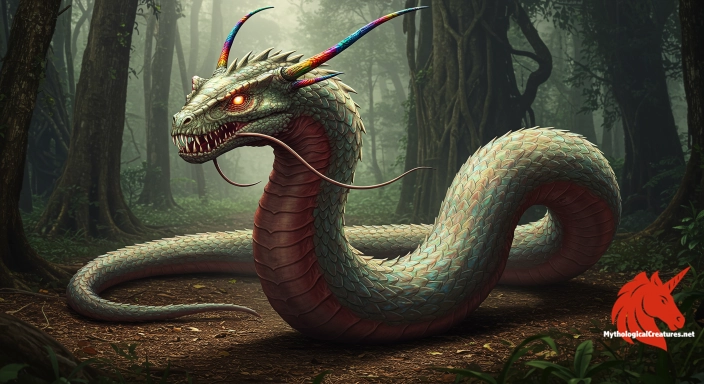
Moñái
Moñái - Moñái's emergence as one of the monstrous offspring of Tau and Kerana underscores the themes of chaos and the supernatural in Guaraní myth, marking him as a formidable presence in indigenous folklore.
the legend in five swipes.
the legend in five swipes.
The Earliest Known Accounts of Moñái
Moñái emerges from the rich tapestry of Guaraní mythology as one of the seven legendary monsters, a figure whose origins are as enigmatic as the natural world he inhabits. His birth as the third son of the primordial pair Tau and Kerana sets him apart, intertwining his essence with the forces of creation and chaos. This ancient being has been woven into the cultural fabric of indigenous lore, symbolising the wild, untamed aspects of nature. His myth stands as a testament to the Guaraní people's enduring connection with the environment and the mysteries that lie within it. The narrative of Moñái is one of contrasts, wherein beauty and fear, order and chaos, rendezvous in a single colossal form. Tales of his origin have been passed down through generations, carried on the lips of storytellers who imbue his character with both reverence and caution. His legend, long before any written record was made, was entrenched in communal rituals and the natural phenomena observed in the wilderness. The enduring legacy of Moñái continues to evoke a sense of wonder and serves as a symbolic bridge between the mythic past and the ever-changing present.
Where can you read about Moñái?
The lore surrounding Moñái has been preserved primarily through oral tradition over countless generations, forming a vital part of the Guaraní narrative landscape. Early chroniclers in the colonial era captured snippets of his myth, though their records only hint at the creature’s full complexity. These historical accounts, though fragmented, provide glimpses into how Moñái was revered and feared in equal measure. Variants of his story illustrate differing roles, with some versions portraying him as a divine guardian of natural realms while others cast him as an agent of impending chaos. Diverse storytelling traditions embellish his image further, especially regarding his distinctive horns and sinuous form. In some accounts, his presence is seen as an omen tied to significant environmental or celestial events. The narrative has also been enriched by post-colonial literary efforts that seek to reclaim and reinterpret indigenous mythologies. Each version of the tale contributes to a multi-layered picture, ensuring that the legacy of Moñái remains vibrant in both scholarly discourse and everyday cultural memory.
What powers did Moñái have?
Moñái is depicted with an enormous, undulating body that evokes the image of a giant serpent gliding through the underbrush and along the banks of remote rivers. His body is said to be covered in finely detailed scales that shimmer in a palette of colours, reflecting the light in unexpected ways and adding to his mystical allure. Dominating his head are two straight, colourful horns, which are not merely ornamental but function as antennae attuned to the energy of his surrounding environment. These vibrant horns serve as focal points in his physical representation, bridging the gap between the terrestrial and the astronomical. His penetrating eyes are often described as glowing with an inner light, hinting at both his wisdom and his formidable presence. Artistic depictions sometimes capture the dynamic interplay of light on his sinuous form, suggesting a creature that is both powerful and gracefully elusive. The sheer length of his body, twisting and coiling in an almost hypnotic manner, reinforces the idea of a force of nature that is as unpredictable as it is majestic. Intricate details in his anatomy, such as the texture of his scales and the subtle variations in his horn colours, highlight a being that is meticulously crafted in myth. While descriptions vary, the consensus is that Moñái embodies a seamless blend of beauty and terror, a living paradox that has both enchanted and alarmed those who behold him.
Moñái: Local Variations in the Story
Within the diverse regions influenced by Guaraní culture, Moñái’s myth takes on unique local flavours that reflect distinct environmental and cultural nuances. In the heartlands where the Guaraní tradition remains strong, he is frequently regarded as a guardian spirit of the wetlands and river systems, a keeper of the natural balance. Some regional narratives present him as a benevolent force, one who protects sacred water sources and the life that comes from them. In contrast, other localities interpret his serpentine presence as ominous, signalling impending natural disturbances or disasters. The vivid portrayal of his horns, for instance, can vary in colour and brightness from one region to another, each variation carrying its own symbolic resonance. Among neighbouring indigenous groups, his legend often intermingles with local deities and spirits, creating a rich tapestry of myth that blurs the boundaries between distinct cultural narratives. Storytellers adapt his myth to reflect local landscapes, whether it be a sacred lake or a twisting river, thereby grounding his otherworldly presence in familiar surroundings. These regional adaptations ensure that Moñái’s myth remains a living, evolving narrative, constantly retold through the lens of local experience and spiritual insight.
Moñái: Echoes in Other Mythologies
Moñái’s compelling blend of serpent-like grace and horned majesty draws intriguing parallels to similar mythological figures found across different cultures. His distinctive form is reminiscent of the horned serpent motifs that appear in various Native American traditions, where such entities often embody the enigmatic forces of nature. Across the globe, mythic serpents and dragon-like creatures have been revered as symbols of both danger and divine power, a duality that Moñái encapsulates with singular elegance. In some Mesoamerican and Asian mythologies, deities with serpentine forms similarly bridge the realms of earth and sky, echoing Moñái’s role as a mediator between the tangible and the mystical. The unique feature of his colourful, antennae-like horns further distinguishes him, inviting comparisons to deities who use physical attributes to channel cosmic energies. Like many such figures, he embodies the tension between creation and destruction, a duality celebrated in myriad cultural stories. These cross-cultural resonances highlight a universal human fascination with creatures that defy ordinary classification. By comparing Moñái with his mythological counterparts around the world, one can appreciate how similar themes of chaos, transformation, and nature’s power continue to inspire and unite diverse cultural narratives.
Moñái: Modern Retellings and Reinventions
Across the ages, the depiction of Moñái has evolved to reflect the shifting cultural and environmental landscapes of the Guaraní people. In ancient times, his image was firmly anchored in the primordial chaos and mystery of the natural world, feared for his unpredictable might and revered for his cosmic origins. With the passage of time and the influence of colonial reinterpretations, his once purely fearsome persona has been softened, reimagined as a symbol of natural resilience and the unyielding spirit of indigenous identity. Contemporary artistic renditions often explore his myth through modern media, where he appears in paintings, literature, and even cinematic portrayals that speak to both ecological concerns and cultural pride. His vibrant and majestic image has also become a touchstone in local festivals and cultural revivals, where traditional stories are retold to inspire new generations. Modern reinterpretations tend to emphasise his role as a guardian of nature, imbuing him with a relevancy that bridges ancient myth and current environmental dialogues. As cultural narratives continue to evolve, Moñái stands as a living symbol of the dynamic interplay between tradition and modernity. Today, he is celebrated not only as a relic of myth but as an enduring emblem of the power and mystery of the natural world, inspiring awe and critical reflection among a wide audience.
Interesting Fact
An intriguing aspect of Moñái is that his horns, while appearing ornamental, serve a critical sensory function, demonstrating a unique blend of beauty and utilitarian design in mythological creatures.
Mythological Treasures
Greek Myths: A field guide to the monsters of ancient Greece
Every monster here earned its place in legend, and each gets a full page of artwork and the story behind it.
Norse Sagas: A field guide to the beasts of the Viking world
Drawn from the saga accounts themselves, with the powers, weaknesses and doom of each being set out.
Egyptian Legends: A field guide to the gods and monsters of ancient Egypt
Guardians of the living and devourers of the dead, with the role each played in judgement.
the legend in five swipes.
Curated sponsor space
One subtle banner. Thousands of myth lovers.
We offer a small number of curated sponsor spots for relevant books, courses, games, and art. No clutter, just well-matched partners.
Partner with usQuick Creature Info
Origin:
Features:
Our Mythic Legendary Rating:

Supernatural Powers:
Physical Attributes:
Abilities:
Lore:
Related Creatures, Tales or Lore
- MMbói Tu'i
- TTeju Jagua
- JJasy Jateré
References
Discover Another Mythical Legend You May Not Have Heard Of?
Uncover the mysteries of ancient folklore and expand your knowledge of legendary beings from cultures around the world.
Dare to Meet the Rådande....
The Mythological Creatures Book Series
Yōkai, Greek, Norse, Egyptian & Chinese. Five illustrated field guides to the creatures the old stories either warned or told you about.
Curated by the Mythological Creatures Team
Series editor: Mythological Creatures Directory
Primary desk: Americas & Indigenous Traditions Desk
(rev. November 2025)