
Morvarc'h: Morvarc'h is a fabulous, flame-breathing horse of Breton legend renowned for its ability to gallop on the waves.
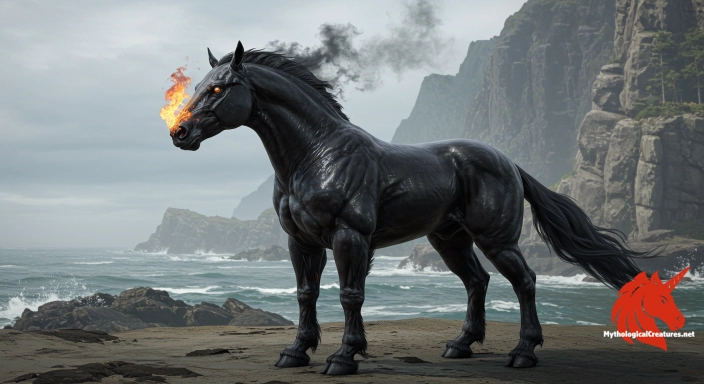
Morvarc'h
Morvarc'h - A symbol of Breton myth and the fusion of elemental forces, underscoring the mystical relationship between land and sea in Celtic tradition.
Origins & First Encounters
Emerging from the mists of Breton legend, Morvarc'h captivates imagination as a supernatural sea-horse endowed with mystical qualities and deep cultural resonance. Born of an intricate tapestry of lore linked to both the drowned city of Ys and regal figures such as Malgven and King Gradlon, this creature is as enigmatic as it is majestic. Its narrative taps into a long-standing fascination with the maritime realm, where elements of the natural and the fantastic coalesce. Early retellings hint at its profound connection to the spirit of the sea, while later adaptations have enriched its mythic stature. The creature’s name, meaning “sea horse” in Breton, encapsulates both its noble equine form and its uncanny abilities. With roots that intertwine oral tradition and literary reinterpretation, Morvarc'h stands as a bridge between ancient folklore and the dynamic storytelling of later centuries. Its story reflects a cultural tradition that honours both bravery and the unknowable forces of nature. Through each evolving account, Morvarc'h continues to evoke awe and invites deeper exploration into the mysteries of Breton heritage.
Source Texts & Tale Variants
The earliest literary glimpses of Morvarc'h emerge from Breton folktales that have been recast by later writers to suit shifting cultural narratives. One prominent version, reworked by Charles Guyot in the early 20th century, introduces the figure as Morvark within the legend of the city of Ys. In a parallel narrative from Cornouaille, the sea-horse’s fate intertwines with that of King Marc'h, adding a layer of tragic irony. Multiple sources present this creature as both a divine gift from Malgven and a victim of mystical misfortune brought on by an enchanted arrow. The variety of tale versions illustrates the fluid nature of Breton myth, where stories are as mutable as the sea itself. Different retellings amplify distinct aspects of its character—sometimes emphasising its galloping prowess against the waves, at other times underscoring its fiery, enigmatic presence. Oral traditions have allowed the narrative to adapt to regional sensibilities, ensuring that Morvarc'h remains ever relevant. This multiplicity of versions not only reinforces its legendary status but also mirrors the inherent dynamism of Celtic folklore. In this way, the literary and folkloric records together weave a rich, composite picture of a creature both timeless and transformative.
Form & Powers
Morvarc'h is described with an intensity that matches its mythic reputation, sporting a sleek, black coat that shimmers mysteriously beneath the moon and waves. Its form is that of a noble steed, yet imbued with unmistakable supernatural elements that set it apart from mortal horses. Striking eyes radiate an ancient wisdom and a hint of melancholy, conveying the deep lore embedded in its character. A particularly unique attribute is its ability to breathe flames through its nostrils, a feature that electrifies its image with both beauty and danger. The muscular build, combining strength and graceful agility, suggests a creature born of the elemental forces of the sea. Imagery often captures it as galloping effortlessly across turbulent waters, as if the ocean itself were its domain. This union of equine elegance and otherworldly power creates a visual tableau that is both daunting and alluring. Variations in accounts occasionally present the sea-horse as possessing a grander, almost majestic stature, reinforcing its reputation as a figure of awe. Every detail—from its dark, luminous coat to its fierce, flame-breathing feature—cements Morvarc'h as a creature where myth meets corporeal splendour.
Regional Faces
The tale of Morvarc'h is steeped in the landscape of Brittany, where local traditions infuse the legend with distinctive regional character. Predominantly celebrated in Cornouaille, his story permeates local communities and is commemorated through striking equestrian statues in towns like Argol. In the venerable Saint Corentin's Cathedral of Quimper, the presence of his likeness underscores the deep-rooted cultural significance of the legend. Small villages such as Pouldreuzic keep the memory of this mystical steed alive through oral tradition and subtle folkloric references. Local variations of the tale often highlight different facets of the creature, whether focusing on its divine origins or its tragic end. Regional storytellers have adapted the narrative to mirror the unique maritime traditions and rugged coastal landscapes of Brittany. These adaptations serve to connect the creature more closely with the identity of each community, blending myth with local pride. As the story travels from one village to another, it gathers layers of detail that reflect the diverse cultural and natural scenery of the region. This geographical adaptation not only reinforces Morvarc'h’s mythical status but also cements his role as a living emblem of Breton heritage.
Cultural Parallels
Morvarc'h shares an enigmatic quality with a host of legendary horses found across Celtic and pan-European mythologies. Comparable to the Irish Each Uisge and the Scottish kelpie, his dominion over water and his supernatural prowess resonate with archetypal themes of mystery and nature’s untameable force. Just as other mythic equines symbolise a liminal existence between the terrestrial and the aquatic, Morvarc'h embodies the paradox of beauty and peril in elemental form. In a broader context, comparisons can be drawn with mythic creatures like the Greek hippocampus, where the fusion of land and sea is depicted with both grace and ferocity. His depiction as a creature that navigates the waves on an almost preternatural gallop aligns him with similar figures celebrated in maritime lore around the world. While traditional narratives across cultures imbue their legendary horses with slightly varied roles—from protectors to harbingers of doom—the underlying motif of transcending natural limits remains universal. This cross-cultural dialogue enriches our understanding of how humans personify elemental forces through equine imagery. The interplay of fire and water in his character, along with his tragic narrative strands, further mirrors the dichotomies found in other mythic traditions. Through these parallels, Morvarc'h emerges as part of a vast tapestry of folklore that celebrates the mysterious allure of the horse as a symbol of both ecological might and mythical beauty.
Legacy & Modern Evolution
Over the centuries, the image of Morvarc'h has undergone a remarkable transformation, evolving from an obscure facet of Breton legend to a celebrated symbol of regional identity. Literary reinterpretations in the 19th and 20th centuries have reshaped his narrative, infusing the myth with contemporary sensibilities while retaining its core mystique. The creature’s heroic and tragic dimensions have been rendered with ever-growing complexity, reflecting changes in artistic and cultural attitudes over time. Modern portrayals, found in novels and musical compositions, continue to explore his extraordinary abilities and fateful destiny, ensuring that the legend remains vibrant and evolving. Statues and other artistic representations in Argol and Quimper serve as tangible reminders of his deep-seated impact on the Breton cultural landscape. His imagery now functions as a bridge between the ancient myths and modern interpretations of nature, divinity, and human endeavour. As contemporary creators revisit and reinvent the tale, they draw on both historical portrayals and fresh insights to craft narratives that speak to renewed themes. Whether as an emblem of environmental power or a metaphor for enduring cultural memory, Morvarc'h resonates with a timeless appeal that continues to inspire. His persistent reinvention is a testament to the dynamic legacy of myth, demonstrating how traditional stories can adapt to reflect the evolving spirit of a community over generations.
Interesting Fact
One of the most intriguing aspects of Morvarc'h is the paradox of its nature, as it melds fiery attributes with an affinity for the water, a combination that challenges conventional elemental boundaries in folklore.
Curated sponsor space
One subtle banner. Thousands of myth lovers.
We offer a small number of curated sponsor spots for relevant books, courses, games, and art. No clutter, just well-matched partners.
Partner with usQuick Creature Info
Features:
Associations:
Our Mythic Legendary Rating:

Also Sometimes Known As:
Habitat:
Supernatural Powers:
Physical Attributes:
Abilities:
Behavior:
Lore:
References
Discover Another Mythical Legend You May Not Have Heard Of?
Uncover the mysteries of ancient folklore and expand your knowledge of legendary beings from cultures around the world.
Dare to Meet the Banyoles Monster....
Curated by the Mythological Creatures Team
Series editor: Mythological Creatures Directory
Primary desk: Northern & European Folklore Desk
(rev. November 2025)