
Nāmaka: Nāmaka is a revered sea goddess in Hawaiian mythology known for her dominion over the ocean and her formidable rivalry with the volcano goddess Pele.
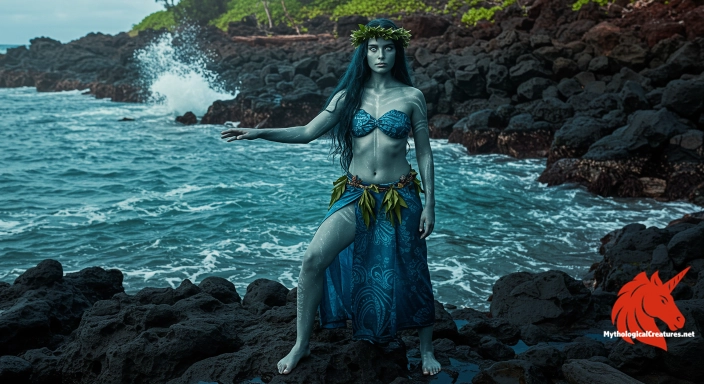
Nāmaka
Nāmaka - Represents the power of the ocean and acts as a balancing force against volcanic fire in Hawaiian mythology.
Origins & First Encounters
Nāmaka stands as an illustrious sea goddess within the rich tapestry of Hawaiian mythology, embodying both the nurturing and destructive aspects of the ocean. Her origins trace back to the divine lineage of Ku-waha-ilo and Haumea, making her an integral member of one of Hawaii’s most celebrated families. Emerging from a tradition of oral storytelling, her myth interweaves familial bonds with cosmic forces and elemental power. As the elder sister of Pele-honua-mea, her role is marked by intense drama, where familial affection meets divine conflict. Early attestations through chants and legends immortalised her reputation as a relentless controller of the tides. Her narrative is set against a backdrop of the Hawaiian worldview, in which natural forces are both revered and feared. Many recount how her turbulent interactions with Pele reveal an eternal struggle between creation and destruction. Over time, her story has captivated audiences for its dramatic symbolism and profound representation of the power of nature. This enduring saga continues to resonate in the hearts of those who revere the ancient wisdom of the sea.
Source Texts & Tale Variants
The myth of Nāmaka has been meticulously passed down through generations via oral traditions and ancient recitations, preserving the complexity of her character. Numerous chants and legends have provided glimpses into her adventures and conflicts, each variant adding layers of interpretation to her mythos. Among the most intriguing sources is Thrum's Kane-huna-moku myth, which casts her as the chiefess of the Mu and Menehune people. Various local narratives recount her dramatic battles against familial forces, emphasising her role as both a benevolent protector and a formidable adversary. Diverse storylines also detail her association with divine figures and the oscillation between her nurturing and wrathful attributes. Some tales elaborate on her tempestuous relationships, particularly her conflict with Pele, reflecting the dichotomy found in many oral traditions. Early anthropologists and early Hawaiian scribes documented fragments of her legends, though no single narrative can claim complete authority. The multiplicity of sources underscores the dynamic nature of her story, inviting continual reinterpretation by successive generations. In every recounting, Nāmaka’s presence remains a critical touchstone for understanding the interplay of nature and divinity in Hawaiian lore. Her legend, therefore, exists as a mosaic of variants that enrich the cultural heritage of the islands.
Form & Powers
Nāmaka is often envisioned as an ethereal embodiment of the ocean, her features shimmering with the many hues of the deep blue sea. Her eyes, suggested by her name as the 'eyes of Kaha‘i', are thought to capture the eternal mystery and depth of the waters. Artists have depicted her with flowing hair that mirrors the cascading waves, soft yet powerfully dynamic in its movement. Her attire is frequently represented as diaphanous garments that billow like sea foam, adding a sense of otherworldly grace to her form. The goddess’s skin is sometimes described as possessing a subtle iridescence, hinting at the luminous reflection of the moon on water. In artistic renditions, she can appear both diminutive and colossal, symbolising the ocean’s capacity to be gentle or overwhelmingly vast. Attributes such as conch shells and coral motifs are often integrated into her depiction, underscoring her dominion over marine life. Traditional artworks capture the interplay of light and tide on her form, evoking the transient beauty of her watery domain. Over time, these myriad descriptions have come to form a composite image, both awe-inspiring and mysterious, emblematic of the ever-changing sea.
Regional Faces
Across the Hawaiian Islands, variations of Nāmaka’s legend reveal a fascinating regional diversity in her portrayal. In some locales, she is revered primarily as a fearsome deity capable of unleashing devastating tidal waves upon rival domains. Other regions, however, celebrate her as a life-giving force, responsible for sustaining the abundant marine ecosystems that define the islands. On Kaua‘i, for instance, her identity is closely tied to the Mu and Menehune peoples, with local lore crediting her with pivotal roles in shaping the watercourses and land. The geographical nuances of these stories often reflect the local environment, where people observe the interplay of oceanic tempests and serene shores. This regional adaptation underscores a broader cultural adaptation, with each community weaving their unique experiences of the sea into the myth. Elements from neighbouring Polynesian traditions, including tales of her husband’s origins in Kahiki, further add layers of regional complexity. Despite these variations, the core of her narrative—a powerful, enigmatic sea goddess—is a unifying thread running through disparate island communities. The localized celebrations and rituals associated with her myth serve as enduring reminders of the intimate connection between people and the ocean. In essence, each regional rendition of her story contributes to a more holistic understanding of her character within a dynamic cultural landscape.
Cultural Parallels
Nāmaka shares a remarkable kinship with other aquatic deities found throughout the Pacific and beyond, mirroring the universal reverence for the sea. Like the Maori deity Tangaroa, she is seen as a powerful guardian of marine life and an embodiment of the natural rhythm of the ocean. Comparisons may also be drawn with figures such as Poseidon, where the might and caprice of the sea are central to both deities’ identities, though Nāmaka’s narrative is deeply enmeshed with familial strife and local legend. Similar dichotomies are evident in the portrayal of Celtic water goddesses, whose dual roles as nurturers and destroyers echo the essence of Nāmaka’s lore. Her dynamic existence, balancing creation and chaos, resonates with the broader mythological theme of nature’s unpredictable temperament. Cross-cultural studies often highlight how indigenous deities like Nāmaka and their counterparts articulate a deep human respect for the marine environment. While her myth is rooted in the unique context of Hawaiian culture, parallels in symbolism can be discerned in other traditions where water is personified as both a sustainer of life and a force of nature. This interconnected web of comparisons enriches our understanding of her role in the spiritual and cultural narratives of diverse peoples. In bridging local legend with universal motifs, Nāmaka’s story underscores a shared human experience with the natural world. Her myth, therefore, stands as a compelling example of how cultural narratives converge around the elemental power of water.
Legacy & Modern Evolution
Over the centuries, the portrayal of Nāmaka has evolved from an ancient goddess of watery fury to a symbol of nature’s resilience in the modern age. Her legacy is not confined solely to myth, but extends into contemporary art, literature, and cultural revival initiatives that seek to reaffirm indigenous values. Modern interpretations often cast her as a guardian of the marine environment, resonating with current ecological concerns and environmental activism. While earlier narratives emphasised dramatic conflicts and divine rivalries, contemporary depictions tend to underscore themes of balance and stewardship over nature. This reimagining has helped solidify her place as a cultural icon in Hawaiian identity, celebrated in festivals and public art installations. Educational programmes now draw on her story to foster a deeper respect for both heritage and the natural world among younger generations. Nāmaka’s enduring influence is evident in the renewed interest in revitalising traditional practices, as communities seek to reconnect with the ancestral wisdom embodied by their mythology. Her multifaceted character has inspired a plethora of artistic endeavours, from stage productions to visual arts, each reinterpretation adding fresh insight to her legend. In the wake of modern challenges such as climate change, she has come to symbolize the ceaseless, transformative power of the sea. Through these evolving narratives, Nāmaka continues to inspire both reverence and reflection, bridging the ancient past with the contemporary spirit.
Interesting Fact
An intriguing aspect of Nāmaka's mythology is her controversial marital bond, where her husband ultimately aligns with her sister Pele, underscoring the complex and multifaceted relationships among Hawaiian deities.
Reach myth fans
Connect your myth-driven brand with this audience
Our readers are writers, educators, gamers, and collectors who care about mythology. Enquire about a limited sponsor placement on creature pages.
Enquire about sponsorshipQuick Creature Info
Origin:
Associations:
Our Mythic Legendary Rating:

Also Sometimes Known As:
Habitat:
Supernatural Powers:
Physical Attributes:
Abilities:
Behavior:
Lore:
References
Discover Another Mythical Legend You May Not Have Heard Of?
Uncover the mysteries of ancient folklore and expand your knowledge of legendary beings from cultures around the world.
Dare to Meet the Befana....

Curated by the Mythological Creatures Team
Series editor: Mythological Creatures Directory
Primary desk: Asian & Pacific Myth Cycles Desk
(rev. November 2025)