
Nebtuwi: Nebtuwi is an ancient Egyptian goddess of fertility, known as the lady of the fields.
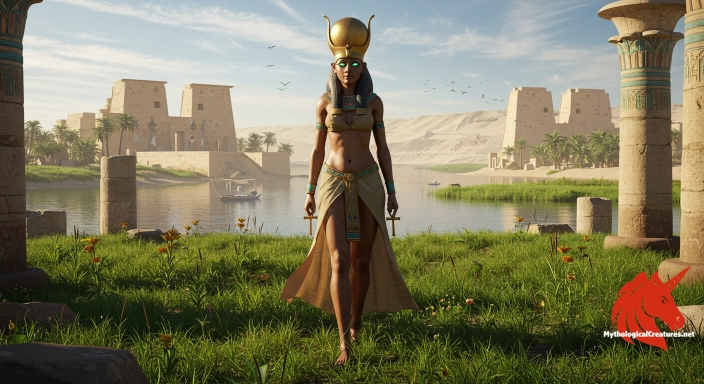
Nebtuwi
Nebtuwi - Nebtuwi played an integral role in promoting agricultural prosperity and fertility in ancient Egypt, with her worship centred at Latopolis (Esna).
the legend in five swipes.
the legend in five swipes.
How did the legend of Nebtuwi begin?
Nebtuwi emerges as a radiant figure in the tapestry of ancient Egyptian mythology, embodying the bounty of the earth and the vitality of the harvest. Her very name, which translates as 'the lady of the fields,' conjures visions of flourishing crops and the nurturing pulse of nature. As a goddess of fertility, she is integrally linked with Khnum, her consort, whose creative prowess is celebrated in the myths of creation. Early attestations of her worship are deeply rooted in the religious heartland of Latopolis, later known as Esna, where agricultural prosperity was paramount. Her role resonates with themes of growth, regeneration, and the intimate connection between the divine and the sustenance of life. Nebtuwi’s attributes share common ground with those of other eminent goddesses such as Isis and Hathor, reflecting a panegyric tradition that celebrated maternal nurturance and protective care. The cultural context in which she flourished was one that revered the cyclical patterns of nature, aligning her with the rhythms of the Nile and the seasonal timing of the harvest. Although shifts in religious practice eventually saw her identity absorbed into the cult of Neith, the echoes of her ancient significance continue to captivate modern imaginations. Today, her legacy endures as a symbol of life, fertility, and the deep-rooted agricultural traditions of ancient Egypt.
Who wrote down the legend of Nebtuwi?
The primary sources detailing Nebtuwi’s cult are interwoven with the broader corpus of Egyptian religious inscriptions and temple reliefs. Relics from Latopolis, where her worship was most fervent, unveil fragments of myth and ceremony that celebrate her as a divine nurturer of the land. Stone carvings and papyrus texts offer glimpses of ceremonial rites, with references that align her closely with fertility and the natural cycles of growth. Although the surviving records are sparse, variations in the myth suggest that her story was fluid and adapted over time, much like many other deities in the Egyptian pantheon. In some inscriptions, her identity is merged subtly with that of widely venerated figures like Isis and Hathor, indicating an overlap of divine functions. These texts sometimes offer alternative versions of her narrative, reflecting a tradition that was inherently regional yet capable of broader religious synthesis. The interpretive challenge of these sources lies in their brevity, forcing modern scholars to piece together a mosaic of fragments and variant traditions. Despite the scarcity of a unified narrative, the collected evidence paints a picture of a goddess whose fundamental role in fertility was both enduring and transformative. Her historical variability underscores the dynamic nature of myth-making in ancient Egypt, where local and regional traditions often intersected.
What did Nebtuwi look like?
Nebtuwi is most commonly depicted as an elegant and serene lady whose artistic renderings underscore her divine essence. Her iconography is accentuated by the distinctive vulture cap she wears, a symbol laden with significance in Egyptian cosmology and closely associated with protection and maternal care. This headgear, both regal and symbolic, distinguishes her from other deities and embeds her within a tradition that honours sky and earth. Artists of the time rendered her in refined garments that often flow with a sense of graceful movement, alluding to the gentle rhythms of the agricultural cycle. The depictions vary slightly from one relief to another, with subtle differences in facial expression, posture, and the intricacies of her adornment reflecting regional artistic styles. Additional details sometimes include motifs of the lotus, reeds, or grain, all of which reinforce her connection to fertility and the nurturing aspects of the land. In certain representations, her figure is complemented by symbols that echo her partnership with Khnum, emphasising the creative union between earth and water. Each portrayal of Nebtuwi weaves together both the aesthetics of royal dignity and the pragmatic symbolism of agrarian abundance, making her one of the more visually evocative divine figures of ancient Egypt.
How does Nebtuwi differ by region?
The veneration of Nebtuwi was largely concentrated in Latopolis, yet her influence gracefully extended beyond this core region through subtle local adaptations. In various parts of Upper Egypt, the attributes of this fertility goddess were intermingled with indigenous traditions, resulting in a rich mosaic of iconography and ritual practice. Regional cults occasionally emphasized aspects of her divine character that were particularly pertinent to local agricultural cycles and natural landscapes. In bordering areas such as Nubia, the stylistic representations of Nebtuwi incorporated unique motifs and decorative elements that resonated with the local environment. These adaptations ensured that while her central identity as a goddess of fertility remained consistent, her appearance and associated myths could vary significantly, embracing regional customs. In some communities, her narrative and symbols were gradually blended with those of the goddess Neith, reflecting the continuous evolution of religious practices in response to socio-political changes. The localised reinventions of Nebtuwi attest to the fluidity of myth in ancient Egypt, where the interchange of symbols across regions served to broaden her appeal. Ultimately, this regional diversity underscores how her story was not static, but rather a living tradition that adapted to the varying cultural and environmental contexts of the ancient world.
Is Nebtuwi unique, or found elsewhere?
Nebtuwi occupies a unique niche in mythological studies, where her functions resonate with those of other fertility deities across diverse cultures. Her role shares several thematic parallels with that of Isis and Hathor, both of whom are equally celebrated for their nurturing and life-affirming qualities in Egyptian lore. Analogous to figures such as the Greek Demeter or the Roman Ceres, Nebtuwi embodies the essential energy of growth and the cyclical renewals of nature. The imagery associated with her, particularly the vulture cap, carries cross-cultural significance, paralleling motifs of protection and divine oversight seen in other ancient civilizations. Her depiction, blending regality with an inherent association to the agrarian world, encapsulates a widespread archetype found in many fertility goddesses. Comparative analysis invites a broader view of how ancient societies venerated the forces of nature and emphasised the continuity of life and harvest. As local practices evolved, Nebtuwi’s attributes were sometimes conflated or contrasted with neighbouring deities, reflecting an ongoing dialogue between regional identities and pan-ethnic mythological concepts. The convergence and divergence of her iconography highlight the interconnectedness of mythologies that span geographical and cultural boundaries, reinforcing the universal human reverence for the natural cycles of birth and renewal.
How did Nebtuwi survive into the modern world?
Over the centuries, the image and worship of Nebtuwi have undergone significant transformations, reflective of changes in religious paradigms and cultural priorities. Originally a prominent deity in the agrarian heartland of Latopolis, her stature was gradually diminished as new religious currents and deities, such as Neith, rose to prominence. Artisans and scribes reinterpreted her iconography over successive dynasties, often integrating traditional elements with emerging symbols that resonated with shifting theological landscapes. Yet, despite this dilution in official cult practice, the core essence of Nebtuwi as a goddess of fertility and renewal persisted in the cultural undercurrents of Egypt. Modern scholarship has rekindled interest in her narrative, recognising her contributions to the intricate mosaic of ancient Egyptian religion. Museum exhibitions, archaeological studies, and cultural festivals in Esna have brought her legacy back into public view, offering fresh interpretations of her historical significance. Contemporary neo-pagan practices and artistic endeavours also draw on her symbolism, celebrating the enduring attributes of nurturing, growth, and natural abundance. The evolution of her myth from an active centre of worship to a revered symbol of fertility and regenerative power encapsulates the dynamic interplay between tradition and reinterpretation in the historical narrative of Egypt.
Interesting Fact
Nebtuwi's assimilation into the cult of Neith highlights the fluid nature of divine worship and the evolution of religious practices in ancient Egypt.
Mythological Treasures
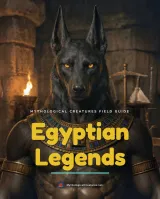
Egyptian Legends: A field guide to the gods and monsters of ancient Egypt
Guardians of the living and devourers of the dead, with the role each played in judgement.
Greek Myths: A field guide to the monsters of ancient Greece
Every monster here earned its place in legend, and each gets a full page of artwork and the story behind it.
Norse Sagas: A field guide to the beasts of the Viking world
Drawn from the saga accounts themselves, with the powers, weaknesses and doom of each being set out.
the legend in five swipes.
Partner with Mythological Creatures
Bring your myth-based world into ours
From game settings to narrative worlds, we work with partners who treat myths with care. Share your project for a potential sponsor slot.
Partner with usQuick Creature Info
Origin:
Associations:
Our Mythic Legendary Rating:

Habitat:
Supernatural Powers:
Physical Attributes:
Abilities:
Behavior:
Lore:
References
Discover Another Mythical Legend You May Not Have Heard Of?
Uncover the mysteries of ancient folklore and expand your knowledge of legendary beings from cultures around the world.
Dare to Meet the Hortdan....
The Mythological Creatures Book Series
Yokai, Greek, Norse, Egyptian & Chinese. Five illustrated field guides to the creatures the old stories either warned or told you about.

Curated by the Mythological Creatures Team
Series editor: Mythological Creatures Directory
Primary desk: Hellenic & Ancient Mediterranean Desk
(rev. November 2025)