
Mut: Mut is an ancient Egyptian mother goddess revered as the primal creator and protector of all life.
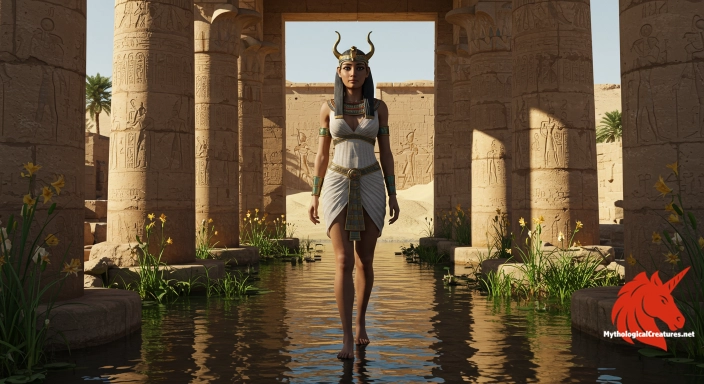
Mut
Mut - Mut is revered as the mother of all creation and a symbol of divine femininity and authority in ancient Egyptian culture.
Origins & First Encounters
Mut is a powerful maternal deity whose worship can be traced back to the early days of ancient Egyptian civilisation. Her name, meaning 'mother', encapsulates her essence as a nurturer and originator of life in the Egyptian pantheon. She emerged from the primordial chaos, linked to the sacred waters of Nu, symbolising the birth of everything in existence. Over time, her role evolved from a formless creative force to a clearly defined goddess celebrated in royal temples and festivals. Her integration into the renowned Theban Triad, alongside Amun-Ra and Khonsu, solidified her status within the complex religious landscape of Egypt. The goddess was deeply influential not only in myth but also in the socio-political life of the nation, with rulers often invoking her image to reinforce their divine right to lead. Mut’s association with both creative beginnings and protective motherhood struck a resonant chord with the people of Egypt. This multifaceted character continues to be a profound symbol of fertility, authority, and the eternal cycle of life.
Source Texts & Tale Variants
Ancient temple reliefs, inscriptions, and votive offerings provide the primary sources through which Mut’s myth is understood today. These early records, found in prominent sites like Karnak, illustrate the goddess’s integral role in state-sponsored rituals and festivals. Textual fragments across various papyri and monuments reveal different strands of her narrative, ranging from her creation-centric origins to her later associations with the royal family of gods. Some sources depict her as a force capable of generating life without a consort, while others place her in an essential partnership with the solar god Amun-Ra. The varying accounts highlight a dynamic character whose attributes were adapted and reinterpreted over successive dynasties. Her celebratory presence in festivals such as the Opet Festival underscores the living tradition of her worship and the communal reverence for her fertility. Scholars note that these sources, while fragmented, offer a mosaic of interpretations that enliven her myth. Multiple story variants not only emphasise her maternal qualities but also reflect the evolving cosmological ideas of ancient Egypt.
Form & Powers
Artistic depictions of Mut consistently reflect her royal status, presenting her as a dignified woman adorned with symbols of sovereignty such as the double crown. This crown, emblematic of the united realms of Upper and Lower Egypt, emphasises her universal authority as a mother figure. In various temple reliefs and statues, her visage exudes both serenity and strength, capturing the dual nature of nurturing warmth and regal power. Artists often embellish her image with intricate jewellery and carefully crafted headdresses that sometimes include the vulture symbol, a mark of divine protection. Her posture, usually composed and graceful, suggests an enduring calm that complements her role as a creator goddess. Some representations even incorporate subtle solar motifs, aligning her with the powerful energies of the sun and the cosmos. The careful blending of human form with symbolic regalia in her portrayal reinforces the connection between the earthly and the divine. These detailed artistic elements serve not only to illustrate her physical beauty but also to convey deep layers of religious meaning and cultural importance.
Regional Faces
The reverence for Mut was most prominent in Thebes, where her cult was deeply interwoven with local traditions and the state religion. In Upper Egypt, she was portrayed with an emphasis on protective motherhood, a reflection of the nurturing characteristics prized in the region. Variations in her iconography across different localities sometimes meant subtle changes in her regalia, adapting her image to meet regional aesthetic preferences. In some provincial settings, local deities with similar maternal aspects were syncretised with Mut, creating a hybrid form that resonated with local community identities. This adaptive process highlights the fluid nature of ancient Egyptian theology, where deities were frequently reinterpreted to reflect local values and needs. Smaller temple shrines and local festivals often showcased these variations, offering a more intimate view of her worship outside the mainstream religious centres. The emphasis on her attributes could shift from emphasising her cosmic power to focusing more on her nurturing side, depending on regional traditions. Such regional adaptations contributed to the rich diversity of her cult, ensuring that her legacy was widely accessible throughout Egypt.
Cultural Parallels
Mut’s character finds echoes in various other mythological traditions that celebrate the archetype of the mother goddess. Her embodiment of fertility, creation, and nurturing is reminiscent of the roles played by deities such as Isis in Egypt and Demeter in Greek lore. Similar to the universal motifs found in the stories of Gaia from Greek mythology or the Sumerian goddess Ninhursag, Mut represents the cyclical nature of life and the earth’s capacity for regeneration. The union of cosmic forces embodied by her partnership with Amun-Ra parallels divine couples in other cultures where the convergence of sky and earth underpins creation myths. This comparative framework underscores a common human recognition of the essential, nurturing power of motherhood. Across various cultures, the reverence for a supreme feminine principle that nurtures and sustains life is a recurring theme. The similarities among these divine figures highlight a shared cultural emphasis on the importance of fertility and natural cycles. Such a comparative analysis deepens our appreciation for Mut as both a distinctly Egyptian deity and a representative of a broader, cross-cultural archetype.
Legacy & Modern Evolution
The transformation of Mut’s worship over the millennia mirrors the evolution of Egyptian religious practice and political power. In the earliest traditions, she was revered as a primordial force of creation, a symbol of nature’s inexhaustible generative power. As Egyptian society grew more complex, her integration into the Theban Triad helped to elevate her status as a deity closely linked with the legitimacy of governmental authority. This deliberate association with state power ensured that her image was continuously adapted to reinforce the cultural and political narratives of the time. In modern times, Mut’s legacy has transcended ancient ritual, finding a place in artistic reinterpretations, scholarly discourse, and even neo-spiritual practices. Contemporary artists and writers often invoke her image to symbolise timeless maternal strength and the creative potential inherent in all life. The goddess’s enduring presence in literature, visual arts, and popular culture serves as a bridge connecting modern society with its ancient past. Her timeless narrative continues to inspire and provoke reflection on the universal themes of creation, protection, and the enduring power of the feminine spirit.
Interesting Fact
An intriguing aspect of Mut’s legacy is how her diverse myths and evolving attributes allowed her to embody both the creation of the world and the maternal care of its inhabitants.
For indie creators
Give your myth project a permanent home
Indie authors, artists, small studios, and makers can secure an annual, non-intrusive sponsor slot that meets readers where they explore.
Obtain more informationQuick Creature Info
Origin:
Associations:
Our Mythic Legendary Rating:

Also Sometimes Known As:
Habitat:
Supernatural Powers:
Physical Attributes:
Abilities:
Behavior:
Lore:
Related Creatures, Tales or Lore
- IIsis
- GGaia
- CCybele
References
Discover Another Mythical Legend You May Not Have Heard Of?
Uncover the mysteries of ancient folklore and expand your knowledge of legendary beings from cultures around the world.
Dare to Meet the Mater Matuta....
Curated by the Mythological Creatures Team
Series editor: Mythological Creatures Directory
Primary desk: Hellenic & Ancient Mediterranean Desk
(rev. November 2025)