
Nineigara: Nineigara is a Mesopotamian goddess associated with dairy products.
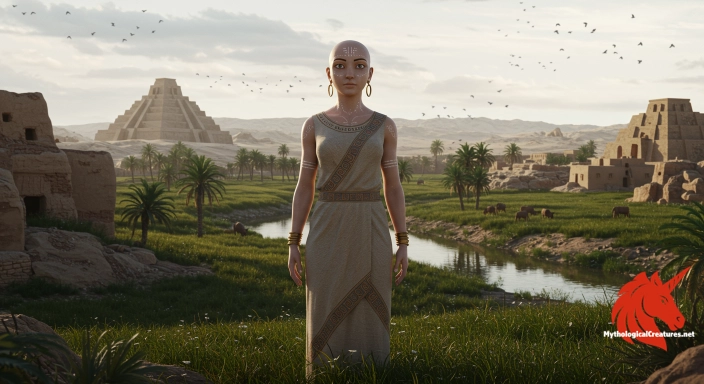
Nineigara
Nineigara - Embodies nourishment, fertility, and the centrality of dairy in ancient Mesopotamian society
Origins & First Encounters
Nineigara is an enigmatic Mesopotamian goddess whose divine sphere encompasses the realm of dairy and pastoral nourishment. Emerging from the heart of ancient agrarian societies, she symbolised the vital connection between the sustenance of milk and the prosperity of the community. Her early attestations, though fragmentary, hint at a veneration rooted in the everyday realities of agricultural life. Placed within the celestial court of the moon god Nanna, her presence ties the cycles of nature with the rhythms of the heavens. Her sacred bond with Ningublaga, the god of cattle, further underscores her role as a keeper of pastoral abundance and fertility. The ritual practices and offerings dedicated to her reveal deep cultural beliefs about the life-giving properties of dairy. As a deity, she was much more than a personification of milk; she emerged as a nurturing force advocating both physical nourishment and spiritual renewal. The goddess exemplified how integral dairy was to sustaining life, symbolising both maternal care and the bounty of the earth. In the rich tapestry of Mesopotamian myth, Nineigara stands as a gentle yet powerful guardian of nourishment.
Source Texts & Tale Variants
The textual evidence linking Nineigara to the realm of dairy appears sporadically in ancient Mesopotamian records, where she is mentioned amidst the litany of deities in temple inscriptions and god lists. Several early inscriptions and fragmentary hymns reference her as a divine figure who ensured the prosperity of milk production and cattle rearing. Variations in the spelling of her name, including the form Nine'igara, reflect the diverse scribal traditions and regional practices of the time. Some of the available texts allude to rituals in which offerings of milk were made, emphasising her role in daily and seasonal ceremonies. Despite the scarcity of extensive narratives detailing her myth, these passages indicate that her worship was interwoven with broader agricultural and lunar cycles. Alternative story variants suggest that Nineigara might have been celebrated in festivals dedicated to the renewal of life and fertility. Her integration into the divine retinue alongside the moon god Nanna points to a layered and interconnected religious system. Although explicit stories concerning her personal exploits are few, the scattered sources underscore her importance within the agricultural context. The surviving fragments, when viewed alongside later interpretations, provide a window into a deity whose influence was as nurturing as it was subtle.
Form & Powers
In artistic depictions, Nineigara is envisioned as a gracious figure exuding both strength and maternal tenderness. Surviving iconographic fragments suggest that she was portrayed with soft, rounded features that emanate an air of gentle benevolence. Often, she is imagined wearing flowing garments adorned with subtle motifs reminiscent of cattle or milk vessels, highlighting her association with dairy. Some representations hint at the inclusion of a distinctive headdress or crown, symbolising her elevated status within the pantheon of deities. There is an artistic interplay of simplicity and intricacy in her depictions, where detailed embroidery on her attire alludes to the richness of pastoral life. The artistic style attributed to her reflects the conventions of ancient Mesopotamian relief and seal impressions, combining both geometric precision and naturalistic softness. Although direct depictions are rare, the imagery that has survived communicates themes of fertility, nourishment, and pastoral abundance. Local artisans adapted her physical portrayal over time, integrating regional elements while maintaining her essential attributes. Overall, her iconography remains a subtle yet profound portrayal of the nurturing forces inherent in nature.
Regional Faces
Across the varied landscapes of ancient Mesopotamia, the worship of Nineigara exhibited regional nuances that mirrored local agricultural practices and societal values. In certain Sumerian city-states, her veneration was tightly linked to the practical aspects of dairy production, with rituals designed to ensure the fertility of cattle and the abundance of milk. In other regions, her role extended to being an integral part of the divine assembly associated with the moon god Nanna, reflecting a more celestial and cosmological interpretation. Variations in her cultic expressions can be observed in the differing epithets and titles that emerged from distinct local traditions. Some communities celebrated her in festivals that combined both agricultural rites and lunar celebrations, emphasising her hybrid nature. Artistic representations found in regional sanctuaries often incorporated local symbols and motifs, adapting her image to suit the particularities of local belief systems. The regional adaptations also allowed Nineigara to interlace with indigenous deities of fertility and pastoral abundance, creating a syncretic religious narrative. These localised expressions emphasised her nurturing aspect and the practical importance of dairy within everyday life. The diverse regional interpretations underscore how ancient communities sought to personalise divine attributes to reflect their unique environmental and cultural contexts.
Cultural Parallels
Nineigara’s divine functions invite comparisons with other nurturing deities from disparate cultures, each embodying the life-sustaining qualities of dairy and pastoral abundance. Her role resonates with that of Hathor in ancient Egyptian mythology, a goddess revered for her associations with motherhood, fertility, and the nurturing powers of cattle. Both goddesses are celebrated for their capacity to provide sustenance, with milk serving as a potent symbol of life and renewal. Similar to other deities in the ancient Near East, Nineigara illustrates the universal human reverence for natural sources of nourishment, bridging the gap between the sacred and the everyday. The iconographic elements such as soft features and bovine symbols have parallels in various cultures where the cow or milk is honoured as an emblem of fertility. Comparative mythologies also draw attention to the overlapping domains of agricultural prosperity and celestial power, linking Nineigara with broader themes found in other pantheons. Deities like her reveal how communities across different regions conceived of divine forces as both nourishing and protective. The cross-cultural exchanges among ancient societies often led to shared motifs, enhancing the symbolic language used to depict such pastoral goddesses. In this light, Nineigara stands as a testament to the enduring human fascination with the goddess archetype that champions the sustenance of life.
Legacy & Modern Evolution
Over time, the portrayal of Nineigara evolved as ancient Mesopotamian society underwent significant cultural and religious transformations. Her specific association with dairy gradually merged into broader narratives of fertility and abundance as the pantheon expanded and adapted to new socio-political realities. Although explicit mentions of her waned in later periods, the symbolic essence of her nurturing power persevered in the rituals and cultural practices that celebrated life and renewal. In the modern era, a renewed academic interest in ancient religions has cast fresh light on her subtle yet essential role in Mesopotamian mythology. Contemporary interpretations often position her as an archetype of maternal care and agricultural sustainability, echoing the timeless importance of nourishment. Exhibitions and scholarly works have begun to trace the threads of her legacy through art and literature, revealing a once-vital connection between divine myth and everyday sustenance. Modern cultural reimaginings sometimes incorporate her aspects in fictional narratives and artistic installations, symbolising a mystical return to nature’s bountiful sources. Her evolving image reflects a dynamic interplay between ancient traditions and modern sensibilities, ensuring that the themes of fertility and nurturing remain relevant today. Ultimately, Nineigara endures as a powerful emblem of the intrinsic relationship between the divine and the natural world, reminding us of an enduring legacy that celebrates the life-giving power of dairy.
Interesting Fact
Although not as prominently celebrated as some other deities, Nineigara's unique domain over dairy highlights the vital role of nourishment and agricultural fertility in Mesopotamian religious practices.
Partner with us
Sponsor this space
Reach thousands of mythology enthusiasts with a curated placement on our creature pages.
Learn about sponsorshipQuick Creature Info
Origin:
Features:
Associations:
Our Mythic Legendary Rating:

Also Sometimes Known As:
Habitat:
Supernatural Powers:
Abilities:
Behavior:
Lore:
Related Creatures, Tales or Lore
- NNinhursag
- NNinlil
- NNingal
References
Discover Another Mythical Legend You May Not Have Heard Of?
Uncover the mysteries of ancient folklore and expand your knowledge of legendary beings from cultures around the world.
Dare to Meet the Half-elf....

Curated by the Mythological Creatures Team
Series editor: Mythological Creatures Directory
Primary desk: Hellenic & Ancient Mediterranean Desk
(rev. November 2025)