
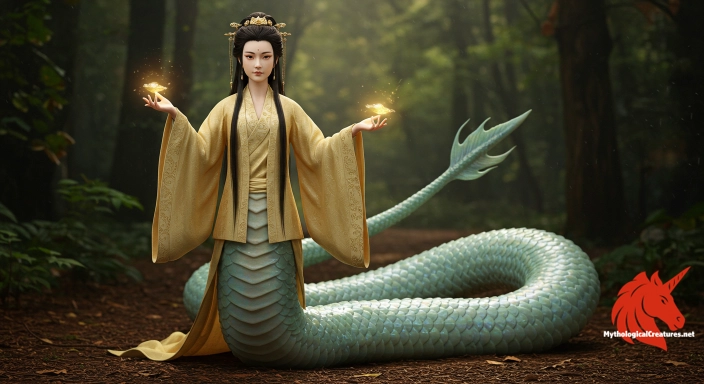
Nüwa: Nüwa is a revered Chinese mother goddess known for creating humanity from clay and repairing the fallen Pillar of Heaven.
Nüwa
Nüwa - Nüwa is a pivotal cultural and religious figure symbolising creation and cosmic restoration.
the legend in five swipes.
the legend in five swipes.
What are the origins of Nüwa?
Nüwa, also known as Nügua, stands as one of the most revered figures in Chinese mythology, embodying both the creation of life and the restoration of cosmic order. Her legend is embedded in ancient narratives where she is celebrated as a mother goddess and culture hero, integral to the tradition of the Three Sovereigns. Myths recount that she fashioned human beings by meticulously moulding clay, a process that symbolises the intimate fusion of the divine with the earthly. Her storied origins are intertwined with the religious practices of Chinese folk traditions, while her influence permeates Confucian, Taoist, and Buddhist thought. Early accounts detail how her divine touch prepared the earth for the emergence of society, blending artistry with cosmic power. Stories also credit her with mending the shattered heavens by patching the sky with five colourful stones and using the legs of a tortoise to reestablish celestial order. Over time, her role has expanded from that of a mere creator to a guardian of cosmic balance, reflecting both nurturing compassion and formidable resilience. Ancient lore presents her as the progenitor who not only gave form to humankind but also restored harmony when chaos reigned. Her narrative has shaped cultural rituals and art, encouraging generations to ponder the mysteries of life’s origin. In every retelling, Nüwa exemplifies creation, restoration, and the delicate interplay between the mundane and the mystical.
The Source Texts Behind Nüwa
Ancient texts, including the Huainanzi and various folk ballads, offer a wealth of insights into the many facets of Nüwa’s mythology. These sources describe a remarkable era when celestial battles led to the collapse of the heavens and the subsequent need for divine repair. Numerous accounts detail her ingenious craftsmanship in sculpting human beings by hand using yellow clay, emphasising a central theme of creative power. In some versions of the myth, she reserved the finest clay for the noble and the elite, while commoners emerged from brown mud fashioned through simpler means. Alternate narratives depict her creation of ‘cord-made people’ as a humble yet profound act, achieved by dragging a string through the fertile muck. Over the centuries, diverse literary traditions have contributed variant details that enrich her mythic portrait. Local legends, ceremonial inscriptions, and poetic compositions have all celebrated her heroic efforts to mend the shattered firmament with five representative coloured stones. These variants illustrate a dynamic myth that adapts with the evolving perceptions of society and spirituality. Despite subtle inconsistencies, the essential themes of creation and cosmic renewal unite these accounts. The multiplicity of sources not only deepens her legendary status but also reinforces her significance as a perennial symbol of regeneration.
What does Nüwa look like?
Nüwa’s physical depictions have evolved over time, shaped by a blend of mythology and artistic interpretation. Often shown with an ethereal beauty that merges human grace with elemental power, she is typically rendered in flowing, traditional garments that echo the colours of nature. Her visage is portrayed as gentle yet resolute, reflecting the dual qualities of compassion and strength inherent in her creative role. Artistic representations sometimes incorporate serpent-like features in her form, symbolising her deep connection with the primal forces of the earth. The lower portion of her figure is occasionally suggested through serpentine curves or hints of natural waterforms, bridging the terrestrial with the divine. Her attire is richly adorned with intricate patterns that sometimes mirror the five vibrant colours of the stones she used to mend the heavens. Soft, lustrous hair is often highlighted in these depictions, cascading in graceful waves that evoke the continual flow of life. The juxtaposition of her serene expression with a dynamic posture speaks to her ability to both nurture and reestablish cosmic harmony. Some artistic renditions portray her with delicate, almost translucent features, hinting at her otherworldly origins. Through centuries of artistic evolution, these multifaceted visual portrayals have ensured that Nüwa remains an enduring symbol of beauty intertwined with cosmic significance.
Which regions tell stories of Nüwa?
Nüwa’s myth has adapted and evolved as it traversed the varied cultural landscapes of China, with regional traditions offering distinctive perspectives on her divine character. In many southern regions, her narrative is interwoven with local agricultural rituals, where she is revered as a guardian of communal prosperity and natural fertility. Northern traditions often emphasise her heroic endeavour to repair the shattered heavens, casting her as a formidable force dedicated to restoring cosmic order. Diverse local legends have incorporated unique cultural accents into her origin story, sometimes portraying her as a mediator between celestial powers and human society. In areas where folk traditions deeply honour the elements of water and earth, her connection to primordial natural forces is accentuated through symbolic iconography. Villages across the country commemorate her creative act with festivals and rituals that echo the themes of restoration and renewal. Despite regional nuances in storytelling, the core attributes of compassion, ingenuity, and endurance remain constant in her depictions. Artistic renditions in temples and murals often reveal subtle differences in her attire and symbolic accessories, reflecting local aesthetic values. Community narratives continue to adapt her myth to reflect contemporary local experiences while preserving ancient motifs. These diverse regional interpretations underscore the adaptability and enduring impact of her legend across China’s cultural tapestry.
Legends Comparable to That of Nüwa
The story of Nüwa invites comparison with creation deities from numerous cultures, revealing striking similarities and nuanced differences. Like Gaia in Greek mythology, she embodies the nurturing essence of the earth and the creative force that forms the basis of human life. Her method of sculpting humankind from clay is a motif shared by many cultures, echoing the biblical narrative of man formed from dust. Similar creation themes appear in other traditions, such as the Sumerian goddess Ninhursag who also symbolised life’s fertility and renewal. The act of repairing a broken cosmos through divine intervention finds parallels in other mythologies where deities confront chaos to restore order. Nüwa’s complementary relationship with Fu Xi highlights a duality that resonates with other cultural pairs balancing creation with cosmic governance. These narratives, although emerging from distinct cultural contexts, reflect a universal human endeavour to explain the origins of existence and the interplay between the mortal and the divine. Comparative analysis reveals that while the materials and methods differ, the elemental themes of creation, healing, and balance remain consistent. More than a mere mythological figure, she encapsulates a fundamental human aspiration to harness nature’s raw elements for the creation of life. Through cross-cultural parallels, Nüwa’s legend ultimately illuminates how disparate societies express similar cosmic truths through imaginative storytelling.
What does Nüwa mean to people today?
Over the centuries, Nüwa’s myth has undergone significant evolution, adapting to the shifting cultural and social landscapes of China. Her ancient narratives, once confined to oral tradition and early texts, have been expanded upon by literary, artistic, and philosophical reinterpretations across dynasties. The celestial repair she performed using colourful stones and tortoise legs has come to symbolise resilience in the face of both natural and human-made disasters. In modern times, her story has been reimagined as a potent emblem of female empowerment and the creative spirit that fosters renewal. Contemporary literature, film, and visual art frequently revisit her legacy, exploring themes of restoration, continuity, and innovative creation. Modern audiences perceive her not only as a figure of myth but as an inspiration for overcoming chaos in everyday life. Her image resonates with contemporary concerns about environmental sustainability and social harmony, ensuring that ancient wisdom informs modern practice. Cultural festivals and art exhibitions often celebrate her enduring influence on both ancient lore and present-day narratives. The transformation of her myth mirrors the broader journey of Chinese cultural identity, combining a reverence for past traditions with a progressive openness to reinterpretation. Nüwa’s legacy, therefore, continues to inspire creative rebirth and communal strength, maintaining a timeless appeal in an ever-changing world.
Interesting Fact
Despite her primary association with creation, Nüwa is also celebrated for her unique role in cosmic repair, marking her as a dual emblem of genesis and restoration in Chinese mythology.
Mythological Treasures
Chinese Beasts: A field guide to the dragons and demon kings of Chinese myth
From river dragons to demon kings, with the legends that shaped five thousand years of storytelling.
Japanese Yokai: A field guide to the spirits and demons of Japanese folklore
Fifteen spirits, with the signs to watch for and what the old tales say to do if you meet one.
Greek Myths: A field guide to the monsters of ancient Greece
Every monster here earned its place in legend, and each gets a full page of artwork and the story behind it.
the legend in five swipes.
Advertising opportunity
Showcase your mythology project
We offer limited sponsor placements for books, courses, games, and creators aligned with our audience.
View partnership optionsQuick Creature Info
Type:
Associations:
Our Mythic Legendary Rating:

Also Sometimes Known As:
Habitat:
Supernatural Powers:
Physical Attributes:
Abilities:
Behavior:
Lore:
References
Discover Another Mythical Legend You May Not Have Heard Of?
Uncover the mysteries of ancient folklore and expand your knowledge of legendary beings from cultures around the world.
Dare to Meet the Ghatotkacha....
The Mythological Creatures Book Series
Yokai, Greek, Norse, Egyptian & Chinese. Five illustrated field guides to the creatures the old stories either warned or told you about.
Curated by the Mythological Creatures Team
Series editor: Mythological Creatures Directory
Primary desk: Asian & Pacific Myth Cycles Desk
(rev. November 2025)