
Orobas: Orobas is a powerful Great Prince of Hell renowned for his dual manifestations as both a striking black stallion accompanied by lightning and a youthful human figure.
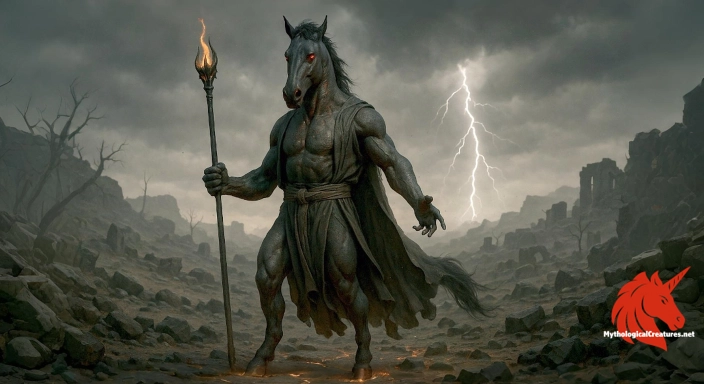
Orobas
Orobas - Orobas is notable for answering inquiries, foretelling events, and providing protection, thus embodying the multifaceted nature of infernal power.
Origins & First Encounters
Orobas stands as one of the most riveting entities within demonology, distinguished as a Great Prince of Hell with command over twenty legions of lesser demons. His mythic character has evolved over time through a tapestry of occult writings and esoteric traditions that present him as both a harbinger of profound insights and a guardian against malign influences. Early attestations of his legend are embedded in medieval grimoires, where his dual nature as a solver of mysteries and a protector of devotees is vividly recorded. The narratives that have survived highlight his ability to provide power over adversaries, a trait that has undoubtedly contributed to his lasting mystique in the realm of the occult. His association with protection, especially against the slander of enemies, adds a unique dimension to his character by intertwining divine intervention with infernal authority. The cultural context in which Orobas was conceived reflects a period marked by a deep fascination with the boundaries between divine grace and demonic force. His depiction is integrally linked to ritual practices that utilised his supposed abilities to foretell the future and reveal concealed truths. As a result, Orobas has come to embody the paradox of being both a formidable challenger and a benevolent protector in the shadowy world of demonology. His enduring legacy continues to intrigue scholars and occult practitioners alike, inviting ongoing reinterpretation that adapts ancient motifs for modern sensibilities. The amalgamation of these qualities cements his status as a uniquely complex figure, one whose mystique is as compelling as it is contradictory.
Source Texts & Tale Variants
Historical knowledge of Orobas is derived from an assortment of ancient manuscripts and demonological treatises that chronicle his formidable powers and mysterious origins. Medieval grimoires extensively detail his capacity to answer questions about the past, present, and future, offering a glimpse of his role as an advisor within the infernal hierarchy. These texts present a variety of story variants that underscore his dual functions of protection and empowerment, with some sources focusing on his ability to counteract evil influences and others emphasising his prophetic talents. Over the centuries, the narrative of Orobas has been enriched by contributions from various occult traditions, each adding layers of complexity to his persona. Certain treatises describe his intervention in personal affairs, citing his capacity to halt slander and restore a balance disrupted by malevolent adversaries. Oral traditions, too, seem to have played a role in cementing his myth, allowing nuanced interpretations to pass from one generation to another. The multiplicity of these sources reflects the shifting perceptions of demonic figures, where elements of fear, fascination, and even admiration interweave. This abundant and variegated body of literature ensures that the legend of Orobas remains dynamic, constantly open to reexamination and reinterpretation by both historical scholars and modern occult enthusiasts.
Form & Powers
Orobas is illustrated with remarkable versatility in physical form, a testament to his shifting nature and multifaceted powers. In one of his most striking manifestations, he appears as a magnificent black stallion, its powerful physique and fierce, untamed energy amplified by the dramatic display of bucking amidst flashes of lightning. This equine form symbolises an elemental force of nature, radiating both overwhelming strength and an unpredictable dynamism. Conversely, other descriptions portray him as a diminutive, dark-haired man with a countenance that exudes cautious wisdom and an enigmatic charm. There is also an account of him appearing as a youthful figure with medium-length blonde curls, a feature that challenges the conventional visage associated with demonic entities. Such contrasting depictions not only highlight the diversity in his representations but also underscore the broader theme of duality inherent in his myth. His eyes are frequently described as gleaming with an inner light that hints at hidden knowledge, while his overall demeanour suggests a blend of innocence and cunning. These detailed physical presentations allow for a rich interpretation of his character, inviting observers to examine the interplay between appearance and perceived power. The variance in his form further deepens his mystique, making him a perpetual subject of fascination in both occult circles and modern imaginative re-tellings.
Regional Faces
The portrayal of Orobas displays intriguing regional variations that mirror the diverse cultural landscapes from which his legend emerged. In the writings of Western Europe, his depiction is frequently intertwined with themes of authority and protection, emphasising his role in countering evil and guarding against misfortune. Within Mediterranean occult traditions, his patronage over horses is further accentuated, resonating with ancient rituals and narratives steeped in equine symbolism. Renaissance influences brought forward an interpretation that underscored his capacity to extinguish slander and restore fairness, a reflection of the social and moral preoccupations of the era. In other parts of Europe, local adaptations have woven his character into broader mythic frameworks that balance his fearsome demonic attributes with aspects of a benevolent guardian. Some regional accounts even stress the duality of his forms, depicting him as both an awe-inspiring beast of nature and a cunning young man, thus highlighting the fluidity of his identity. The localised stories often adapt his skills of foresight to address the specific fears and aspirations of their communities. This amalgamation of influences from various regions underscores the adaptability of his myth, which has managed to maintain core elements while evolving with local cultural narratives. The regional variations of Orobas's character serve to reinforce his universal appeal and the malleable quality of myth itself.
Cultural Parallels
When examining the myth of Orobas, it becomes evident that his attributes resonate with those of other complex figures from demonological and broader mythic traditions. His ability to foretell the future and command respect through supernatural might draws parallels with other oracular and guardian entities found in various occult systems. Much like shapeshifting trickster figures and dual-natured guardians, Orobas embodies the synthesis of destructive and protective powers. Comparisons might also be drawn with other well-known demon princes whose narratives oscillate between benevolence and malevolence, reflecting the perennial tension between order and chaos. His protective role against slander and malevolent spirits finds echoes in the broader mythological tradition of deities and spirits tasked with maintaining cosmic balance. The integration of equine symbolism in his imagery also aligns him with ancient mythic figures that harness the power of nature and the animal kingdom. This complex tapestry of qualities situates Orobas within a cross-cultural network of characters who defy simple categorisation, embodying both salvation and damnation. Such comparative analysis emphasises the universality of themes like duality, hidden wisdom, and transformative power across diverse cultural and mythological landscapes.
Legacy & Modern Evolution
The historical evolution of Orobas reflects the dynamic interplay between ancient myth and modern reinterpretation, illustrating how a single figure can traverse centuries of changing cultural paradigms. In archaic demonological texts, he was depicted as an immutable force of the infernal realm, his powers both feared and revered in equal measure. As intellectual and occult currents shifted during the Renaissance, his image began to acquire additional layers of complexity that transcended traditional notions of evil. In recent times, modern occult practitioners and artists have reimagined Orobas as a multifaceted symbol of both resistance and hidden wisdom. Contemporary interpretations often emphasise his role as a defender against social defamation and malign influences, aligning him with modern ideals of empowerment and protection. This redefinition has allowed the figure of Orobas to enter popular culture, where his dramatic manifestations continue to inspire literature, art, and even digital media. The continuous transformation of his iconography illustrates how ancient symbols can adapt to the evolving values and aesthetic sensibilities of successive generations. His enduring legacy, therefore, is not only a testament to his historical significance but also to the timeless nature of the archetypes he represents. As debates about his true nature persist among both scholars and enthusiasts, Orobas remains a vibrant exemplar of the rich and mutable tapestry of myth.
Interesting Fact
Despite his fearsome reputation as a demon, Orobas is uniquely sought after for his ability to protect and provide clarity, underscoring the intricate duality and moral ambiguity inherent in many infernal entities.
For publishers and studios
Your next readers are already here
Many of our visitors are looking for books, campaigns, and resources that deepen their journey into myth. Position your title or setting here.
Discuss a placementQuick Creature Info
Associations:
Our Mythic Legendary Rating:

Habitat:
Supernatural Powers:
Physical Attributes:
Abilities:
Behavior:
Lore:
References
Discover Another Mythical Legend You May Not Have Heard Of?
Uncover the mysteries of ancient folklore and expand your knowledge of legendary beings from cultures around the world.
Dare to Meet the Epiales....
Curated by the Mythological Creatures Team
Series editor: Mythological Creatures Directory
Primary desk: Hellenic & Ancient Mediterranean Desk
(rev. November 2025)