
Othreis: Othreis is an oread nymph from Greek mythology, intrinsically connected to Mount Othrys.
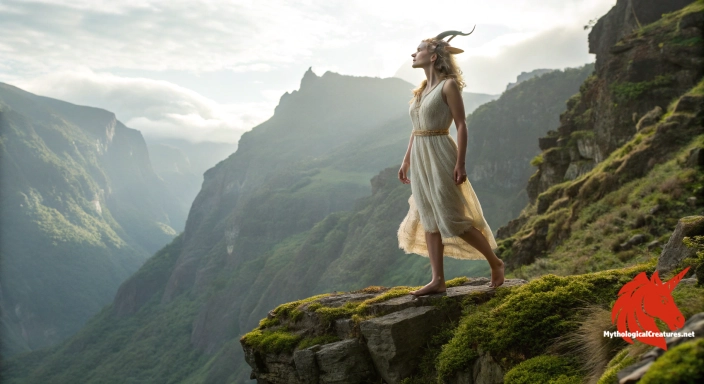
Othreis
Othreis - Othreis represents the enduring spirit of the mountainous regions of Greece and highlights the close intertwining of nature with divine forces through her relationships with Zeus and Apollo.
Origins & First Encounters
Othreis emerges in myth as a fascinating embodiment of the ancient Greek reverence for nature and divine interplay. Bearing a name that signifies her origin from Mount Othrys, she is celebrated as more than a simple nymph, but rather as a guardian of the mountain’s sacred spirit. Her mythic birth is interwoven with the elemental forces of earth and sky, hinting at an origin steeped in mystery and timeless tradition. Tales of her existence were nurtured in local rites and whispered among those who dwelled in the shadow of the great mountain. As an oread, her presence symbolises the rugged beauty and unpredictable character of untamed landscapes. Her celebrated unions with both Zeus and Apollo lend her a dual divine connection that bridges the lofty and the earthly. In ancient gatherings, her story was recounted with reverence, thereby strengthening her position within the rich tapestry of Greek myth. The legacy of Othreis reflects an enduring admiration for the raw power of nature and the transcendent qualities of the divine. Through orally transmitted traditions and local cults, her narrative has been preserved as an emblem of the harmonious intersection between the mortal and the sacred.
Source Texts & Tale Variants
Accounts of Othreis appear sporadically in fragmented ancient texts, where she is mentioned in contexts of sacred mountain worship and ritual veneration. Literary sources remain sparse, yet her myth is sustained through local cult practices and ritual invocations that have been passed down through generations. Poetic fragments and obscure hymns allude to her divine interactions, suggesting a role that bridged the human and the celestial. Archaeological discoveries such as votive offerings and ritual artefacts in the vicinity of Mount Othrys lend subtle credence to her celebrated presence. Various story variants have emerged over time, each highlighting different facets of her divine essence and her relationships with the major Olympians. In some narratives, she is portrayed as a mediator between deities, while in others her nurturing aspect as a mother figure is accentuated. Oral traditions enriched her legend further, incorporating local lore and symbolic elements that have evolved with regional practices. The collective textual and material evidence, though not abundant, confirms that her myth served as a living connection between the ancient people and the sanctity of their natural world.
Form & Powers
Othreis is envisioned as a nymph whose physical form mirrors the rugged splendour of the mountainous terrain she inhabits. Classical depictions imbue her with a graceful yet wild allure, blending refined beauty with raw, untamed strength. Descriptions suggest that her skin carries a subtle luminescence, much like the first light that kisses the craggy peaks at dawn. Her hair is often imagined to cascade freely, evoking the tumbling streams and soft mists that shroud the highlands. Deep, reflective eyes are attributed to her, mirroring the ever-changing skies and the deep hues of shadowed forests. She is frequently portrayed draped in garments that seem crafted from natural elements—soft mosses, shimmering leaves, and delicate petals—that underscore her intimate bond with the earth. Artistic renditions capture both her ethereal beauty and the underlying power reminiscent of the immovable mountains. Every aspect of her appearance speaks to a duality of fragility and resilience, as though she embodies the very soul of the wilderness. Her image remains a timeless symbol of the fusion between divine grace and the formidable forces of nature.
Regional Faces
While Othreis is deeply rooted in the environs of Mount Othrys, her myth has been refined by a variety of regional traditions and local interpretations. In central Greece, she is honoured as a patron of mountain sanctuaries and a symbol of the untamed, natural world. Rural communities adopted her legend to explain the capricious nature of the highlands, portraying her as both a benevolent protector and a force capable of unleashing nature’s fury. Local folk traditions often interlace her story with that of other regional nymphs, resulting in a composite figure that embodies multiple aspects of nature’s bounty. In isolated mountain villages, annual rites and invocations celebrated her as the emblem of fertility, protection, and the cyclical renewal of the seasons. Adaptations of her myth often include vivid narratives that explain local geological phenomena and natural wonders. As these stories were passed from one community to another, her character absorbed distinctive local traits, making her a multifaceted deity. Such regional variations ensured that her tale reflected the unique environmental challenges and cultural values of each locality. Over time, these diverse adaptations have enriched her myth, allowing her legacy to resonate across various landscapes and traditions.
Cultural Parallels
In comparing Othreis with other mythological figures, one finds striking parallels with nature spirits across diverse cultures. Her character, imbued with both nurturing and formidable aspects, is reminiscent of other goddesses and nymphs who preside over natural landscapes, such as the Roman Diana. Similarities can also be observed in the elusive woodland and mountain spirits celebrated in Celtic traditions, where nature itself is revered as a divine entity. The recurrent theme of a female guardian who embodies the forces of nature unites these varied mythic figures across cultural boundaries. Like many such deities, Othreis serves as a mediator between humanity and the elemental powers governing the natural world. Some regional lore even draws comparisons between her and the Slavic Vila or Anatolian spirit figures, all of whom symbolise the mysterious intersection between beauty and the wild. Despite these common threads, her narrative retains a distinct Greek character through her direct association with Zeus, Apollo, and Mount Othrys. This distinctiveness sets her apart within the broader tradition of nature deities, highlighting both universal themes and unique mythological nuances. Such cross-cultural comparisons underscore the powerful, symbolic role played by figures whose origins lie in the revered landscapes of the ancient world.
Legacy & Modern Evolution
Over the centuries, the figure of Othreis has transitioned from a relatively obscure mythic character to a potent symbol of nature’s enduring mystique and the eternal interplay between humanity and the divine. Early depictions rooted in local cult practices have been reimagined in the light of later classical, medieval, and renaissance interpretations, each layer adding depth to her character. Her image served, for a time, as an allegory for the raw beauty of the wilderness, inspiring poets, painters, and sculptors to celebrate the synthesis of the civilized and the wild. In modern times, a renewed interest in ancient myth and environmental consciousness has drawn scholars and artists alike back to her story. Contemporary adaptations often present her as an icon of eco-spirituality and the inviolable bond between nature and the human spirit. Artistic works, ranging from literature to visual arts, invoke her legacy as representative of the untamed and transformative forces of the natural world. Her myth has been appropriated in various cultural movements, where she signifies both the loss of ancient wisdom and the hope for a harmonious future with nature. Although the original textual sources remain fragmentary, the enduring power of her narrative continues to influence modern perspectives on myth, beauty, and environmental stewardship. Othreis stands today as a timeless emblem, bridging the ancient past with contemporary quests for meaning in the natural realm.
Interesting Fact
Othreis’s direct relationships with major Olympian deities illustrate the frequent and intricate interconnections between nature spirits and gods in Greek mythology.
Partner with us
Sponsor this space
Reach thousands of mythology enthusiasts with a curated placement on our creature pages.
Learn about sponsorshipQuick Creature Info
Origin:
Associations:
Our Mythic Legendary Rating:

Also Sometimes Known As:
Habitat:
Supernatural Powers:
Physical Attributes:
Abilities:
Behavior:
Lore:
Related Creatures, Tales or Lore
- CCyrene
- EEcho
- AArethusa
References
Discover Another Mythical Legend You May Not Have Heard Of?
Uncover the mysteries of ancient folklore and expand your knowledge of legendary beings from cultures around the world.
Dare to Meet the Achilles....
Curated by the Mythological Creatures Team
Series editor: Mythological Creatures Directory
Primary desk: Hellenic & Ancient Mediterranean Desk
(rev. November 2025)