
Ox-Head and Horse-Face: Ox-Head and Horse-Face are two fearsome guardians of the Chinese underworld.
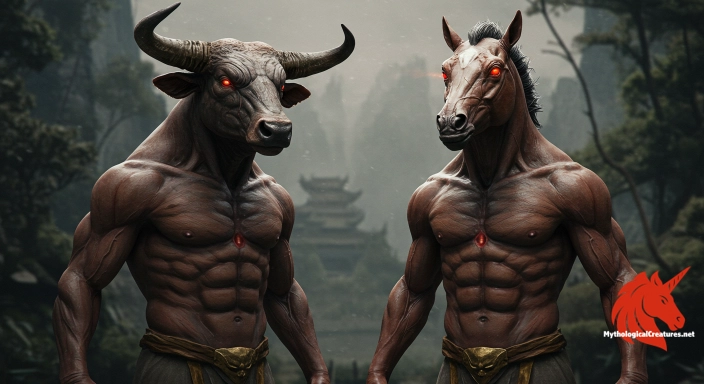
Ox-Head and Horse-Face
Ox-Head and Horse-Face - They are the first beings encountered by dead souls, symbolising the transition from life to the afterlife.
Origins & First Encounters
Ox-Head and Horse-Face emerge from the rich depths of Chinese myth as imposing guardians at the threshold of the underworld. Their legendary roles are interwoven with ancient beliefs about life, death, and the journey of the soul. These figures, whose origins reach back into a miasma of pre-Imperial folk traditions, embody both the inevitability of death and the possibility of moral rebirth. Early attestations of their names can be found in the oral and pictorial traditions of rural communities, later echoing through the works of classical literature. Their striking features—a bull-like head for Ox-Head and a horse-like countenance for Horse-Face—serve as symbolic embodiments of animalistic power and steadfast duty. Over time, their myth was integrated into broader religious narratives, spanning Taoist, Buddhist, and folk religious contexts. They are seen not merely as fearsome spectres but as ancient custodians charged with the solemn task of escorting souls to their next realm. Their enduring presence in myth reflects a cultural preoccupation with the balance of justice, the cycle of life, and the mystery of the beyond.
Source Texts & Tale Variants
The accounts of these underworld sentinels are preserved in a variety of ancient texts and folklore, each offering unique insights into their roles and attributes. Early literary sources, often embedded in folk operas and local myth cycles, laid the groundwork for their classic depictions in later works. Various manuscripts and illustrated texts from the Ming and Qing dynasties recount their appearances and duties in striking detail. Their portrayal in popular religious texts has provided a mosaic of narrative variants, each linking the guardians closely with the metaphysical realms of death and rebirth. Different communities have added layers of nuance, sometimes emphasising their function as moral arbiters while in other stories they appear as dutiful guides. In some tales the duo is accompanied by additional spirits, which further amplifies the intricate structure of the afterlife. Oral storytelling traditions have ensured that these narratives evolve, absorbing local colour and spiritual symbolism over time. As such, the treasure trove of sources paints a dynamic picture of how these mythic figures have been revered and feared alike across generations. Their stories continue to serve as a window into the ancient Chinese worldview of life, death, and cosmic justice.
Form & Powers
Ox-Head is portrayed with a powerful, ox-like head adorned with prominent horns and a rugged, steadfast expression that hints at deep, primordial strength. His visage is both formidable and enigmatic, with textured features that evoke the earthy qualities of the bovine spirit. In stark contrast, Horse-Face bears the unmistakable attributes of a horse, exhibiting a wide, expressive countenance marked by a long snout and intense, vigilant eyes. Both creatures possess the body of a man, lending an unsettling blend of humanity and bestiality. Their human forms are often illustrated as clad in traditional garb or demonic armour, reinforcing their roles as otherworldly chaperones. Distinctive physical traits, such as a flowing mane for Horse-Face or a coarse beard for Ox-Head, further underline their supernatural essence. Variations in artistic depictions sometimes highlight differences in size and expression, reflecting diverse local interpretations. The detailed rendering of their hybrid anatomies has allowed artists and storytellers alike to encapsulate the dual nature of order and chaos inherent in the underworld. Through these visual cues, each figure communicates a potent mix of dread and awe, encapsulating the mysteries of death and duty.
Regional Faces
Throughout China, regional interpretations of Ox-Head and Horse-Face have imbued them with local flavours that mirror the unique cultural and spiritual landscapes of different areas. In rural communities, their images are frequently blended with local iconography, where traditional dress and pastoral symbols merge with their mythic features. Certain regions portray Ox-Head as a rugged symbol of agrarian strength, echoing the hardiness of the countryside, while Horse-Face is sometimes seen as embodying the fleeting nature of life and the rapid passage into the afterlife. Local temple art and folk festivals have embraced these guardians, presenting them with distinctive regional embellishments that differ from the canonical portrayals in imperial texts. Beyond the borders of China, neighbouring cultures in East Asia have adapted their characteristics to align with local mythic paradigms. In these adaptations, subtle modifications in form and function are made to better resonate with indigenous beliefs about life, death, and the spirit world. Such regional variations emphasize the fluidity of myth, where universal themes are tailored to fit local customs and narratives. The regional diversity in their depictions testifies to the lasting and adaptable nature of these figures, whose symbolism continues to evolve with the cultural landscape.
Cultural Parallels
The mythic roles of Ox-Head and Horse-Face invite comparisons with similar guardians in other cultural traditions. Their function as escorts of souls into the realm of the dead bears similarities to Cerberus, the multi-headed guardian of the Greek underworld, albeit with a distinctly non-hound appearance. In parallel, the image of Charon, the ferryman who guides souls across the river of death, resonates with the guiding role these Chinese stalwarts play. The integration of human and animal features in their depictions also mirrors hybrid figures found in various mythologies that symbolise the liminality between worlds. Comparable guardians in Indian lore, such as Yama, emphasise the administration of moral consequence and the journey after death, binding these narratives together across vast cultural divides. Such cross-cultural connections illuminate a shared human fascination with the mystery of life beyond the physical realm. By comparing these figures with other mythological custodians of the afterlife, one observes a universal motif of security, judgment, and transition. This dialogue between traditions highlights the broader human endeavour to understand mortality and the cosmic order, where animalistic attributes serve as metaphors for natural forces. Through these comparative lenses, Ox-Head and Horse-Face emerge not only as uniquely Chinese entities but also as part of a global mythological tapestry.
Legacy & Modern Evolution
The evolution of Ox-Head and Horse-Face in historical and modern contexts reveals a continual reinvention in response to shifting cultural narratives. Early portrayals in ancient scrolls and woodblock prints set a standard of fear and reverence that has been reinterpreted by successive generations. In modern times, these guardians have transcended their original folkloric boundaries to appear in literature, film, and popular art, where their roles are often imbued with fresh psychological and philosophical layers. Contemporary artists have reimagined them as symbols of the inexorable nature of destiny and the transformative journey of the soul. Modern depictions tend to highlight the complexity of their characters, showing them as both stern enforcers of cosmic law and tragic figures caught between worlds. Their presence in modern media, such as graphic novels and television dramas, has introduced them to a global audience, expanding their influence far beyond traditional Chinese culture. As modern spiritualities continue to explore themes of life, death, and rebirth, these mythological figures are increasingly embraced as enduring icons of transition and existential mystery. Their evolving legacy underscores the timeless appeal of myth, where ancient symbols are continually adapted to express contemporary concerns and universal truths.
Interesting Fact
An interesting aspect of Ox-Head and Horse-Face is that their human forms, combined with their animal features, challenge the typical depiction of deities, merging the natural with the supernatural.
For indie creators
Give your myth project a permanent home
Indie authors, artists, small studios, and makers can secure an annual, non-intrusive sponsor slot that meets readers where they explore.
Obtain more informationQuick Creature Info
Features:
Our Mythic Legendary Rating:

Also Sometimes Known As:
Habitat:
Supernatural Powers:
Physical Attributes:
Abilities:
Behavior:
Lore:
References
Discover Another Mythical Legend You May Not Have Heard Of?
Uncover the mysteries of ancient folklore and expand your knowledge of legendary beings from cultures around the world.
Dare to Meet the Adlivun....
Curated by the Mythological Creatures Team
Series editor: Mythological Creatures Directory
Primary desk: Asian & Pacific Myth Cycles Desk
(rev. November 2025)