
Peluda: The Peluda is a mythical beast from French medieval folklore, known for its shaggy green fur and serpent head.
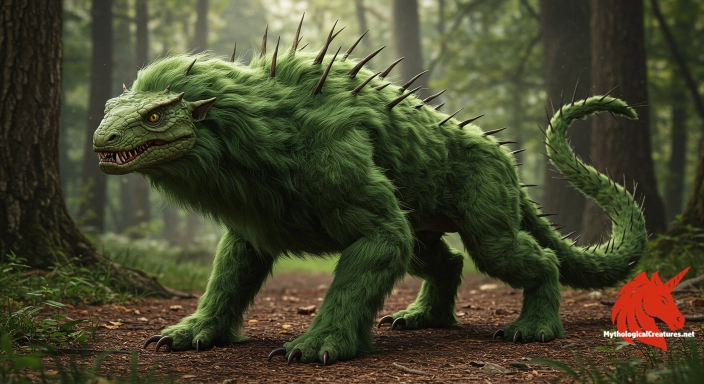
Peluda
Peluda - The Peluda is remembered as a symbol of nature's wrath and a cautionary tale highlighting vulnerability despite formidable power.
Origins & First Encounters
The Peluda is a formidable creature entrenched in medieval French lore that has long haunted the imagination of local communities along the River Huisne. Its dual identity, also known as La Velue in French and Peluda in Spanish, reflects a unique cross-cultural presence that transcends national boundaries. Emerging from the mists of a turbulent era, this beast symbolised the unpredictable and often hostile forces of nature during a time when environmental hazards were interpreted as divine portents. The creature’s origins are rooted in the rich oral traditions and early recorded texts of La Ferté-Bernard, where it was portrayed as an unstoppable menace. Its fearsome reputation was amplified by the vivid imagery used to describe its appearance and destructive powers, planting seeds of both terror and fascination among its witnesses. The myth served not only as a cautionary tale but also as an explanation for natural disasters that struck crops and livestock, deeply impacting agrarian societies. With its legend passed down through generations, the narrative of the Peluda became interwoven with the socio-cultural fabric of medieval communities. Its enduring legacy testifies to the power of myth in encapsulating human fears and the mysterious forces of nature. Over time, the creature evolved into a symbol that embodies both the promiscuity of the natural world and the timeless human struggle against uncontrollable calamities. The Peluda remains a captivating subject in the study of myth, reflecting a period of history marked by uncertainty, wonder, and the eternal clash between man and nature.
Source Texts & Tale Variants
Ancient manuscripts and regional chronicles offer a window into the early depictions of the Peluda, presenting a creature born of both terror and enchantment. Early textual references from the medieval period describe the beast with striking detail, emphasising its unusual characteristics and the havoc it wreaked along the River Huisne. The narrative is further enriched by oral traditions that, over centuries, have woven additional threads into the creature’s complex persona. Various story variants recount differing aspects of its destructive power, with some accounts highlighting its ability to unleash fire, while others focus on its capacity to cause catastrophic floods. One enduring version of the legend recounts the fateful encounter with a maiden named l’Agnelle, whose would-be rescuer discovered the creature’s only weakness in its tail. This particular tale has not only shaped the perception of the beast but also reinforced the motif of a singular vulnerability in invincible monsters. As these accounts were filtered through the lens of local folklore, regional storytellers gradually adapted the narrative to incorporate elements that resonated with their own experiences and fears. Multiple versions of this story have emerged over time, each capturing unique details while preserving the core characteristics of the Peluda. The blending of written records and oral history has ensured that the myth remains both dynamic and deeply rooted in cultural memory. Such a synthesis of sources demonstrates how legend is continually reshaped by the interplay of tradition, interpretation, and time.
Form & Powers
The physical description of the Peluda is as remarkable as it is terrifying, with every detail contributing to its otherworldly aura. At the forefront of its features is a serpentine head that exudes an air of ancient menace and cunning, setting the tone for its entire form. Enveloping its body is a thick coat of long, green fur that lends the creature an almost spectral appearance under moonlight. Adding to its fearsome profile are the poison-tipped spines that jut from its back, each one symbolising a lethal weapon designed to inflict harm. The beast is often depicted with a sinuous, elongated physique that hints at both agility and unbridled power, enabling it to navigate its rugged terrain with ease. Its tail, robust yet vulnerable, is uniquely significant as the sole point of weakness in an otherwise formidable armour. Some depictions even suggest that glistening scales can be seen intermingled with its fur, creating a fusion of reptilian and mammalian traits. The stark contrast between its wild, unkempt hair and the precise, venomous nature of its spines adds a layer of complexity to its mythological representation. Every element of its anatomy—from the piercing eyes to the lethal tail—contributes to a composite image that is both mesmerizing and repellent. The detailed physical characterisation of the Peluda allows it to stand apart as an emblem of the mysterious and often deadly forces of nature.
Regional Faces
The legend of the Peluda is marked by regional variations that reveal a rich tapestry of local interpretation and cultural adaptation. In France, particularly around the area of La Ferté-Bernard, the creature is known as La Velue, and it is most often depicted as a harbinger of destruction tied inexorably to the natural landscape. Here, its association with the River Huisne deepens its connection to the local ecology, where floods and other natural disasters were common motifs in folklore. In nearby Spanish traditions, adaptations of the myth have retained the central characteristics of a wild, man-eating beast while sometimes imbuing it with additional qualities reflective of the region’s own mythic pantheon. Artists and storytellers in different locales emphasise distinctive traits—whether it be variations in fur colour or the subtleties of its fiery versus aquatic attributes—that speak to their environmental circumstances. These diverse regional renditions demonstrate how a singular myth can be refracted through the unique cultural lenses of neighbouring communities. Local festivals, art, and literature have each contributed to the evolving narrative of the Peluda, often using the creature as a symbol of both caution and the indomitable spirit of nature. Such fluidity in its regional portrayal underscores the dynamic relationship between myth and the lived experiences of communities. Ultimately, despite these regional differences, the Peluda remains a potent emblem of wild, elemental power capable of transcending cultural and geographical boundaries.
Cultural Parallels
The Peluda finds intriguing parallels in various mythological traditions, its composite features offering a rich ground for cross-cultural comparison. Much like the Hydra of Greek mythology, the creature incorporates multiple dangerous attributes that highlight nature’s dual potential for both nurture and destruction. Its reptilian characteristics, fused with a wild, hairy exterior, invite comparisons to European dragons and other hybrid beasts known for their formidable presence in battle against human order. Similar mythical entities often possess a singular vulnerability that provides both a challenge and a narrative resolution, much like the exposed tail of the Peluda marks its only weak point. This motif resonates across diverse cultures, symbolising the notion that every mighty force harbours a hidden frailty. The creature also echoes elements found in Latin American and Iberian folklore where wild, untamed beasts serve as cautionary figures manifesting nature’s unpredictable wrath. Such creatures often embody the community’s struggle against natural calamities and the internal conflicts of human society. Comparative myths across continents shed light on the universal human tendency to personify environmental challenges with monstrous imagery. The Peluda, therefore, is not an isolated legend but part of a broader mythic tradition that spans cultures and epochs. Its features and narrative function as a bridge among varied stories of nature, heroism, and the inevitable interplay between human vulnerability and the formidable forces beyond control.
Legacy & Modern Evolution
The evolution of the Peluda from a feared medieval monster to a celebrated cultural icon illustrates the fluid nature of myth and the enduring human fascination with the unknown. In its earliest portrayals, the creature was an omnipresent terror, a cautionary symbol of the unpredictable might of nature during an era when natural disasters were often inexplicable. As centuries passed, the narrative of the Peluda became more nuanced, its terrifying attributes gradually giving way to a more complex legacy that finds resonance in modern art and literature. Contemporary reinterpretations often celebrate the creature’s wild imagery, transforming it into a metaphor for the untamed aspects of both nature and human spirit. In local French communities, regional festivals and art installations have embraced the myth, using it as a platform to explore themes of environmental change and cultural identity. Modern fantasy literature and role-playing games have also drawn upon the rich detailing of the Peluda, reimagining its legend for a new generation of enthusiasts. This modern legacy underscores the adaptability of myth, capable of absorbing the anxieties and aspirations of each era. The creature now symbolizes not just the horrors of the past, but the vibrant and sometimes chaotic dialogue between humanity and the natural world. In re-examining the Peluda, modern interpreters reveal the layers of symbolism that continue to inspire creative expression and reflection. Ultimately, the historical evolution of this mythic beast attests to the transformative power of folklore in articulating both timeless fears and emerging hopes.
Interesting Fact
A notable aspect of the Peluda legend is its ambiguous elemental power, with some accounts attributing fire-breathing abilities and others suggesting it could induce floods—reflecting the varied interpretations of its nature in medieval folklore.
For serious myth projects
Feature your work alongside the legends
From academic works to story-rich games, we highlight projects that respect world mythologies. Talk to us about a measured, long-term placement.
Start a conversationQuick Creature Info
Features:
Associations:
Our Mythic Legendary Rating:

Also Sometimes Known As:
Habitat:
Supernatural Powers:
Physical Attributes:
Abilities:
Behavior:
Weaknesses:
Lore:
Related Creatures, Tales or Lore
References
Discover Another Mythical Legend You May Not Have Heard Of?
Uncover the mysteries of ancient folklore and expand your knowledge of legendary beings from cultures around the world.
Dare to Meet the Zashiki-warashi....

Curated by the Mythological Creatures Team
Series editor: Mythological Creatures Directory
Primary desk: Hellenic & Ancient Mediterranean Desk
(rev. November 2025)