
Renenutet: Renenutet is an ancient Egyptian goddess of grain, nourishment, and the harvest.
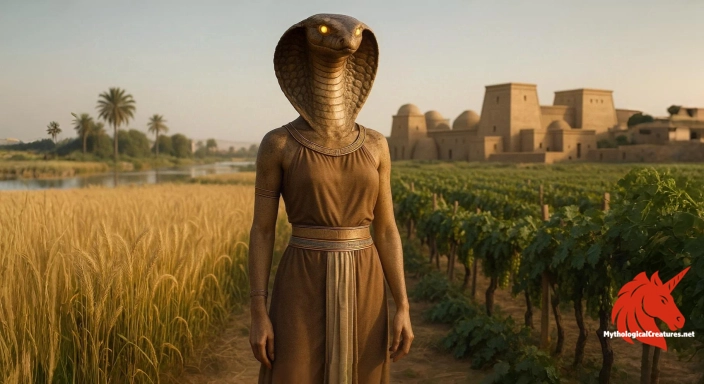
Renenutet
Renenutet - Central to ensuring agricultural fertility and sustaining life, her protection extended to food stores and the royal office.
Origins & First Encounters
Renenutet stands as a dynamic goddess whose essence intertwines nourishment, fertility and protection within the vast panorama of ancient Egyptian spirituality. Her genesis is rooted in a time when the sustenance of life and the seasonal rhythms of agriculture held paramount significance, and her origins can be traced back to early cult practices centred in Terenuthis. Her very name, echoing gestures of fondling and nursing, evokes a sense of compassionate guardianship that extended over the pharaoh from birth until death. Distinct in her dual portrayal as both a cobra and a woman crowned with a serpent’s head, she embodies a rare blend of fierce power and tender care. Celebrations and rituals in her honour were integral during harvests, reflecting society’s deep reliance on the cyclical bounty of nature. Her multifaceted role elevated her status not only as a bringer of prosperity but also as a protector of the vital food stores. Over time, the goddess became a symbolic nexus of life and sustenance, embodying the promise of both regeneration and stability. Her enduring legacy continues to illuminate the intricate relationship between celestial guardianship and the earthly realm of abundance and security.
Source Texts & Tale Variants
Ancient inscriptions, temple reliefs and ritual artefacts provide a rich tapestry that unveils Renenutet’s storied past. The surviving texts along with detailed hieroglyphic depictions found in granaries, kitchens, and vineyards reveal her multifaceted character as both nurturer and protector. Images of her in wine-making scenes and on stamps for wine containers offer compelling evidence of her central role in sustaining food supplies. Varied versions of her narrative emerge in different texts, some portraying her as the maternal figure to deities like Nehebkau, while others highlight her protective attributes. In several accounts, her close associations with Sobek and Geb add layers of complexity, intertwining aspects of water and earth to the fertile motifs of her character. The Greek renditions of her name as Thermouthis or Hermouthis further illustrate the transmission and adaptation of her myth beyond local boundaries. Each variant contributes to a mosaic of interpretations that celebrate her as an indispensable guardian of the harvest. The diversity of these sources underscores how cultural memory and textual traditions combined to craft her enduring mythos. These narratives collectively offer a window into the ceremonial life and agricultural practices that celebrated her divine attributes.
Form & Powers
Renenutet is frequently depicted through the striking imagery of a cobra, a form that captures both elegance and latent ferocity. Artists rendered her either as a sleek serpent or as a woman whose head is that of a cobra, merging human grace with formidable reptilian power. The sinuous curves of her form, whether delicately streamlined or boldly coiled, speak of an intrinsic balance between nurturing warmth and fierce protection. Her iconography often includes elaborate headgear and symbols that signify bountiful harvests, accentuating her role as the mistress of provisions. In many artworks, shimmering scales and detailed eyes suggest a vigilant spirit, always watching over the cultivated fields and stored granaries. The deliberate emphasis on both beauty and danger in her representations underscores her dual nature as a guardian of life and sustenance. Variations in size and stylistic detail throughout the centuries reflect the evolving artistry and regional innovations within ancient Egyptian art. The careful blending of human and serpent features in her depictions artfully communicates the amalgamation of tenderness with power. These vivid portraits, full of symbolic nuance, continue to provide deep insights into the spiritual and practical significance of her form within Egyptian culture.
Regional Faces
Renenutet’s worship reveals striking nuances as her cult spread from its heartland in Terenuthis to the broader expanse of Lower Egypt. In different regions, local traditions adapted her core attributes to fit unique agricultural practices and cultural expectations. Some communities celebrated her primarily as a benevolent provider ensuring the fertility of crop fields and vineyards, while others emphasised her protective power against threats to food stores. In the Faiyum area, for instance, her association with Sobek underscored the delicate balance between water, soil fertility and the bounty of harvest. Local iconography evolved, often incorporating regional motifs that symbolised the rich silt deposits and seasonal rains essential to the land. Her integration with deities such as Wadjet and Meretseger in local lore further reflected the syncretic tendencies of Egyptian religious practice. Despite these regional adaptations, the consistent themes of nurture and safeguard remained central to her identity. Each locale contributed its own artistic and mythological inflections, enriching the tapestry of her legend. These geographical variations not only highlight local ingenuity but also ensure that her divine presence resonated widely across different Egyptian communities.
Cultural Parallels
An examination of Renenutet’s role across mythologies reveals fascinating parallels with other deities who preside over agricultural bounty and protection. The nurturing aspect of her character, coupled with an undercurrent of fierce defences, resonates with figures such as Demeter and Ceres in Greco-Roman traditions. Similar to these goddesses, she embodies the intricate connection between the fertility of the land and the cycles of life and death. The dual symbolism of the serpent present in her iconography is mirrored in various cultures, where serpentine forms are often imbued with meanings of regeneration and both danger and protection. These cross-cultural comparisons underscore the universal importance of agricultural deities in maintaining societal stability. In her merging of roles with deities like Isis and Wadjet, there is a clear reflection of shared themes concerning guardianship and maternal care. Such analogues emphasise the interwoven narratives that describe the life-sustaining forces present in nature. Comparative analysis highlights how her myth has resonated with diverse communities by addressing fundamental human concerns—namely, the provision and protection of life itself. The shared motifs across cultures illustrate a global reverence for the processes that ensure renewal and abundance, confirming Renenutet’s place among the pantheon of universal life-givers.
Legacy & Modern Evolution
The historical journey of Renenutet’s myth mirrors the broader evolution of religious thought within ancient Egypt, evolving from a local guardian of harvests to a complex symbol of divine sustenance. Over the centuries, her attributes became increasingly intertwined with those of other potent deities, such as Wadjet and Sobek, reflecting the dynamic nature of myth-making. As calendar systems shifted and agricultural practices advanced, so too did her representations, adapting to the changing needs of a society deeply reliant on nature’s rhythms. Modern scholars and enthusiasts alike continue to find inspiration in her multifaceted narrative, which speaks to themes of nurture, protection and the cyclical renewal of life. Contemporary exhibitions and academic discussions have revived interest in her rich symbolism, portraying her as an emblem of environmental balance and sustainable abundance. Artists and cultural commentators have reimagined her image in ways that resonate with modern concerns about food security and ecological stewardship. The legacy of Renenutet endures through the artefacts and temple inscriptions that continue to inform our understanding of ancient agricultural practices. Her enduring influence serves as a bridge between the sacred traditions of the past and contemporary reflections on nature’s vitality and resilience. In this way, Renenutet remains a timeless figure whose myth continues to inspire reverence for the life-giving forces of our world.
Interesting Fact
An intriguing aspect of Renenutet is her capacity to embody both nurturing care and formidable protection, mirroring the ancient Egyptian belief in the interconnectedness of life, fertility, and divine guardianship.
For authors, artists, and makers
Created something from the realm of myth?
If your book, deck, game, or artwork draws from legendary creatures and lore, you can showcase it here in a tasteful, year-round placement.
Share your projectQuick Creature Info
Origin:
Features:
Associations:
Our Mythic Legendary Rating:

Also Sometimes Known As:
Habitat:
Supernatural Powers:
Physical Attributes:
Abilities:
Behavior:
Lore:
Related Creatures, Tales or Lore
- WWadjet
- MMeretseger
- IIsis
References
Discover Another Mythical Legend You May Not Have Heard Of?
Uncover the mysteries of ancient folklore and expand your knowledge of legendary beings from cultures around the world.
Dare to Meet the Theseus....

Curated by the Mythological Creatures Team
Series editor: Mythological Creatures Directory
Primary desk: Hellenic & Ancient Mediterranean Desk
(rev. November 2025)