
Šarruma: Šarruma is a Hurrian god known for his dual depictions as an anthropomorphic figure sometimes riding a leopard and as a theriomorphic bull.
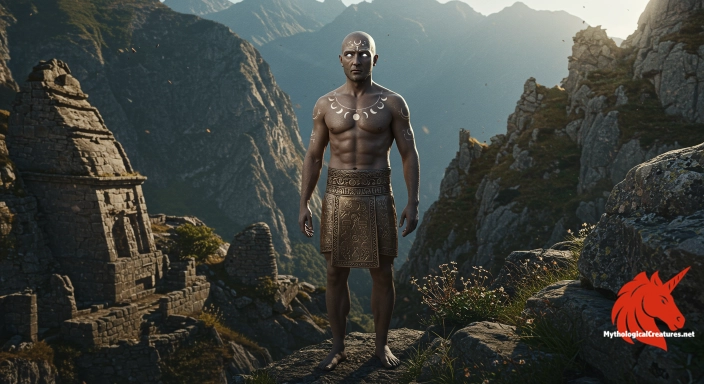
Šarruma
Šarruma - Šarruma played an important role in the Hurrian pantheon, later influencing Hittite and Luwian religious practices as a symbol of divine communication and the power of the mountains.
Origins & First Encounters
Šarruma emerges from the rich tapestry of Hurrian mythology as a deity whose multifaceted nature reflects both celestial and terrestrial forces. His origins are intertwined with the ancient cultures of southeastern Anatolia and northern Syria, where his worship found fertile ground. He was first attested in contexts that emphasised his dual representation, merging human and animal features in striking ways. Born to Ḫepat and Teshub, his lineage positioned him within a powerful divine family, underscoring his significance in the pantheon. His role extended beyond the ordinary, as he was venerated not only as a messenger but also as a mountain god, blending elements of nature and the divine. A connection with lunar deities added another layer of mystique to his character. His depictions, which vary from an anthropomorphic figure riding atop a leopard to a theriomorphic form resembling a bull, further highlight the complexity of his mythic persona. The cultural context of his worship illustrates an evolving religious landscape that adapted ancient traditions to meet the spiritual needs of diverse communities.
Source Texts & Tale Variants
Surviving mythological texts offer only a glimpse into the enigmatic character of Šarruma, with the scant surviving narrative portraying him as a messenger of Kumarbi. The limited literary sources do not fully capture the breadth of his symbolic roles, yet they hint at his importance in ritual and religious practice. In the ancient records of Hurrian society, rituals and inscriptions mention his association with both mountainous landscapes and lunar cycles. Textual fragments from Kizzuwatna and nearby regions further attest to his presence in local cultic activities. The Hittite records, albeit somewhat fragmentary, recast him within a broader divine assembly, offering subtle variations in his portrayal. Lesser-known texts from Ugaritic and Emar traditions contribute additional layers to the mosaic of his myth. The available evidence, although sparse, illustrates how Šarruma’s character was interpreted differently by various communities over time. Even in cases where the narrative is brief, the picture that emerges is one of a dynamic deity whose roles shifted with the changing cultural and political landscapes.
Form & Powers
In artistic depictions, Šarruma’s physical form is as striking as his mythic narrative, merging human and beast-like characteristics in an evocative manner. Many images portray him in an anthropomorphic guise, exuding an air of regality and dynamism, often seen riding on the back of a formidable leopard. This motif underscores both his agility and a predatory essence, elements that resonate with the spirit of the natural world. In contrast, his theriomorphic representation as a bull casts him in a role emblematic of raw strength and virility, symbolising the fertility of the land and the enduring power of nature. His visual iconography frequently includes distinctive features such as pronounced horns, which are rendered with a careful attention to symbolic detail. The composite nature of his imagery speaks to a deliberate artistic choice of blending qualities that are both human and animal, suggesting a god who operates at the intersection of intellect and instinct. Variations in size, posture, and adornment in different artworks suggest that local artists adapted his image to reflect regional ideals of beauty and power. Such detailed physical descriptions not only set him apart from other deities but also serve as a visual narrative of his dynamic roles in the divine hierarchy.
Regional Faces
As Šarruma’s worship spread beyond its Hurrian origins, his depiction underwent notable adaptations that reflected regional traditions and cultural sensibilities. In southeastern Anatolia and northern Syria, where the Hurrian faith first blossomed, his representation was closely aligned with the rugged landscapes and mountainous terrains. In the Hittite pantheon, his imagery and functions were absorbed and reinterpreted, blending seamlessly with indigenous beliefs and iconographic norms. The inhabitants of Ugarit and Emar embraced him in a manner consistent with their own artistic and religious practices, often highlighting his role as an intermediary between divine realms and mortal existence. In Kizzuwatna, rituals dedicated to him integrated local customs that underscored his association with both the earth and the heavens. The later adoption of his worship in the Luwian tradition further illustrates how flexible his myth could be, with regional adaptations emphasising different aspects of his persona. The multifaceted nature of his iconography allowed communities to adapt his symbolism to address local concerns, whether they be agricultural fertility or spiritual guidance. These regional variations provide a fascinating glimpse into how an ancient deity’s image can evolve across time and space, continually resonating with diverse audiences.
Cultural Parallels
The figure of Šarruma invites a comparative examination with other mythological entities whose identities similarly defy simple categorisation. His dual nature, straddling both human and animal forms, can be compared with composite deities from other ancient Near Eastern and Indo-European traditions, where the merging of man and beast often symbolises a bridge between worlds. Much like other bull deities revered for their associations with strength and fertility, Šarruma embodies the potent force of nature, drawing parallels with figures celebrated in Mesopotamian lore. His role as a divine messenger, though not as elaborately documented as those of other intermediary gods, shares resonances with deities in various cultures who convey messages between the realms of gods and men. The imagery of a rider on a leopard further connects him to the archetype of a heroic figure, echoing themes found in the myths of warrior deities and chthonic figures. This synthesis of narratives suggests a broader thematic alignment where mountain and lunar symbolism intersect, fuelling a cross-cultural dialogue on the nature of divinity. His composite attributes thereby serve as a testament to the universal appeal of gods who encapsulate multiple forces of nature and civilisation. Through such comparative lenses, Šarruma illustrates how ancient mythologies often overlap, reflecting shared human preoccupations with power, transformation, and the divine mystery.
Legacy & Modern Evolution
The evolution of Šarruma’s mythic persona offers a window into the shifting landscapes of ancient religious thought and cultural integration. Over the centuries, his incorporation into the Hittite and Luwian pantheons attests to his enduring appeal far beyond his original Hurrian milieu. Artistic representations of his image evolved steadily, as later periods saw a nuanced blend of the human and animalistic elements that once defined his character. The persistence of his worship into the Hellenistic period underscores a legacy that managed to survive significant cultural transitions and reinterpretations. Modern interpretations often highlight the symbolic richness of his dual forms and his multifaceted role in mediating between various cosmic forces. Contemporary scholars and artists find in his iconography a layered narrative that speaks to ancient ideas about power, transformation, and the natural world. His story is not only a relic of bygone belief systems but also a source of inspiration for modern creative endeavours seeking to reconnect with ancestral mythic themes. In this way, Šarruma continues to resonate as a bridge between ancient spiritual traditions and modern cultural expression, embodying the timeless allure of myth and mystery.
Interesting Fact
One of the most intriguing aspects of Šarruma is his dual iconography, which blends human and animal forms, symbolising both a divine messenger and a potent mountain deity; this fluidity in representation underscores the syncretic nature of ancient Near Eastern divinity.
For myth educators and toolmakers
Built a resource for mythology learners?
If you offer courses, teaching tools, or research platforms focused on myth and folklore, consider a discrete placement on our reference pages.
Introduce your resourceQuick Creature Info
Origin:
Features:
Associations:
Our Mythic Legendary Rating:

Also Sometimes Known As:
Habitat:
Supernatural Powers:
Physical Attributes:
Abilities:
Behavior:
Lore:
Related Creatures, Tales or Lore
- HHermes
- NNabu
- IIshum
References
Discover Another Mythical Legend You May Not Have Heard Of?
Uncover the mysteries of ancient folklore and expand your knowledge of legendary beings from cultures around the world.
Dare to Meet the Renenutet....
Curated by the Mythological Creatures Team
Series editor: Mythological Creatures Directory
Primary desk: Hellenic & Ancient Mediterranean Desk
(rev. November 2025)